
Ever paused mid-sentence and wondered: affect or effect? You’re not alone and here’s the quick answer:
👉 Affect = usually a verb (to influence)
👉 Effect = usually a noun (a result)
These two words look and sound similar, which makes them one of the most confusing pairs in English. But once you know this simple rule, the confusion disappears.
In this quick guide, you’ll learn the difference with clear examples so you can choose the right word confidently every time.
Affect or Effect – Quick Answer

Quick rule:
- Affect is usually a verb (an action).
- Effect is usually a noun (a result).
Simple Examples:
- Stress can affect your health. (affect = influence)
- Stress can have a bad effect on your health. (effect = result)
Easy memory trick:
- Affect = Action
- Effect = End result
In 90% of writing situations, this rule works perfectly.
The Origin of Affect and Effect
Understanding the origin of these words helps explain why they are so confusing.
Origin of Affect
- Comes from the Latin word afficere
- Meaning: to influence, to act upon
From its earliest use, affect focused on action and influence, which is why it is mainly used as a verb today.
Origin of Effect
- Comes from the Latin word effectus
- Meaning: result, outcome
From the start, effect was about results, which explains why it is mainly used as a noun.
Why the Confusion Exists
Both words:
- Share Latin roots
- Entered English around the same time
- Appear in similar contexts
Over centuries, their meanings stayed close, creating the modern confusion between affect or effect.
British English vs American English Spelling
Unlike words such as colour vs color or organise vs organize, affect and effect are spelled the same in British and American English. The confusion here is usage, not spelling.
Key Difference
- British English: Follows the same grammar rules
- American English: Uses the same meanings and forms
Examples:
- UK: Weather can affect travel plans.
- US: Weather can affect travel plans.
- UK: The new law had a strong effect.
- US: The new law had a strong effect.
Comparison Table: British vs American Usage
| Aspect | British English | American English |
| Affect (verb) | Same usage | Same usage |
| Effect (noun) | Same usage | Same usage |
| Spelling | No change | No change |
| Meaning | Identical | Identical |
✔ No regional spelling difference
✔ Only grammar and context matter
Which Spelling Should You Use?

Since there is no spelling difference, the real question is which word should you use.
Use Affect if:
- You are talking about influence
- Something is changing or impacting something else
Examples:
- Noise can affect concentration.
- The decision will affect our budget.
Use Effect if:
- You are talking about a result or outcome
- Something has already happened
Examples:
- The policy had a positive effect.
- The medicine had no effect.
Audience Based Advice
- US audience: Follow standard rule (affect = verb, effect = noun)
- UK/Commonwealth audience: Same rule applies
- Global audience: Use simple sentences to avoid confusion
Common Mistakes with Effect or Affect
These are the most frequent errors people make.
Mistake 1: Using effect as a verb (incorrectly)
❌ This will effect your work.
✔ This will affect your work.
(Exception exists, but rare explained later)
Mistake 2: Using affect as a noun
❌ The affect was immediate.
✔ The effect was immediate.
Mistake 3: Guessing instead of checking
Many writers guess and hope for the best. This leads to errors in exams, blogs, and professional emails.
Rare Exception (Advanced Use)
- Effect can be a verb meaning to bring about
- Example: The manager effected change.
- Example: The manager effected change.
This is formal and uncommon. Beginners should ignore it.
Effect and Affect in Everyday Examples
Emails
- The delay may affect delivery time.
- The delay had a negative effect on customers.
News
- Climate change affects global food supply.
- The policy’s effects are still being studied.
Social Media
- Stress can affect mental health.
- That post had a huge effect on engagement.
Formal Writing
- This medication may affect blood pressure.
- The treatment showed positive effects.
Effect vs Affect – Google Trends & Usage Data
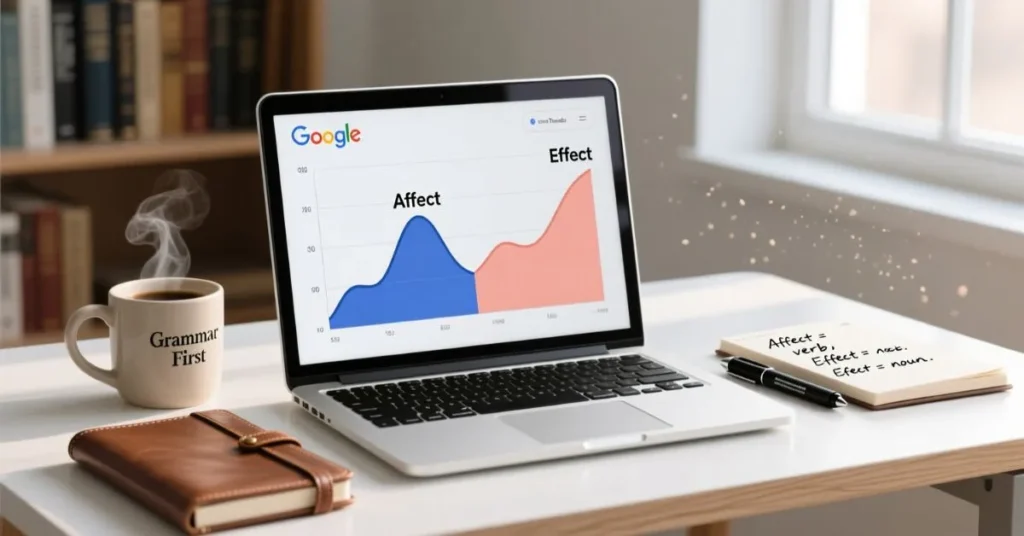
Search data shows that affect or effect is one of the top grammar related searches worldwide.
Popular Regions
- United States
- United Kingdom
- Canada
- Australia
- India
Why People Search This Keyword
- Academic writing
- Exams and tests
- Professional emails
- SEO and content writing
Usage Pattern
- Affect appears more often in action based sentences
- Effect appears more in reports, studies, and results
This confirms that users want both a quick rule and clear examples which this guide provides.
Comparison Table: Affect vs Effect
| Feature | Affect | Effect |
| Part of Speech | Verb (usually) | Noun (usually) |
| Meaning | To influence | Result or outcome |
| Example | Stress can affect sleep | Stress has an effect |
| Common Use | Action | Result |
| Difficulty Level | Medium | Medium |
FAQs
1. Is affect always a verb?
Almost always, yes. Rarely, it can be a noun in psychology, but beginners should ignore this.
2. Is effect always a noun?
Mostly, yes. It can be a verb meaning to cause, but this is rare and formal.
3. Which is more common: affect or effect?
Both are common, but affect appears slightly more in everyday writing.
4. How do I remember the difference?
Use the trick: Affect = Action, Effect = End result.
5. Is the rule the same in British and American English?
Yes. There is no spelling or meaning difference.
6. Can I use both in one sentence?
Yes. Example: The storm affected the city, and the effect was widespread damage.
7. Are mistakes with affect or effect serious?
Yes, especially in academic, legal, and professional writing.
Conclusion:
The confusion between affect and effect is common but easy to fix.
👉 Affect = action (influence)
👉 Effect = result
There’s no British vs American difference, so just focus on meaning. Ask yourself is something causing change, or is it the outcome?
Master this simple rule, and your writing becomes clearer, sharper, and more professional instantly.
Discover More About:
Handle or Handel: Which One Is Right And Wrong (2026)
Many or Meny: What’s the Right English Word? (2026)