Have you ever stopped while writing an email, contract, or blog post and wondered whether to write finalise or finalize? You are not alone.
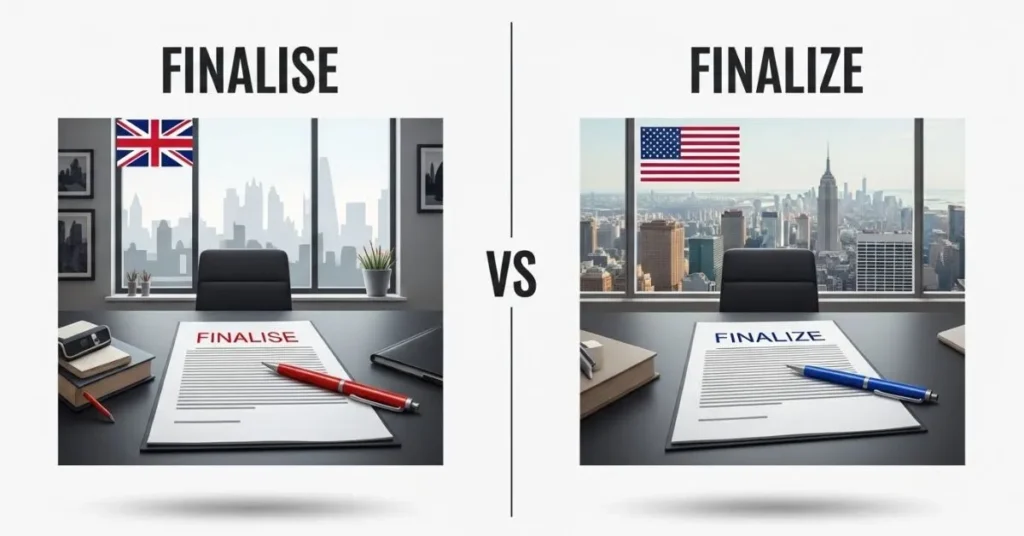
Both spellings are correct, but they are used in different regions of English. This confusion happens because British English prefers finalise, while American English uses finalize.
Using the wrong spelling for your audience can make your writing look inconsistent or unprofessional.
Once you understand this regional difference, choosing the correct spelling becomes quick and easy.
Finalise or Finalize: Quick Answer
Both finalise and finalize are correct, but they are used in different regions.
- Finalise is the correct spelling in British English
- Finalize is the correct spelling in American English
Examples
- UK: We will finalise the agreement tomorrow.
- US: We will finalize the agreement tomorrow.
The meaning is the same in both cases: to complete, confirm, or make something official. The difference is only spelling, not meaning or usage.
The Origin of Finalize and Finalise
The word comes from the Latin root finalis, meaning “end” or “last.” It entered English through French and Latin influence, becoming final and later expanding into verbs.
In early English, verbs ending in -ize were common. This spelling comes from Greek -izein and Latin -izare. Contrary to popular belief, -ize is not American by origin. It existed long before American English.
However, during the 18th and 19th centuries, British English gradually accepted -ise as an alternative spelling. Over time:
- British English adopted finalise
- American English standardized finalize
Both forms remained correct within their regions. This is why modern dictionaries list both spellings and label them by region.
British English vs American English Spelling
The spelling difference follows a clear pattern found in many English verbs.
Common Pattern
- British English: -ise
- American English: -ize
Examples
- Organise / Organize
- Realise / Realize
- Finalise / Finalize
Comparison Table
| Feature | British English | American English |
| Correct spelling | Finalise | Finalize |
| Dictionary standard | Oxford, Cambridge (UK) | Merriam-Webster |
| Usage region | UK, Australia, New Zealand | United States |
| Meaning | To complete or confirm | To complete or confirm |
| Professional acceptance | Yes | Yes |
Important note:
Some British publications (including Oxford) also accept -ize, but finalise remains more common in everyday UK usage.
Which Spelling Should You Use?
The correct choice depends on your audience, not personal preference.
Use Finalise if:
- You are writing for a UK audience
- Your readers are in Australia, New Zealand, or South Africa
- You follow British English style guides
- You work with UK schools, companies, or publishers
Use Finalize if:
- You are writing for a US audience
- Your content targets American businesses or universities
- You follow APA, Chicago, or US legal style
- Your website uses American spelling consistently
For Global or SEO Content
If your audience is international:
- Pick one spelling
- Stay consistent
- Match the spelling used on your website or brand guide
Consistency matters more than the specific variant.
Common Mistakes with Finalize or Finalise
Here are the most frequent errors writers make:
❌ Mixing spellings
We will finalise the plan and then finalize the budget.
✅ Choose one spelling and stick to it.
❌ Assuming one is incorrect
Both spellings are correct. The mistake is using the wrong one for your audience.
❌ Thinking -ise is informal
British English finalise is fully formal and correct.
❌ Changing spelling within one document
This creates confusion and looks unprofessional.
❌ Believing -ize is always American
Historically, -ize existed first. The difference is regional, not quality-based.
Finalize and Finalise in Everyday Examples
Emails
- UK: Please finalise the draft before Friday.
- US: Please finalize the draft before Friday.
News Writing
- UK: The government will finalise the policy next week.
- US: The government will finalize the policy next week.
Social Media
- Almost ready to finalize our launch 🚀
- Just need to finalise the details today.
Formal and Legal Writing
- The parties agreed to finalize the contract.
- The committee will finalise the proposal.
Meaning and tone stay the same in all contexts.
Finalize vs Finalise: Google Trends & Usage Data
Search data shows that:
- Finalize dominates searches in the United States
- Finalise is more common in the UK, Australia, and New Zealand
- Global searches are split, depending on user location
In international business writing, both spellings appear frequently. SEO tools show that users often search “finalise or finalize” to confirm which is correct, not because one is wrong.
For SEO purposes:
- US-focused sites rank better using finalize
- UK-focused sites rank better using finalise
- Educational content should explain both
Comparison Table: Finalise vs Finalize
| Aspect | Finalise | Finalize |
| English variant | British English | American English |
| Meaning | Complete or make official | Complete or make official |
| Formal usage | Yes | Yes |
| Used in contracts | Yes | Yes |
| Accepted worldwide | Region-based | Region-based |
FAQs:
1. Are finalise and finalize the same word?
Yes. They have the same meaning. The difference is regional spelling.
2. Is finalise wrong in American English?
It is not wrong, but it is non-standard in US writing.
3. Is finalize acceptable in British English?
Yes, but finalise is more commonly expected.
4. Which spelling should I use in exams?
Use the spelling taught in your curriculum (UK or US).
5. What about international companies?
Choose one spelling and apply it consistently.
6. Does spelling affect SEO?
Yes. Matching regional spelling improves relevance and trust.
7. Is one spelling more formal?
No. Both are equally formal and professional.
Conclusion
The difference between finalise or finalize is not about right or wrong, but about region.
Both spellings are correct. Finalise is used in the UK and Commonwealth countries, while finalize is standard in the United States.
The most important rule is consistency. Choose the spelling that matches your audience and use it throughout.
This small choice improves clarity and makes your writing look professional and confident.
Discover More About:
Families or Familys: Which Spelling Is Correct?
Insight or Insite? What’s the Correct English Word?
Tier or Teir? Which One Is Right? (2026)