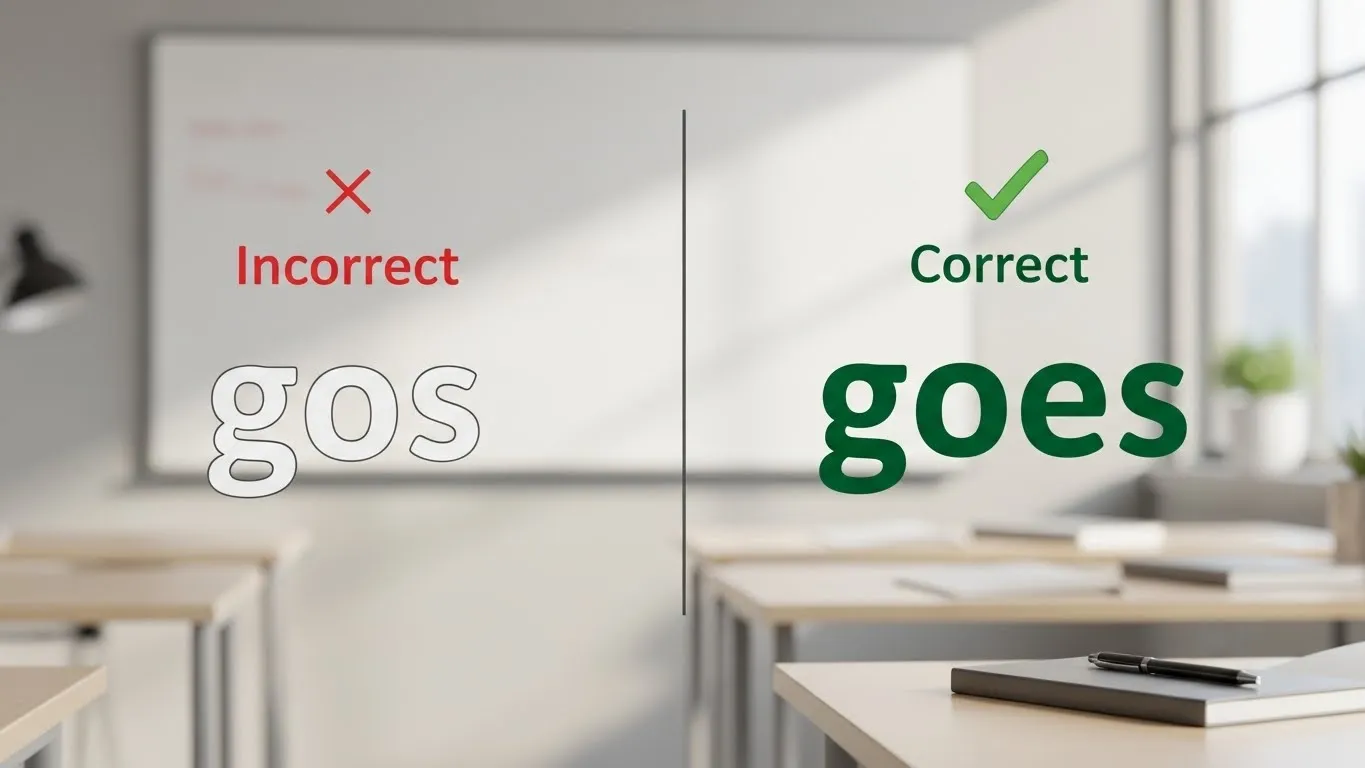
Many people search for gos or goes because both forms appear online, which causes confusion.
At first, gos may seem correct because we add -s to verbs like runs, walks, and talks. So it feels natural to think go becomes gos.
The truth is simple: goes is correct, and gos is wrong.
This rule is the same in British and American English. There is no spelling difference.
In this guide, you will quickly learn the correct form, understand why the mistake happens, and see clear examples.
By the end, you will confidently use goes every time.
Gos or Goes – Quick Answer
Goes is the only correct spelling. Gos is incorrect and not accepted in standard English.
The verb go changes to goes in the third person singular (he, she, it).
Correct examples:
- He goes to school every day.
- She goes to work at 9 a.m.
- The train goes through the tunnel.
Incorrect examples:
- ❌ He gos to school.
- ❌ She gos home early.
No dictionary, grammar book, or style guide accepts gos as correct.
Discover More About:
The Origin of Gos or Goes
To understand why goes exists, we need to look at history.
The verb go comes from Old English gān, which already had irregular forms. Over time, English verbs changed, but go kept its special behavior. When English developed rules for third-person singular verbs, most verbs simply added -s (runs, writes). However, verbs ending in -o, -ch, -sh, -ss, -x, and -z followed a different rule.
Instead of adding -s, these verbs add -es for easier pronunciation.
That is why:
- go → goes
- do → does
- echo → echoes
The spelling gos never became standard, even in older English. It appears today only as a spelling mistake or informal error.
British English vs American English Spelling
Unlike many spelling debates, gos or goes is not a British vs American issue. Both forms of English follow the same rule.
Key point:
👉 British English and American English both use goes.
There is no regional variation here.
Comparison Table: British vs American English
| Feature | British English | American English |
| Correct form | goes | goes |
| Alternative spelling | None | None |
| gos accepted? | ❌ No | ❌ No |
| Used in formal writing | ✅ Yes | ✅ Yes |
| Used in exams | ✅ Yes | ✅ Yes |
If you see gos anywhere, it is an error, not a regional difference.
Which Spelling Should You Use?
The answer depends on grammar, not audience.
Use goes if:
- You are writing for the US audience
- You are writing for the UK or Commonwealth audience
- You are writing globally
- You are writing formally or informally
- You are writing for school, work, or online content
Never use gos
- Not in casual writing
- Not in creative writing
- Not in social media
- Not in dialogue (unless showing a mistake on purpose)
Bottom line:
✔ Always use goes
❌ Never use gos
Common Mistakes with Gos or Goes
Even native speakers make this mistake, especially in fast typing.
1. Applying regular verb rules
Many people think:
run → runs
go → gos
This logic is incorrect because go is irregular.
2. Informal texting habits
People sometimes type gos quickly in messages, but this does not make it correct.
3. ESL learner confusion
English learners often struggle with verbs ending in -o.
4. Autocorrect errors
Some keyboards fail to flag gos immediately, leading to published mistakes.
Corrections:
- ❌ He gos there → ✅ He goes there
- ❌ She gos shopping → ✅ She goes shopping
Gos or Goes in Everyday Examples
Seeing real-life usage helps fix the rule in your mind.
Emails
- ✅ She goes on leave next week.
- ❌ She gos on leave next week.
News
- ✅ The new policy goes into effect tomorrow.
- ❌ The new policy gos into effect tomorrow.
Social Media
- ✅ He goes live every Friday.
- ❌ He gos live every Friday.
Formal Writing
- ✅ This rule goes against company policy.
- ❌ This rule gos against company policy.
Everyday Speech
Even though pronunciation sounds similar, spelling must remain goes in writing.
Gos or Goes – Google Trends & Usage Data
Search data shows a clear pattern:
- goes is searched millions of times globally.
- gos appears mostly in:
- Grammar questions
- ESL searches
- Misspellings
By region:
- United States: Goes dominates in all contexts.
- United Kingdom: Goes is standard and exclusive.
- India, Pakistan, Australia: Goes is taught in schools and exams.
- Global English: Goes is universal.
Search engines also treat gos as an error and often suggest goes instead.
Comparison Table: Gos vs Goes
| Feature | Gos | Goes |
| Correct spelling | ❌ No | ✅ Yes |
| Dictionary accepted | ❌ No | ✅ Yes |
| Used in British English | ❌ No | ✅ Yes |
| Used in American English | ❌ No | ✅ Yes |
| Suitable for exams | ❌ No | ✅ Yes |
| Professional writing | ❌ No | ✅ Yes |
FAQs:
1. Is gos ever correct?
No. Gos is never correct in standard English.
2. Why does go become goes and not gos?
Because verbs ending in -o add -es in the third person singular.
3. Is this a British vs American spelling difference?
No. Both British and American English use goes only.
4. Can gos be used informally?
No. Even informal English does not accept gos.
5. Is goes used in past tense?
No. Past tense of go is went, not goes.
6. Why do people still search gos or goes?
Because learners apply regular verb rules and get confused.
7. Will using gos hurt my writing?
Yes. It signals poor grammar and reduces credibility.
Conclusion:
The confusion between gos or goes may seem small, but it matters.
Gos is incorrect, while goes is the only correct form in British, American, and global English.
The rule is simple: verbs ending in -o add -es in the third person singular. That is why we write goes, like does or echoes. There are no exceptions.
To keep your writing clear and professional, always use goes. This small choice makes a big difference in accuracy and trust.

I’m a U.S. based content writer and language researcher with a strong focus on English grammar, spelling differences, and frequently confused terms. My writing is aimed at helping readers write more clearly and correctly in daily use, workplace communication, and digital content.