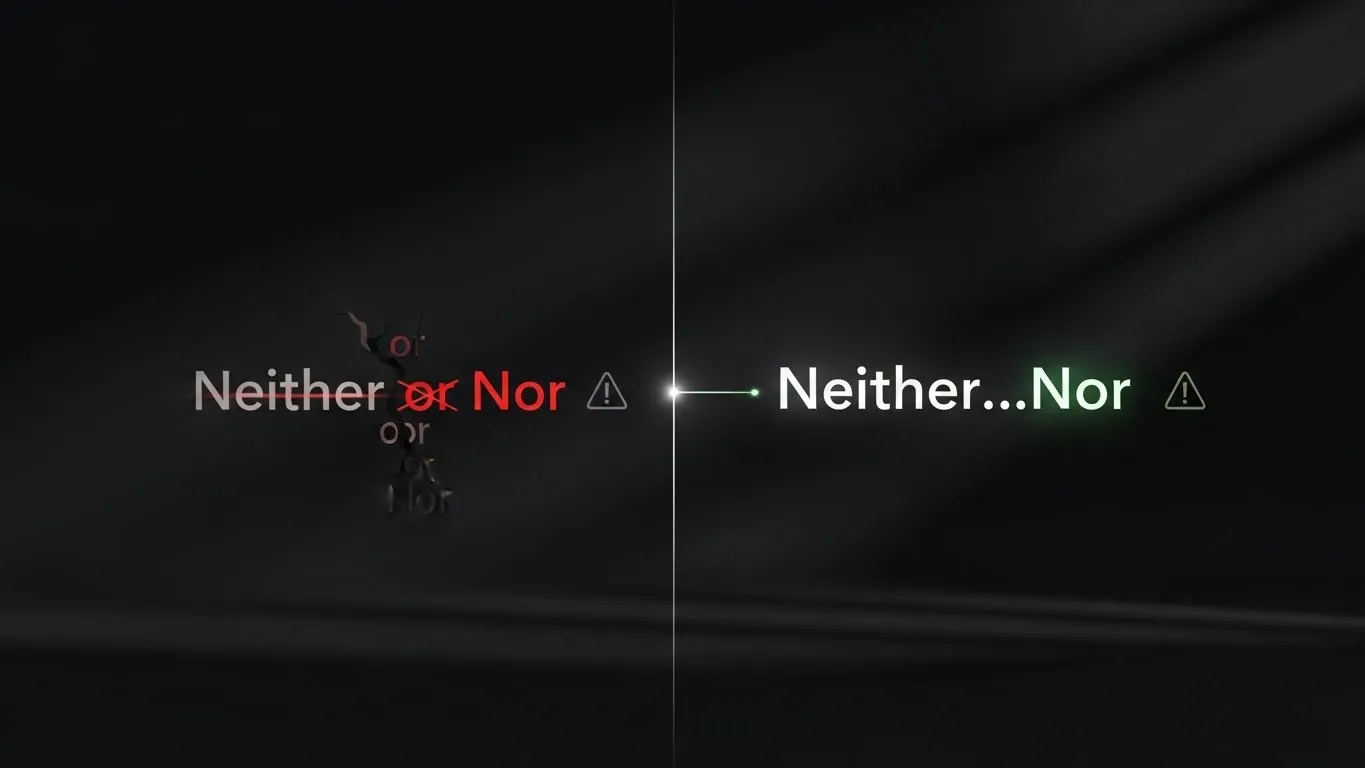
Many people search for neither or nor because they know the words belong together but aren’t sure how to use them correctly.
This confusion shows up in emails, exams, blog posts, and professional writing, where even a small mistake can make a sentence sound wrong.
The issue is simple: people often pair neither with or, or misunderstand how neither…nor works.
Because English has pairs like either…or and both…and, it’s easy to assume neither or is correct but it isn’t.
You’ll learn the correct rule, common mistakes, and clear everyday examples, so you can use neither…nor confidently every time.
Neither or Nor – Quick Answer
Neither or nor is incorrect.
The correct structure is neither…nor.
Correct Examples
- Neither tea nor coffee is available.
- She likes neither cats nor dogs.
- Neither the manager nor the staff were informed.
Incorrect Examples
- ❌ Neither tea or coffee
- ❌ Neither cats or dogs
Rule:
If you start a sentence with neither, you must use nor, not or.
The Origin of Neither or Nor
The phrase neither…nor comes from Old English. The word neither originally meant not one of two, while nor worked as its natural partner to continue the negative idea.
English developed several paired structures:
- both…and (positive)
- either…or (choice)
- neither…nor (negative choice)
Over time, these pairs became fixed patterns. Writers and speakers followed them because they sound balanced and clear. Mixing them breaks the rhythm and meaning of the sentence.
There are no spelling variations in this case. Unlike words such as colour/color or finalise/finalize, neither and nor are spelled the same everywhere. The confusion is not about spelling it is about grammar and structure.
Discover More About:
Ves or Vez: The Correct Spelling Rule (2026)
Complimented or Complemented: Understand the Difference
British English vs American English Spelling
There is no spelling difference between British and American English for neither…nor.
Both follow the same grammar rule.
Examples in British English
- Neither the train nor the bus arrives on time.
- He speaks neither French nor Spanish.
Examples in American English
- Neither the company nor its clients were notified.
- She wants neither fame nor money.
Comparison Table
| Feature | British English | American English |
| Spelling | Neither…nor | Neither…nor |
| Grammar rule | Same | Same |
| Usage | Identical | Identical |
| Formal acceptance | Yes | Yes |
Conclusion:
There is no regional difference. The rule is universal.
Which Spelling Should You Use?
Since neither…nor has no spelling variations, the choice depends only on correct grammar, not location.
Use neither…nor if:
- Your audience is in the US
- Your audience is in the UK
- You write for a global audience
- You are writing academically or professionally
Avoid:
- Mixing neither with or
- Switching structures mid-sentence
Key advice:
Consistency matters more than anything. Always keep the pair together.
Common Mistakes with Neither or Nor
These mistakes are very common, even among fluent English speakers.
Mistake 1: Using or instead of nor
❌ Neither John or Sarah called.
✅ Neither John nor Sarah called.
Mistake 2: Subject-verb disagreement
❌ Neither the teachers nor the student are present.
✅ Neither the teachers nor the student is present.
Rule:
The verb agrees with the noun closest to it.
Mistake 3: Double negatives
❌ I don’t like neither coffee nor tea.
✅ I like neither coffee nor tea.
Mistake 4: Breaking parallel structure
❌ Neither running nor to swim is allowed.
✅ Neither running nor swimming is allowed.
Neither or Nor in Everyday Examples
Emails
- Neither the document nor the attachment was included.
- I am available neither Monday nor Tuesday.
News Writing
- Neither the minister nor the opposition responded.
- Neither floods nor heatwaves slowed the rescue.
Social Media
- Neither coffee nor sleep is working today.
- Neither Monday nor Friday feels right.
Formal Writing
- The study found neither evidence nor correlation.
- Neither policy nor procedure supports this claim.
Neither or Nor – Google Trends & Usage Data
Search data shows that people often type:
- neither or nor
- neither or
- neither nor meaning
This tells us one thing: users are unsure about the rule, not the words themselves.
Usage by Region
- US: Common in education and business writing
- UK: Frequent in exams and formal communication
- Global: Popular among ESL learners
Why Searches Are High
- Spoken English sounds similar
- Learners confuse it with either…or
- Grammar rules are not always taught clearly
Important note:
Correct usage is far more common in published writing than incorrect usage.
Comparison Table – Keyword Variations
| Variation | Correct | Reason |
| Neither or nor | ❌ No | Mixed structure |
| Neither nor | ✅ Yes | Correct paired form |
| Either or | ✅ Yes | Different structure |
| Neither or | ❌ No | Grammar error |
FAQs:
1. Is neither or nor ever correct?
No. It is always incorrect. Use neither…nor.
2. Can I use neither alone?
Yes, but only if the sentence is clear.
Example: Neither option works.
3. Does neither…nor sound formal?
It works in both formal and informal writing.
4. What comes after neither…nor: singular or plural verb?
The verb agrees with the closest subject.
5. Is neither…nor negative?
Yes. It expresses a double negative choice, but grammatically correct.
6. Can I replace neither…nor with not…or?
Sometimes, but neither…nor is usually clearer and more natural.
7. Do British and American English follow the same rule?
Yes. There is no difference.
Conclusion:
The confusion around neither or nor is common, but the rule is simple: neither or nor is never correct.
The correct structure is neither…nor, and it is used as a fixed pair in all forms of English.
Using neither…nor correctly makes your writing clearer and more professional, whether you are writing emails, exams, blogs, or social posts.
Remember three basics:
• Never use neither with or
• Keep both parts of the sentence parallel
• Make the verb agree with the nearest subject
Once you learn this rule, it becomes natural. Clear grammar leads to clear communication and neither…nor is a rule worth knowing.

I’m a U.S. based content writer and language researcher with a strong focus on English grammar, spelling differences, and frequently confused terms. My writing is aimed at helping readers write more clearly and correctly in daily use, workplace communication, and digital content.