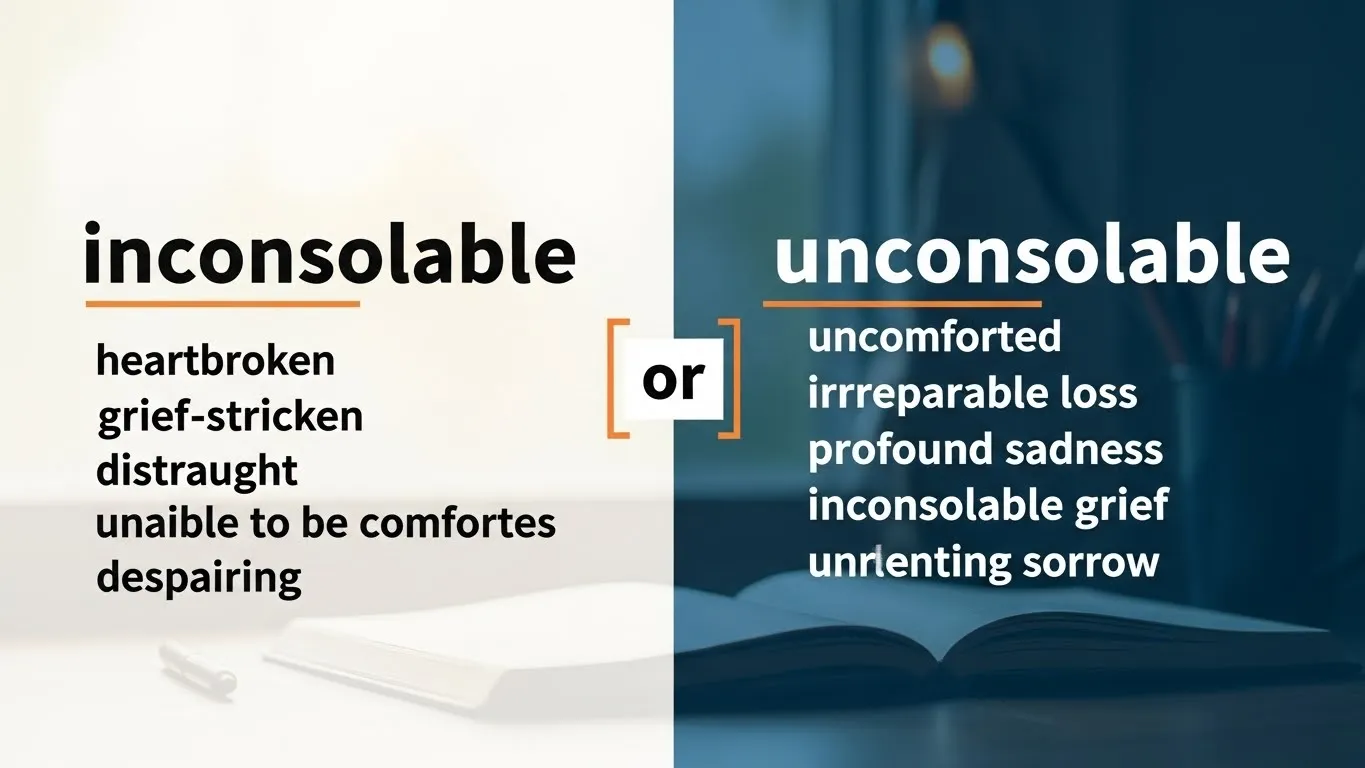
Few spelling questions cause as much quiet frustration as “inconsolable or unconsolable.”
Both versions look right, sound the same, and often appear in emotional writing. That’s why so many writers stop and wonder which one is actually correct.
The confusion comes from pronunciation. When spoken, the word can sound like it starts with in- or un-.
English also allows many spelling variations, such as finalise/finalize, which makes it tempting to think both forms are acceptable.
But here’s the clear answer: only one spelling is correct. The other is simply a mistake. It has no support in dictionaries, academic writing, or professional English.
By the end, you’ll know exactly which spelling to use and you’ll never hesitate again.
Unconsolable or Inconsolable – Quick Answer
Inconsolable is the only correct spelling.
Unconsolable is incorrect and not recognized in standard English.
Examples:
- ✅ She was inconsolable after hearing the news.
- ❌ She was unconsolable after hearing the news.
Inconsolable means unable to be comforted, especially during deep emotional distress such as grief, loss, or heartbreak.
The Origin of Inconsolable
Understanding the origin explains why only one spelling exists.
Word History
- Latin root: inconsolabilis
- in- = not
- consolari = to comfort
- Meaning: “not able to be comforted”
The word passed from Latin into Old French and then into Middle English, where the spelling inconsolable became fixed.
Why “Unconsolable” Never Became Standard
English uses both in- and un- as negative prefixes, but they are not interchangeable.
This word entered English already formed with in-, and it stayed that way.
👉 Unconsolable is a modern spelling error created by analogy, not history.
British English vs American English Spelling
Unlike many spelling debates, this one is not regional.
Key Point
Both British English and American English use the same spelling: inconsolable.
There is no British variant and no American variant.
Comparison Table
| Feature | Inconsolable | Unconsolable |
| British English | ✅ Correct | ❌ Incorrect |
| American English | ✅ Correct | ❌ Incorrect |
| Dictionary approved | ✅ Yes | ❌ No |
| Academic writing | ✅ Accepted | ❌ Rejected |
| SEO & professional use | ✅ Safe | ❌ Risky |
✔️ This makes the decision simple: always use inconsolable.
Which Spelling Should You Use?
For US Audiences
Use inconsolable. It is the only accepted spelling in American English.
For UK & Commonwealth Audiences
Use inconsolable. British English follows the same rule.
For Global or SEO Writing
Always use inconsolable.
Using unconsolable can:
- Harm credibility
- Trigger spellcheck errors
- Reduce SEO trust signals
👉 Professional rule: If one spelling is universally correct, consistency becomes effortless.
Common Mistakes with Inconsolable or Unconsolable
Here are the most frequent errors writers make:
1. Assuming “un-” is acceptable
❌ The child was unconsolable.
✅ The child was inconsolable.
2. Thinking it’s a regional difference
There is no British vs American split here.
3. Trusting informal web usage
Some blogs or social posts use unconsolable, but popularity does not equal correctness.
4. Autocorrect confusion
Spellcheck tools may fail to flag informal text, but dictionaries remain clear.
Inconsolable in Everyday Examples
Emails
- She was inconsolable after the meeting was canceled.
News Reporting
- The family was left inconsolable following the tragic accident.
Social Media
- Still inconsolable after last night’s loss.
Formal Writing
- The novel portrays a mother inconsolable in the face of irreversible loss.
Across all tones casual, journalistic, or academic the spelling never changes.
Inconsolable or Unconsolable – Comparison Table
| Aspect | Inconsolable | Unconsolable |
| Correct spelling | ✅ Yes | ❌ No |
| Historical usage | ✅ Strong | ❌ None |
| Dictionary presence | ✅ Listed | ❌ Absent |
| Academic acceptance | ✅ Accepted | ❌ Rejected |
| SEO-safe | ✅ Yes | ❌ No |
Inconsolable – Google Trends & Usage Data
Search Behavior
- Searches spike during:
- Emotional writing queries
- Grammar checks
- Student assignments
- SEO spelling comparisons
Regional Usage
- United States: Inconsolable dominates
- United Kingdom: Inconsolable only
- Australia & Canada: Inconsolable standard
- Global English: Inconsolable preferred
Contexts of Use
- News articles
- Literature
- Psychology writing
- Social commentary
👉 Unconsolable shows minimal presence and usually appears in misspellings, not authoritative sources.
FAQs:
1. Is unconsolable ever correct?
No. It is not accepted in modern English.
2. Do any dictionaries recognize unconsolable?
No major dictionary lists it as a valid word.
3. Why do people write unconsolable?
Because un- is a common negative prefix and the word sounds similar when spoken.
4. Is inconsolable formal or emotional?
Both. It is suitable for formal writing and emotional contexts.
5. Can inconsolable describe adults and children?
Yes. It applies to anyone unable to be comforted.
6. Is inconsolable used in psychology or literature?
Yes. It appears frequently in academic, literary, and clinical writing.
7. Will using unconsolable hurt SEO?
Yes. Misspellings reduce authority and trust signals.
Conclusion:
The confusion between inconsolable or unconsolable may seem minor, but it matters more than most writers think.
In professional and digital writing, correct spelling builds clarity, credibility, and trust.
The rule is simple: inconsolable is the only correct spelling. It is dictionary approved and used in British, American, and global English.
Unconsolable has no official standing and is just a common mistake.
If you want clear, confident, and professional writing, always use inconsolable.
Learn More About:
Stabilise or Stabilize: What’s the Difference?(2026)
Presence or Presense: Which Spelling Is Correct? (2026)