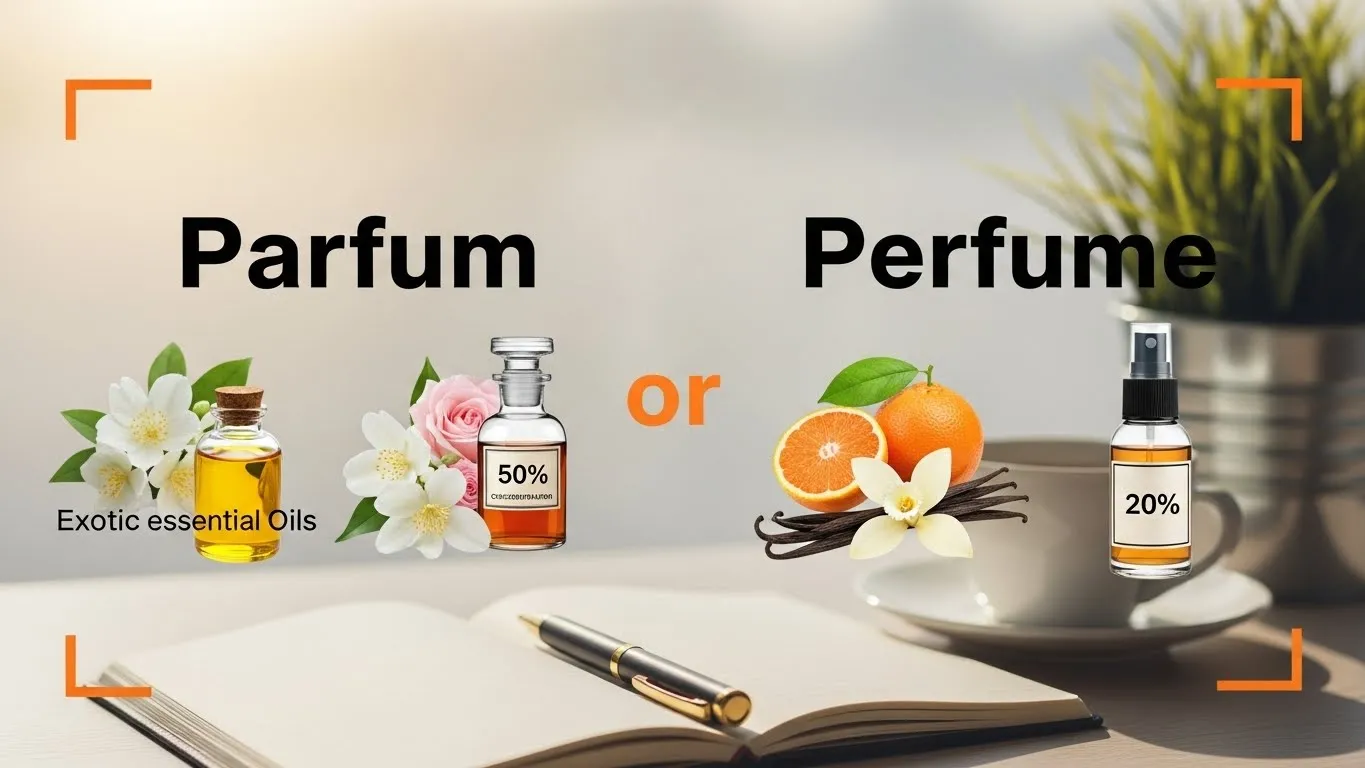
Few words in the fragrance world confuse people like parfum or perfume.
Is parfum just a fancy spelling?
Is perfume American and parfum British?
Or do they mean something different?
Both words appear everywhere on luxury bottles, online shops, and ads.
French brands love parfum, while English speakers usually go for perfume.
No wonder writers, shoppers, and bloggers often get it wrong!
In this article, you’ll know exactly which to use and how to write it confidently in emails, blogs, or social media posts.
Parfum or Perfume – Quick Answer
Perfume is the correct and standard English word.
Parfum is a French word often used to describe a specific fragrance strength, not a spelling alternative.
Examples:
- ✅ She bought a new perfume for daily use.
- ✅ The bottle says Eau de Parfum (a concentration level).
- ❌ I love this parfum (incorrect in normal English writing).
Short rule:
- Use perfume in English sentences.
- Use parfum only in French terms or product labels like Eau de Parfum.
The Origin of Perfum or Parfume
The history of parfum or perfume goes back hundreds of years.
The word perfume comes from the Latin phrase per fumum, meaning “through smoke.” Ancient civilizations burned scented woods and resins during rituals, which led to the idea of fragrance.
French later adopted this concept as parfum, and France became the global center of fragrance culture. Because of this influence, French terms still dominate the perfume industry today.
Over time:
- French kept “parfum” as its standard word.
- English adapted it to “perfume”, adjusting the spelling to fit English phonetics.
The spelling difference exists because English often modifies borrowed words to match pronunciation and grammar rules. While the fragrance industry preserves French terms for elegance and branding, standard English writing follows perfume.
British English vs American English Spelling
Unlike words such as colour/color or favourite/favorite, parfum vs perfume is not a British vs American spelling difference.
Both British and American English use perfume.
Key comparison
| Aspect | British English | American English |
| Standard word | Perfume | Perfume |
| “Parfum” usage | French labels only | French labels only |
| Formal writing | Perfume | Perfume |
| Marketing terms | Eau de Parfum | Eau de Parfum |
Important note:
If you see parfum in English content, it is usually:
- A brand choice
- A French phrase
- A reference to fragrance strength
It is not a spelling variant.
Which Spelling Should You Use?
Your choice depends on context and audience, not region.
Use perfume if:
- You are writing blogs, articles, or SEO content
- You are writing emails or social posts
- Your audience is global
- You want clarity and correctness
Use parfum only if:
- You are naming a product label (Eau de Parfum)
- You are discussing fragrance concentrations
- You are quoting a French brand or term
Professional rule:
In full English sentences, perfume is always the safer and correct choice.
Common Mistakes with Parfum or Perfume
Many writers make small but important errors with this keyword.
Mistake 1: Using parfum as an English noun
❌ This parfum smells nice.
✅ This perfume smells nice.
Mistake 2: Assuming parfum is British English
❌ Parfum is the UK spelling.
✅ Perfume is used in both UK and US English.
Mistake 3: Mixing terms in the same sentence
❌ This perfume is an expensive parfum.
✅ This perfume is an Eau de Parfum.
Mistake 4: Overusing French terms for SEO
Search engines and readers expect perfume, not parfum, in English content.
Parfum or Perfume in Everyday Examples
Here’s how correct usage looks in real life.
Emails
- I bought a new perfume for the event.
- This perfume lasts all day.
News Articles
- The brand launched a luxury perfume line this summer.
Social Media
- This perfume is my new favorite 😍
- Long-lasting perfume for winter vibes.
Formal Writing
- The study examined consumer preferences for luxury perfumes.
- French Eau de Parfum contains a higher oil concentration.
Parfum or Perfume – Google Trends & Usage Data
Search behavior shows a clear pattern.
- Perfume is searched globally in English-speaking countries.
- Parfum spikes mainly in:
- France
- Luxury brand searches
- Product-specific queries
Usage insights:
- Bloggers, journalists, and educators use perfume
- Brands use parfum for elegance and tradition
- SEO content performs better with perfume
Conclusion from trends:
If your goal is reach, clarity, and search visibility, perfume wins.
Comparison Table: Parfum vs Perfume
| Feature | Parfum | Perfume |
| Language | French | English |
| Correct in English sentences | ❌ | ✅ |
| Used on product labels | ✅ | ✅ |
| SEO-friendly | ❌ | ✅ |
| Everyday writing | ❌ | ✅ |
| Indicates fragrance strength | ✅ | ❌ |
FAQs:
1. Is parfum the same as perfume?
No. Parfum is French and often refers to fragrance strength. Perfume is the English word.
2. Is parfum stronger than perfume?
Parfum usually indicates a higher concentration, but in English, we still call it perfume.
3. Can I use parfum in English writing?
Only when part of a French term like Eau de Parfum.
4. Is parfum British English?
No. British English uses perfume, not parfum.
5. Why do luxury brands use parfum?
French terms suggest tradition, quality, and luxury.
6. Which spelling is better for SEO?
Perfume performs better in English-language searches.
7. Is it wrong to say “this parfum”?
Yes, in standard English, that is incorrect.
Conclusion:
he confusion between parfum and perfume comes from French influence in the fragrance world.
In English, perfume is always correct for writing, emails, blogs, or social media.
Parfum should only appear on product labels or French phrases like Eau de Parfum.
For clarity, professionalism, and better SEO, stick with perfume.
Use parfum only when intentional never as a spelling alternative. This simple rule keeps your writing correct, polished, and globally understandable.
Discover More About:
Presence or Presense: Which Spelling Is Correct? (2026)
Uncapable or Incapable: Which Spelling Is Correct in 2026

I’m a U.S. based content writer and language researcher with a strong focus on English grammar, spelling differences, and frequently confused terms. My writing is aimed at helping readers write more clearly and correctly in daily use, workplace communication, and digital content.