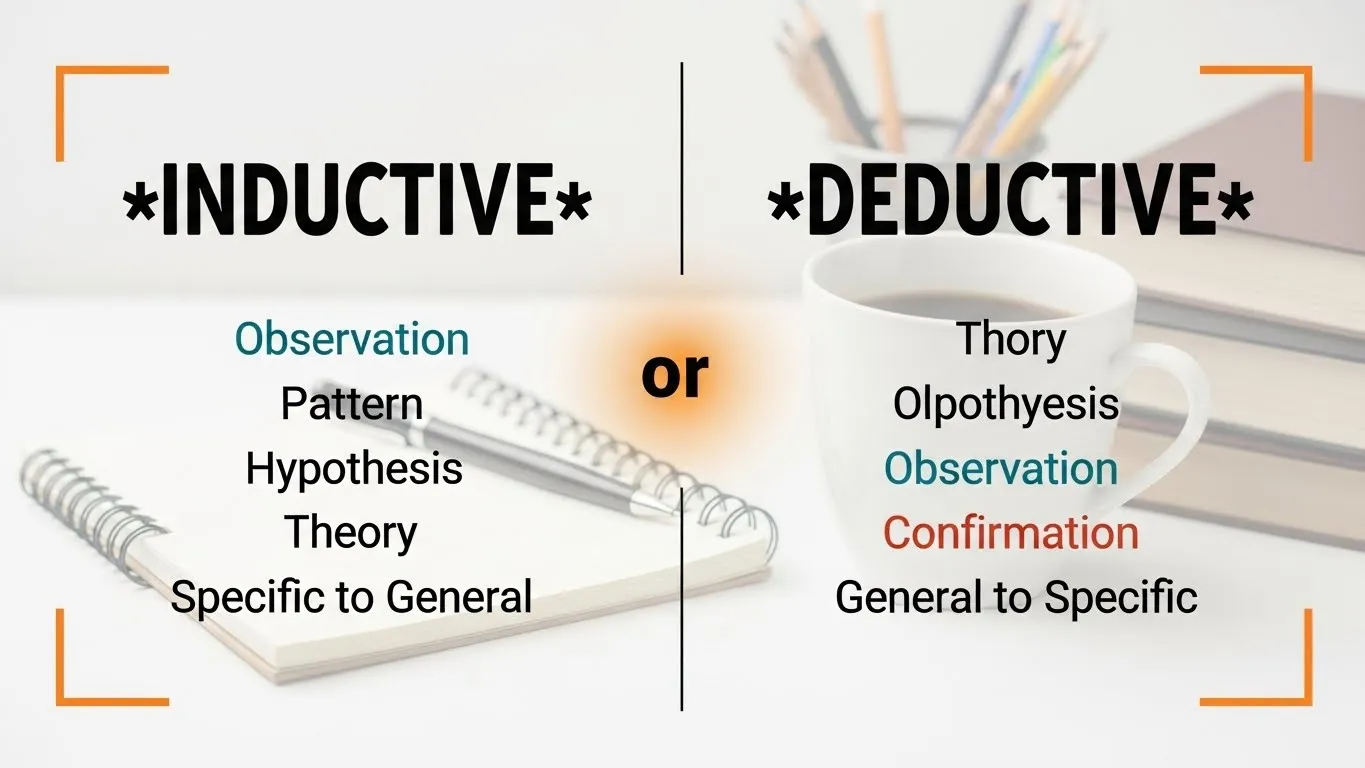
Many people search for inductive or deductive because these terms sound similar but mean very different things.
They appear everywhere schools, universities, research papers, business reports, and everyday discussions yet they are often confused or misused.
The problem is simple: both words describe ways of reasoning, both lead to conclusions, and both are often mentioned together.
Students struggle with them in exams, professionals hesitate in reports, and writers pause, unsure which term fits their example.
This guide clears that confusion fast. You’ll learn the key difference between inductive and deductive, where the words come from, how they’re used in British and American English, and which one to choose in real situations.
With clear examples and practical tips, you’ll know exactly which word to use every time.
Inductive or Deductive – Quick Answer
Inductive reasoning moves from specific examples to a general conclusion.
Deductive reasoning moves from a general rule to a specific conclusion.
Inductive example:
- The sun has risen every day so far.
- Therefore, the sun will rise tomorrow.
Deductive example:
- All humans are mortal.
- Socrates is human.
- Therefore, Socrates is mortal.
In short:
- Inductive = patterns → theory
- Deductive = rule → result
The Origin of Deductive or Inductive
Both words come from Latin, and their meanings have stayed stable for centuries.
Origin of Inductive
- From Latin inducere, meaning “to lead into”
- Entered English in the late Middle Ages
- Used heavily in science and philosophy
- Focuses on building ideas from observation
Origin of Deductive
- From Latin deducere, meaning “to lead down”
- Entered English around the same period
- Common in formal logic and mathematics
- Focuses on applying known rules
There are no spelling differences between inductive and deductive across regions. The confusion is about meaning, not spelling.
British English vs American English Spelling
There is no spelling difference between British English and American English for these words.
| Term | British English | American English | Meaning |
| Inductive | Inductive | Inductive | Reasoning from examples |
| Deductive | Deductive | Deductive | Reasoning from rules |
Unlike words such as finalise/finalize, inductive and deductive are spelled the same everywhere.
Which Spelling Should You Use?
Because spelling does not change, your choice depends on context, not location.
- US audience: Use inductive or deductive based on reasoning style
- UK / Commonwealth: Same usage rules apply
- Global audience: Clear explanation matters more than regional preference
Focus on clarity, not variation. Readers worldwide expect these terms to be used correctly.
Common Mistakes with Inductive or Deductive
Mistake 1: Using them as synonyms
❌ “This is an inductive conclusion based on a general law.”
✅ “This is a deductive conclusion based on a general law.”
Mistake 2: Reversing the meaning
❌ “Inductive reasoning starts with a rule.”
✅ “Deductive reasoning starts with a rule.”
Mistake 3: Overusing them in casual writing
❌ “My inductive reasoning says the movie is good.”
✅ “Based on what I’ve seen, the movie seems good.”
Mistake 4: Mixing logic steps
❌ Combining examples and rules without clarity
✅ Clearly state whether you start with data or theory
Inductive or Deductive in Everyday Examples
Emails
- Inductive:
“Based on recent delays, we may need to adjust the schedule.” - Deductive:
“Company policy requires approval, so this request must wait.”
News
- Inductive:
“Several cities reported growth, suggesting economic recovery.” - Deductive:
“Since the law applies nationwide, all regions must comply.”
Social Media
- Inductive:
“Everyone I follow loves this app—so it must be good.” - Deductive:
“If the update breaks features, users will complain.”
Formal Writing
- Inductive:
Research papers often start with data. - Deductive:
Legal arguments often start with laws.
Inductive or Deductive – Google Trends & Usage Data
Search data shows that inductive or deductive is most commonly searched by:
- Students
- Teachers
- Researchers
- Business analysts
Popular Regions
- United States
- United Kingdom
- India
- Australia
- Canada
Contexts of Use
- Education
- Science
- Philosophy
- AI and data analysis
- Business strategy
Interest rises during exam seasons, online courses, and research deadlines, showing strong academic intent.
Comparison Table: Inductive vs Deductive
| Feature | Inductive | Deductive |
| Direction | Specific → General | General → Specific |
| Common Fields | Science, data analysis | Math, law, logic |
| Certainty | Probable | Certain (if premises are true) |
| Starting Point | Observations | Rules or theories |
| Risk | Overgeneralization | False premise |
FAQs:
1. Is inductive reasoning always correct?
No. It suggests likelihood, not certainty.
2. Is deductive reasoning better?
Not better just different. It depends on your goal.
3. Which is used in science?
Both. Inductive builds theories; deductive tests them.
4. Can writing use both?
Yes. Strong arguments often combine both.
5. Is inductive informal?
No. It is widely used in academic research.
6. Is deductive more logical?
Both are logical. Deductive is more rigid.
7. Are these words interchangeable?
No. They describe opposite reasoning directions.
Conclusion:
Understanding inductive or deductive reasoning helps you think clearly and communicate better.
Inductive reasoning builds ideas from examples, while deductive reasoning applies rules to reach conclusions.
There is no spelling difference between British and American English, so the key is context. Ask yourself: Am I starting with examples or a rule? That question gives you the answer.
Use the right term, avoid common mistakes, and your writing will sound clear, confident, and professional.
Discover More About:
Finalise or Finalize: Which One Is Correct? (2026)
Attendance or Attendence: Which Is Correct?

I’m a U.S. based content writer and language researcher with a strong focus on English grammar, spelling differences, and frequently confused terms. My writing is aimed at helping readers write more clearly and correctly in daily use, workplace communication, and digital content.