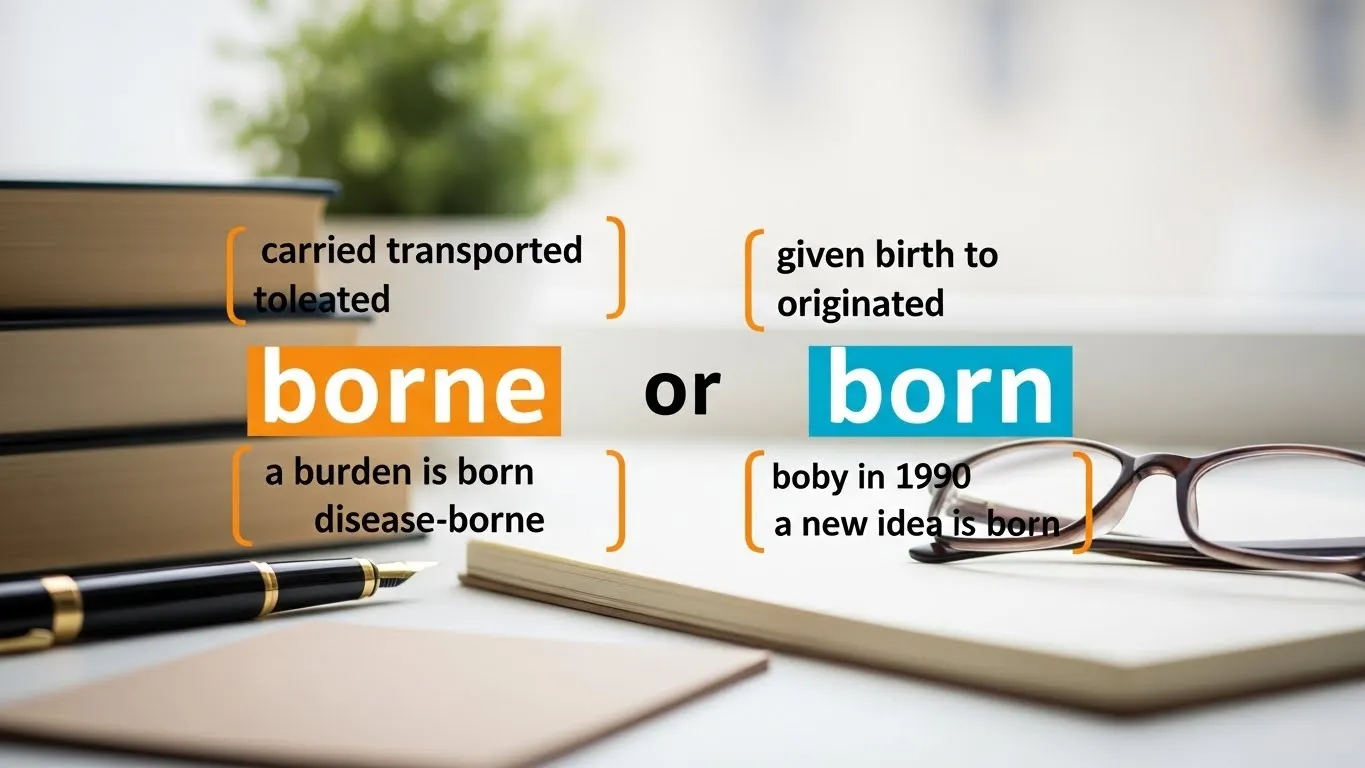
Few English word pairs cause as much confusion as borne or born. They look alike, share the same root, and sound related but they are not interchangeable.
Writers at every level often stop and ask: Is it borne or born here? One wrong choice can change the meaning and weaken your writing.
People usually search for borne or born when writing about birth, responsibility, or proof. Phrases like born in 1990, airborne, costs borne by the company, or borne out by facts blur the line between the two words.
The key difference is simple: born relates to birth or origin, while borne refers to carrying, supporting, or enduring.
This guide clears the confusion fast. You’ll get clear rules, real examples, and practical tips so you can use borne or born correctly every time with confidence and ease.
Borne or Born – Quick Answer
Born is used for birth, origin, or natural ability.
Borne is used for carrying, supporting, enduring, or producing.
Examples
- She was born in London. ✅
- He is a born leader. ✅
- The cost was borne by the company. ✅
- The theory is borne out by evidence. ✅
Rule to remember:
If you mean birth or origin, use born.
If you mean carry, support, or endure, use borne.
The Origin of Borne or Born
Both borne and born come from the Old English verb beran, meaning to carry, bring, or bear. Over time, English split the verb bear into different past forms based on meaning and usage.
- Born developed as a specialized past participle used almost only for birth and origin.
- Borne remained the general past participle of bear, used for meanings like carry, support, tolerate, or produce.
This split happened centuries ago and became fixed through usage rather than logic. That is why English keeps both forms today even though they come from the same verb.
British English vs American English Spelling
Good news: there is no spelling difference between British and American English for borne or born. Both regions follow the same rules.
The confusion is grammatical, not regional.
Usage Comparison Table
| Meaning | Correct Word | Example |
| Birth | Born | She was born in 2001 |
| Origin | Born | A born artist |
| Carry | Borne | The load was borne easily |
| Responsibility | Borne | Costs are borne by taxpayers |
| Evidence | Borne | Claims borne out by data |
| Air-related compound | Borne | Airborne particles |
Which Spelling Should You Use?
For US Audiences
Follow the standard rule:
- Born → birth or origin
- Borne → carry or support
American readers expect strict correctness.
For UK & Commonwealth Audiences
The same rules apply. British English does not allow flexibility here.
For Global or SEO Writing
Use the correct grammatical form every time. Search engines and professional editors treat misuse as an error.
Bottom line:
This is not a style choice. One word will always be wrong if the meaning is wrong.
Common Mistakes with Borne or Born
Here are the most frequent errors and how to fix them.
❌ The expenses were born by the company.
✅ The expenses were borne by the company.
She was borne in Canada.
✅ She was born in Canada.
❌ The idea was born out by facts.
✅ The idea was borne out by facts.
He has borne talent for music.
✅ He has born talent for music.
(Better: He is a born musician.)
Borne or Born in Everyday Examples
Emails
- I was born into a family of teachers.
- The costs will be borne by our department.
News Writing
- She was born in poverty but rose to fame.
- The burden was borne by small businesses.
Social Media
- A star is born today!
- Stress should not be borne alone.
Formal & Academic Writing
- The hypothesis is borne out by the results.
- He was born in the early twentieth century.
Borne or Born – Google Trends & Usage Data
Search data shows that:
- Born is searched far more often due to its use in birth-related queries.
- Borne appears mainly in academic, legal, and formal contexts.
- Countries with high search interest include the US, UK, Canada, Australia, and India.
Most searches for borne or born come from:
- Students
- ESL learners
- Writers and editors
- Legal and academic professionals
This confirms one thing: people know the words exist but want clarity on usage.
Borne vs Born – Comparison Table
| Aspect | Born | Borne |
| Part of speech | Past participle | Past participle |
| Main meaning | Birth / origin | Carry / support |
| Common phrases | Born in, born leader | Borne out, costs borne |
| Used for people | Yes | Rarely |
| Used for responsibility | No | Yes |
| Correct worldwide | Yes | Yes |
FAQs:
1. Is “borne” ever used for birth?
No. Born is always used for birth-related meanings.
2. Can I use “born” instead of “borne”?
Only when talking about birth or origin. Otherwise, it is incorrect.
3. Why does English have both words?
They evolved from the same verb but split over time due to usage patterns.
4. Is “airborn” correct?
No. The correct spelling is airborne.
5. What does “borne out” mean?
It means confirmed or supported by evidence.
6. Is “newly born” correct?
Yes. This phrase is commonly used and correct.
7. Which word is more formal?
Borne appears more often in formal and academic writing.
Conclusion:
The difference between borne and born is tiny in spelling but powerful in meaning.
Born is about life, origin, and natural ability.
Borne is about carrying, supporting, or enduring something. Mixing them up makes writing unclear and incorrect.
There’s no British or American split here these rules are universal.
If you mean where someone came from, use born. If you mean who carried a burden or responsibility, use borne.
Master this distinction once, and hesitation disappears.
Born creates life.
Borne carries weight.
Find More About:
Continuous or Continual: Meaning And Differences
Parfum or Perfume? Which One Is Correct in 2026

I’m a U.S. based content writer and language researcher with a strong focus on English grammar, spelling differences, and frequently confused terms. My writing is aimed at helping readers write more clearly and correctly in daily use, workplace communication, and digital content.