Few words feel as positive as congrats and congratulations, yet many writers pause before choosing one. Which sounds right here? That quick doubt is why thousands search “congrats or congratulations” every month.
Both words share the same meaning praise and good wishes but their tone is different. One feels warm and casual, the other polished and professional.
Congrats is casual and friendly, while congratulations is formal and professional.
This small difference can matter in emails, social media posts, cards, and formal messages.
This guide clears it up fast. You’ll learn the correct choice, see real examples, and know exactly when to use each word with confidence.
Congrats or Congratulations – Quick Answer
Both are correct, but they are not equal in tone.
- Congratulations is the full, formal word.
- Example: Congratulations on your promotion.
- Congrats is an informal shortened form.
- Example: Congrats on the new job!
Use congratulations in professional, academic, or formal writing. Use congrats in casual messages, social media, and friendly conversations.
The Origin of Congrats and Congratulations
The word congratulations comes from the Latin verb congratulari, meaning “to wish joy” or “to express pleasure at someone else’s good fortune.” It entered English in the early 1600s and was used mainly in formal writing and speeches.
Over time, English speakers naturally shortened long words in everyday speech. Just as advertisement became ad and refrigerator became fridge, congratulations was shortened to congrats.
This shortening is called a clipping in linguistics. Importantly:
- Congrats is not slang.
- It is an accepted informal form, especially in modern English.
There is no spelling debate here only a tone and context difference. Both words share the same root and meaning; the difference lies in formality, not correctness.
British English vs American English Spelling
There is no spelling difference between British and American English for these words. Both regions use:
- Congratulations
- Congrats
However, usage frequency and tone preferences vary slightly.
Usage Comparison
| Aspect | British English | American English |
| Congratulations | Very common in formal and written contexts | Very common in formal and written contexts |
| Congrats | Used, but slightly more reserved | Extremely common and casual |
| Professional emails | Prefer “Congratulations” | Prefer “Congratulations” |
| Social media | Mix of both | Heavy use of “Congrats” |
Key point: This is not like colour vs color. The spelling is the same worldwide.
Which Spelling Should You Use?
The right choice depends on your audience and situation.
For the United States:
- Casual messages → Congrats
- Work emails, announcements → Congratulations
For the UK and Commonwealth:
- Formal or polite tone → Congratulations
- Friendly texts → Congrats
Global or Professional Writing
- Always choose Congratulations
When in doubt, use congratulations. It is never wrong or rude, while congrats can feel too casual in serious contexts.
Common Mistakes with Congratulations or Congrats
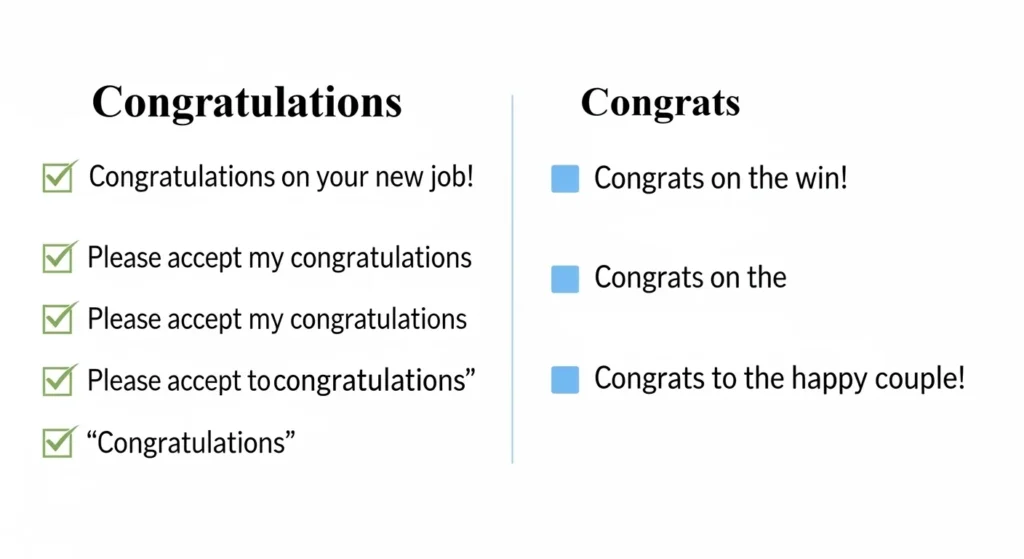
Even simple words cause common errors. Here are the most frequent ones.
❌ Writing “Congratulation” (singular)
- Incorrect: Congratulation on your success.
- Correct: Congratulations on your success.
The word is almost always plural.
❌ Using “Congrats” in formal documents
- Incorrect: Congrats on your appointment as CEO.
- Correct: Congratulations on your appointment as CEO.
❌ Misspellings
- Congradulations ❌
- Congratualtions ❌
- Congratz ❌
Only congratulations and congrats are correct.
❌ Overusing “Congrats” in serious situations
- Avoid using congrats in:
- Job offer letters
- Academic awards
- Legal or official announcements
Congratulations and Congrats in Everyday Examples
Emails
- Formal: Congratulations on completing the project successfully.
- Casual: Congrats! Great job on the presentation.
News Headlines
- Congratulations to the national team on their victory.
Social Media
- Congrats to everyone who graduated today! 🎓
Workplace Messages
- Congratulations on your promotion. We wish you continued success.
Cards and Invitations
- Congratulations on your wedding.
- Congrats on the new baby!
Congratulations vs Congrats – Google Trends & Usage Data
Search data shows that “congrats” spikes during:
- Graduation seasons
- Sports events
- Award shows
- Social media trends
“Congratulations” is searched more often for:
- Email writing help
- Professional wording
- Cards and formal messages
Popularity by Region (General Trend)
| Country/Region | Preferred Usage |
| United States | Congrats (casual), Congratulations (formal) |
| United Kingdom | Congratulations dominates |
| Canada | Mixed |
| Australia | Mixed |
| Global Business English | Congratulations |
The data confirms what usage suggests: tone matters more than location.
Comparison Table: Congrats vs Congratulations
| Feature | Congrats | Congratulations |
| Form | Shortened | Full word |
| Tone | Casual | Formal |
| Grammar | Correct | Correct |
| Best for | Texts, social media | Emails, speeches |
| Professional use | Limited | Ideal |
| Global safety | Medium | High |
FAQs:
1. Is “congrats” grammatically correct?
Yes. It is a correct informal shortening of congratulations.
2. Can I use “congrats” in emails?
Only in casual or internal emails. Avoid it in formal communication.
3. Why is “congratulations” plural?
It comes from Latin usage where plural forms expressed goodwill and praise.
4. Is “congrats” slang?
No. It is informal but widely accepted in modern English.
5. Can I write “many congrats”?
Yes, in casual writing. For formal writing, use “many congratulations.”
6. Is “congratulations” old-fashioned?
No. It remains the standard formal expression worldwide.
7. Which is better for SEO writing?
Congratulations performs better in professional and informational content.
Conclusion:
The choice between congrats and congratulations isn’t about correctness it’s about tone and context. Both are right, but they create different impressions.
Use congratulations for professional writing, formal messages, or a global audience. It sounds polished and is always appropriate.
Choose congrats for friends, social media, and casual conversations. It feels warm, modern, and relaxed.
When in doubt, go with congratulations.
It works in every situation and adds clarity and confidence to your writing.
Discover More About:
Parfum or Perfume? Which One Is Correct in 2026
Foreword or Forward: Difference and Use