
Ever stopped mid sentence and thought, “Should I write analysis or analyses?”
You’re definitely not the only one. At first glance, the difference seems tiny but it actually matters a lot.
Analysis and analyses come from the same root word, yet they serve different purposes.
Analysis refers to a single study or examination, while analyses talks about multiple. What makes it tricky is that English borrows this word from another language, so the plural doesn’t follow the usual “add -s” rule.
In this guide, you’ll learn the difference in a clear, practical way with easy rules and real life examples so you can use both words confidently without any second guessing.
Analyses or Analysis – Quick Answer
Analysis is singular.
Analyses is plural.
Examples:
- This analysis explains the results.
- The report includes several analyses.
- Her analysis is detailed and clear.
- The scientist reviewed multiple analyses.
Simple rule:
- One study, report, or review → analysis
- More than one → analyses
The Origin of Analyses and Analysis
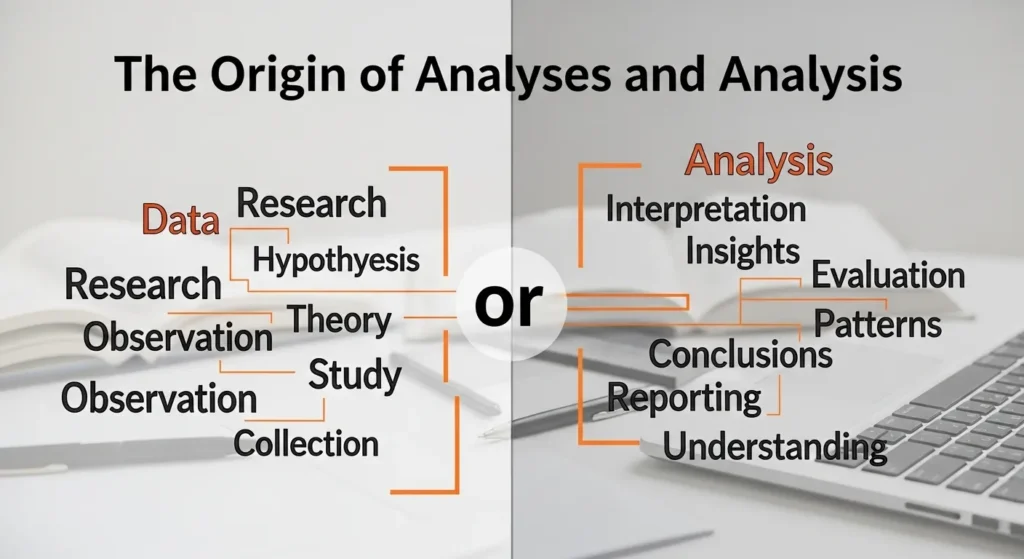
The confusion between analysis and analyses comes from their origin.
Origin of analysis
- Comes from Greek analyo
- Meaning: to break something down
- Entered English through Latin and academic writing
Why the plural is analyses
- Greek-based words often change form in the plural
- -is becomes -es
- Similar examples:
- Thesis → Theses
- Crisis → Crises
- Hypothesis → Hypotheses
Why confusion exists
- Plural form looks unusual
- Pronunciation changes slightly
- English usually adds “s,” but not here
This makes analyses or analysis a common grammar challenge.
British English vs American English Spelling
There is no spelling difference between British and American English for analysis or analyses.
The rules are the same worldwide.
Comparison Table
| Word | British English | American English | Meaning |
| Analysis | Analysis | Analysis | Singular |
| Analyses | Analyses | Analyses | Plural |
Key point:
This is a grammar difference, not a regional spelling difference.
Which Spelling Should You Use?
Your choice depends on number, not location.
Use analysis when:
- Referring to one study or review
- Talking about one explanation
- Describing a single process
Examples:
- The analysis is complete.
- His analysis explains the problem.
Use analyses when:
- Referring to multiple studies
- Comparing different reviews
- Discussing several evaluations
Examples:
- The paper includes several analyses.
- We reviewed past analyses for accuracy.
Audience-based advice:
- US audience: Same rule
- UK/Commonwealth audience: Same rule
- Global audience: Same rule
Always count the subject.
Analysis and Analyses in Academic and Research Writing
In academic and research writing, choosing between analysis and analyses is especially important. A single experiment, report, or interpretation uses analysis.
When comparing results from multiple studies or sources, analyses is required. Using the wrong form can weaken arguments and reduce clarity in essays, journals, and research papers.
Common Mistakes with Analysis or Analyses
Mistake 1: Using analyses for one item
❌ This analyses shows the result.
✅ This analysis shows the result.
Mistake 2: Using analysis for multiple items
❌ The report includes many analysis.
✅ The report includes many analyses.
Mistake 3: Adding “s” to analysis
❌ analysises
✅ analyses
Mistake 4: Confusing pronunciation
- Analysis: uh-NAL-uh-sis
- Analyses: uh-NAL-uh-seez
Analyses or Analysis in Everyday Examples
Emails
- Please review the analysis by Friday.
- I’ve attached two analyses for comparison.
News
- The analysis explains market trends.
- Experts released multiple analyses today.
Social Media
- New analysis just dropped!
- These analyses reveal shocking facts.
Formal Writing
- The analysis supports the hypothesis.
- Previous analyses confirm the findings.
Correct usage improves clarity and professionalism.
Analysis vs Analyses – Google Trends & Usage Data
Search trends show analyses or analysis is popular in:
- Academic writing
- Research fields
- Business reports
- Data and SEO content
Popular regions:
- United States
- United Kingdom
- India
- Pakistan
- Australia
Usage insight:
- Analysis appears more often in general writing
- Analyses is common in academic and research contexts
Most searches come from people writing essays, reports, and professional documents.
Analyses vs Analysis: Comparison Table
| Feature | Analysis | Analyses |
| Number | Singular | Plural |
| Meaning | One study or review | Multiple studies |
| Ends with | -is | -es |
| Common use | General writing | Academic writing |
| Example | One analysis | Several analyses |
FAQs:
1. What is the difference between analysis and analyses?
Analysis is singular. Analyses is plural.
2. Is analyses American or British?
It is used in both. There is no regional difference.
3. Can I say “many analysis”?
No. Use many analyses.
4. Why doesn’t analysis become analysiss?
Because it follows Greek plural rules.
5. Is analyses formal?
Yes. It is common in academic and professional writing.
6. How do I remember the difference?
Think: one = analysis, many = analyses.
7. Are analysis and analyses pronounced the same?
No. The ending sound changes.
8: What is the correct plural of analysis?
The correct plural is analyses.
Conclusion:
The difference between analysis and analyses is simple. Analysis is singular, while analyses is plural.
The confusion comes from Greek grammar rules, not modern English plural patterns.
There is no British or American difference. Just count what you mean: one is analysis, more than one is analyses.
Using the correct form makes your writing clearer, more accurate, and more professional.
Find More About:
Availability or Availabilities: Which Is Correct?
Congrats or Congratulations: Which One Is Correct?
Tier or Teir? Which One Is Right? (2026)

I’m a U.S. based content writer and language researcher with a strong focus on English grammar, spelling differences, and frequently confused terms. My writing is aimed at helping readers write more clearly and correctly in daily use, workplace communication, and digital content.