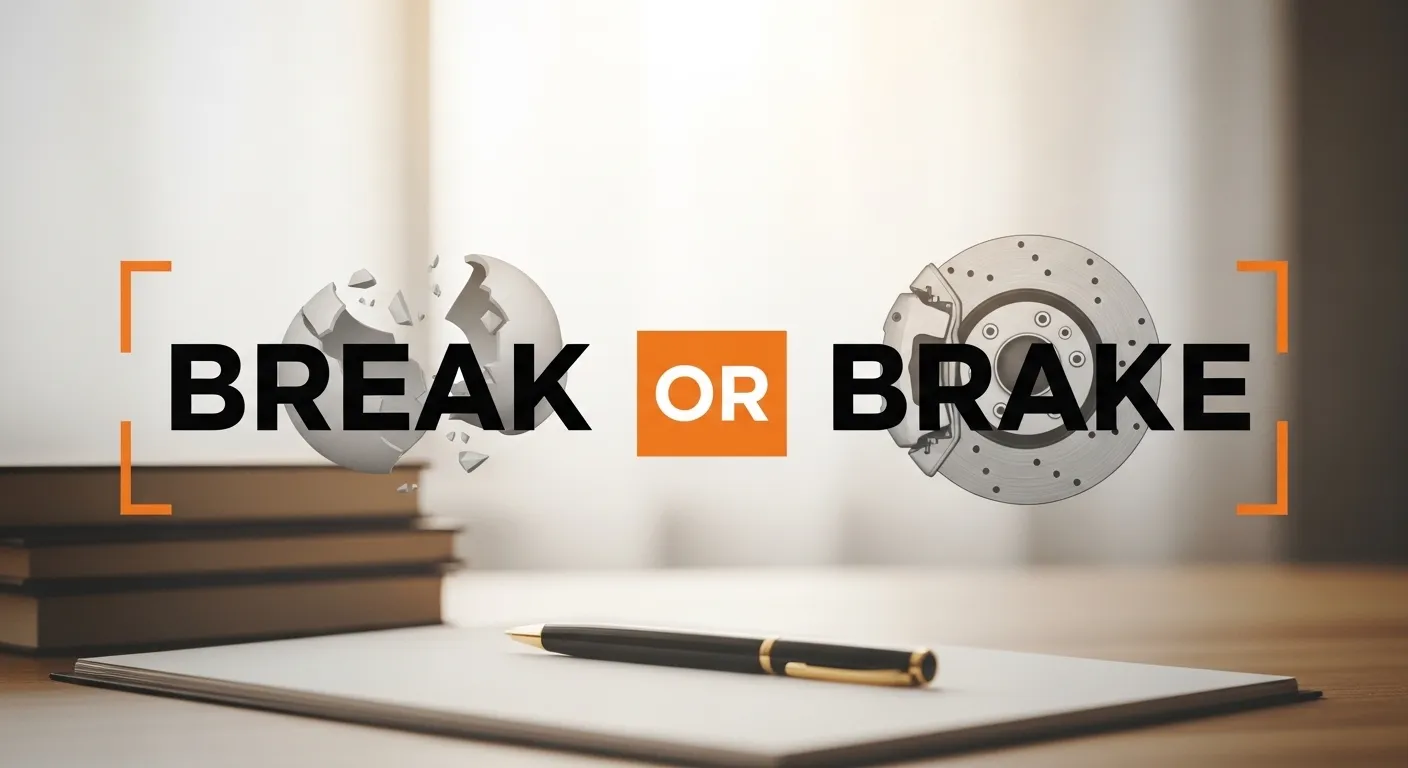
Many people search for “break or brake” because the words sound the same. But they have different meanings.
Brake is about stopping a vehicle.
Break means to damage something or take a rest.
For example, “Press the brake” is correct for driving.
“Take a break” is correct for resting.
One small spelling change can change the whole meaning.
Remember: Brake = car.
Break = everything else.
Break or Brake – Quick Answer
Break means to damage, destroy, separate into pieces, or pause something.
Brake means to slow down or stop a vehicle.
Simple Examples:
- Please break the chocolate into small pieces.
- I need a short break from work.
- The driver hit the brake quickly.
- Always check your car’s brakes before a long trip.
Easy Memory Tip:
- Break = Smash or Pause
- Brake = Stop a car
If it relates to driving, stopping, or vehicles, use brake.
In all other cases, use break.
The Origin of Break or Brake
Understanding word history makes this easier.
Origin of “Break”
The word break comes from Old English brecan. It meant to shatter, burst, or destroy. Over time, it also came to mean pause or interruption. That is why we say:
- Coffee break
- Lunch break
- Break the rules
- Break the silence
The meaning expanded beyond physical damage.
Origin of “Brake”
The word brake comes from a different root. It originally referred to a device used to slow wheels. When vehicles became common, the word was used for car stopping systems.
So even though the words sound the same today, their roots are different. That is why their spellings are different.
British English vs American English Spelling
Good news: There is no spelling difference between British and American English for break and brake.
Both countries use:
- Break
- Brake
Unlike words such as color/colour or favorite/favourite, this pair does not change across regions.
Comparison Table: British vs American Usage
| Meaning | American English | British English | Example |
| Damage or pause | Break | Break | Take a break. |
| Vehicle stopping system | Brake | Brake | Press the brake. |
The spelling stays the same in the US, UK, Canada, Australia, and other English-speaking countries.
The confusion is not regional. It is purely about meaning.
Which Spelling Should You Use?
The answer depends on context, not country.
If You Are Writing for a US Audience:
Use break for damage or pause.
Use brake for vehicles.
If You Are Writing for a UK or Commonwealth Audience:
The same rule applies.
If You Write for a Global Audience:
Focus on meaning. The spelling rule is universal.
Professional tip:
If you work in automotive writing, transport, or driving safety, double-check “brake.” It is often misspelled as “break.”
If you write general content, “break” will be more common.
Common Mistakes with Brake or Break
Here are frequent errors people make.
1. Writing “break” when talking about cars
❌ I pressed the break pedal.
✅ I pressed the brake pedal.
2. Writing “brake” when talking about rest
❌ Let’s take a short brake.
✅ Let’s take a short break.
3. Mixing them in business writing
❌ We need to brake this bad habit.
✅ We need to break this bad habit.
4. News headline mistakes
❌ Driver hits break to avoid crash.
✅ Driver hits brake to avoid crash.
5. Social media typos
❌ Time for a coffee brake ☕
✅ Time for a coffee break ☕
These mistakes are common because spellcheck may not catch them. Both words are correct English words. Only context decides which one is right.
Break Vs Brake in Everyday Examples
Let’s see how professionals use these words in real life.
In Emails
- I will take a short break and reply soon.
- Please check the car’s brakes before delivery.
News Writing
- The company decided to break its contract.
- The driver slammed the brakes to avoid a collision.
In Social Media
- Study hard, but take a break sometimes.
- If your brakes make noise, see a mechanic.
Formal Writing
- The stress caused a mental break.
- Faulty brakes can lead to serious accidents.
You can see the pattern clearly. Only vehicle-related contexts use brake.
Break or Brake – Google Trends & Usage Data
Search data shows that “break” is far more common than “brake.”
Why?
Because break has many meanings:
- Rest
- Damage
- Pause
- Opportunity (“big break”)
- Law violation (“break the law”)
Brake is more limited. It mainly appears in:
- Driving topics
- Car maintenance
- Road safety
- Transport news
In countries with high car usage like the United States, Canada, Australia, and the UK, searches for “brake pads” and “brake repair” are common.
But overall, “break” dominates in search volume because it has wider use in daily language.
Break vs Brake – Side-by-Side Comparison
| Feature | Break | Brake |
| Part of Speech | Noun & Verb | Noun & Verb |
| Main Meaning | Damage or pause | Slow or stop vehicle |
| Used in Driving? | No | Yes |
| Example Sentence | Take a break. | Press the brake. |
| Common Error | Used instead of brake | Used instead of break |
| Regional Difference | None | None |
This table makes the difference very clear.
FAQs:
1. Is it break time or brake time?
It is break time. It means time to rest.
2. Is it brake pedal or break pedal?
It is brake pedal. It controls the car’s stopping system.
3. Why do people confuse break and brake?
They sound exactly the same. They are homophones.
4. Are break and brake interchangeable?
No. They have completely different meanings.
5. Does British English spell brake differently?
No. Both American and British English use brake.
6. Is it “break the rules” or “brake the rules”?
It is break the rules. It means to violate rules.
7. Is it “slam the breaks” or “slam the brakes”?
It is slam the brakes. Brake becomes plural here.
Conclusion:
Summary:
The difference between break and brake is simple.
Use break for damage, rest, or pause.
Use brake when talking about stopping a vehicle.
The spelling is the same in British and American English. Context is what matters. If it relates to a car stopping, choose brake. Otherwise, use break.
Discover More About:
Employees or Employee’s: Which One Is Correct?
Trialled or Trialed: Which Spelling Is Correct? (2026)

I’m a U.S. based content writer and language researcher with a strong focus on English grammar, spelling differences, and frequently confused terms. My writing is aimed at helping readers write more clearly and correctly in daily use, workplace communication, and digital content.