People search for “meet or meat” because the words sound the same but have very different meanings. This confusion often causes spelling mistakes in emails, school assignments, business writing, and social media posts.
A small error, like writing “Nice to meat you,” can look unprofessional and change the meaning of a sentence.
This guide solves that confusion quickly and clearly. It explains the difference between meet and meat, shows correct usage, highlights common mistakes, and compares British and American English.
By the end, you will confidently know which word to use in every situation.
Meet or Meat – Quick Answer
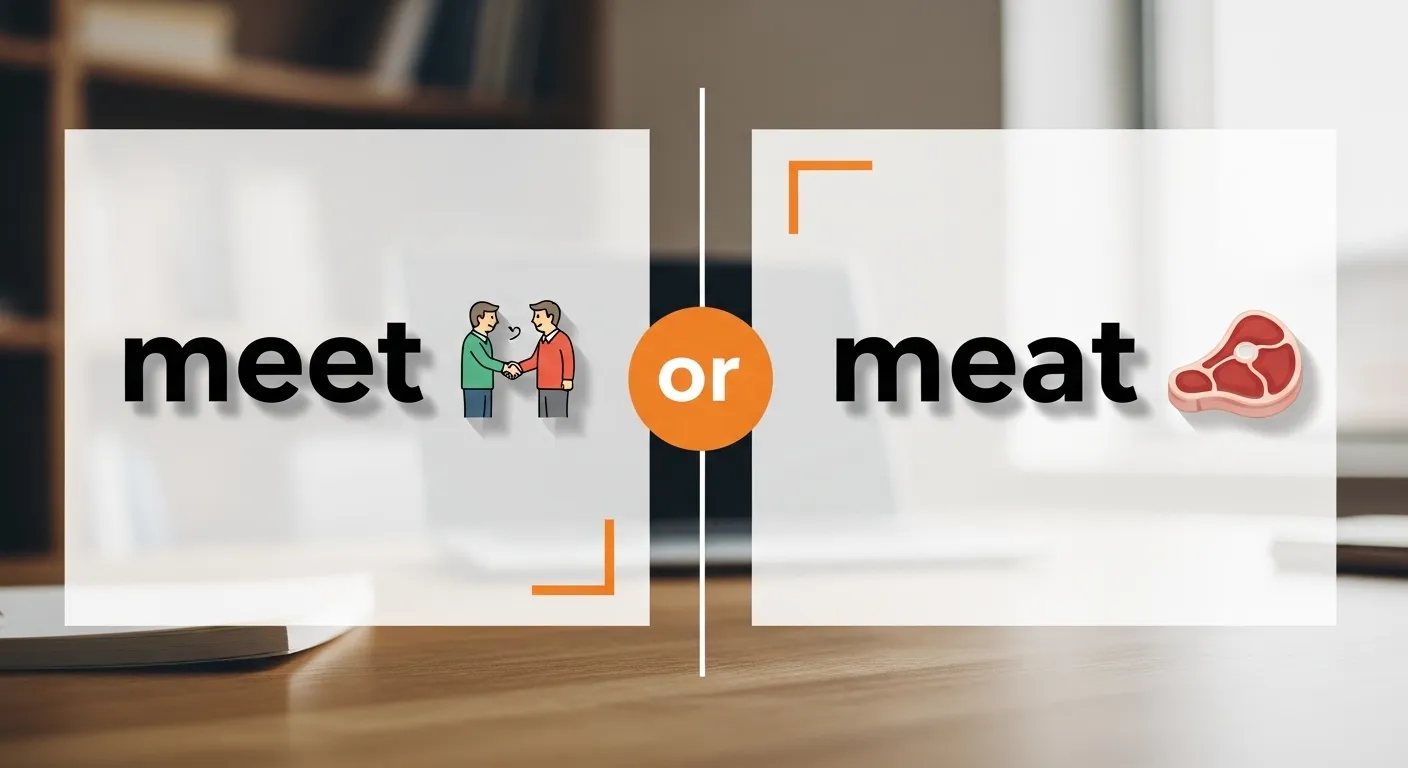
Meet is a verb. It means to come together, see someone, or join.
Meat is a noun. It means animal flesh used as food.
Simple Examples:
- I will meet you at 5 PM. ✅
- Nice to meet you. ✅
- She does not eat meat. ✅
- The restaurant serves fresh meat. ✅
Incorrect example:
- Nice to meat you. ❌
- Let’s meat tomorrow. ❌
If you are talking about people coming together, use meet.
If you are talking about food, use meat.
The Origin of Meet or Meat
Understanding the history makes things clearer.
Origin of “Meet”
The word meet comes from Old English mētan. It meant “to come across” or “to encounter.” Over time, the spelling changed but the meaning stayed almost the same.
In modern English, meet is mainly used as a verb:
- Meet a friend
- Meet a goal
- Meet expectations
It can also be a noun in sports, like a track meet.
Origin of “Meat”
The word meat comes from Old English mete. Long ago, it meant “food” in general. Over time, its meaning became more specific. Today, it refers only to animal flesh.
So originally, “meat” meant any type of food. Now it only means food from animals.
That is why the spellings look similar. They both come from Old English words with similar sounds.
British English vs American English Spelling
Good news: There is no spelling difference between British and American English for “meet” and “meat.”
Both countries use:
- Meet ✅
- Meat ✅
Unlike words such as “color” vs “colour,” these words stay the same.
Comparison Table
| Word | Part of Speech | Meaning | British Spelling | American Spelling |
| Meet | Verb | To come together | Meet | Meet |
| Meat | Noun | Animal flesh used as food | Meat | Meat |
There is no variation between the UK, US, Canada, or Australia. The confusion is not about region. It is about meaning.
Which Spelling Should You Use?
Your choice depends on what you are talking about.
If Your Audience Is in the US:
Use meet for action.
Use meat for food.
If Your Audience Is in the UK or Commonwealth:
The same rule applies.
For Global or Online Writing:
The spelling does not change anywhere in the English-speaking world.
So the real question is not location. It is context.
Ask yourself:
- Am I talking about people coming together? → Use meet
- Am I talking about food from animals? → Use meat
Simple.
Common Mistakes with Meat or Meet
Here are frequent errors people make:
1. “Nice to meat you.”
Correct: Nice to meet you.
2. “Let’s meat next week.”
Correct: Let’s meet next week.
3. “I don’t eat meet.”
Correct: I don’t eat meat.
4. “We will meat the deadline.”
Correct: We will meet the deadline.
Notice something important:
Meet is often used in business writing:
- Meet a client
- Meet a deadline
- Meet requirements
Meat is only about food.
If the sentence talks about goals, plans, people, or events, it is always meet.
Meat or Meet in Everyday Examples
Let’s see how these words appear in real life.
In Emails
Correct:
- I look forward to meeting you tomorrow.
- Let’s meet at 3 PM.
Incorrect:
- I look forward to meat you tomorrow. ❌
In News Headlines
- Company leaders meet to discuss growth.
- Rising meat prices affect consumers.
On Social Media
- Excited to meet my followers!
- BBQ night! Lots of meat and fun.
In Formal Writing
- The company must meet safety standards.
- Red meat consumption has increased.
You can see that meet often appears in professional or goal-based contexts.
Meat appears in food, health, and cooking contexts.
Meet Vs Meat – Google Trends & Usage Data
Search data shows that many people type “meet or meat” into search engines. This is because:
- They sound the same.
- Spell-check does not always catch context mistakes.
- Voice typing creates errors.
Countries where English learners search this keyword often include:
- India
- Pakistan
- United States
- United Kingdom
The confusion usually appears in business phrases like:
- Meet the deadline
- Nice to meet you
People sometimes type “meat” by mistake.
In terms of frequency:
- Meet is used more often in daily writing because it has many meanings.
- Meat is more specific and used mostly in food-related topics.
Meat vs Meet – Side-by-Side Comparison Table
| Feature | Meet | Meat |
| Meaning | To come together | Animal flesh as food |
| Part of Speech | Verb (mostly) | Noun |
| Used in Business? | Yes | No |
| Used in Food Context? | No | Yes |
| Example Sentence | We will meet soon. | I do not eat meat. |
| Common Mistake | Writing “meat” instead | Writing “meet” instead |
This table makes the difference clear.
FAQs:
1. Are meet and meat homophones?
Yes. They sound the same but have different meanings and spellings.
2. Is “Nice to meat you” ever correct?
No. It is always incorrect. The correct phrase is “Nice to meet you.”
3. Can meet be used as a noun?
Yes. In sports, a competition is called a “meet,” like a swim meet.
4. Does meat ever mean something other than food?
In modern English, no. It mainly means animal flesh used as food.
5. Is there a British spelling difference?
No. Both British and American English use the same spelling.
6. Why do people confuse meet and meat?
Because they sound identical when spoken.
7. Which word is more common?
“Meet” is used more often in daily communication because it has more meanings.
Conclusion:
The confusion between meet or meat is simple but common. Both words sound the same, but they have very different meanings. “Meet” is about people, plans, goals, and coming together. “Meat” is about food from animals.
There is no difference between British and American spelling. The only thing that matters is context. If your sentence talks about meeting someone, achieving a goal, or gathering, use meet. If it talks about food, cooking, or diet, use meat.
Before you publish an email, blog post, or message, quickly check the sentence. Ask yourself: Am I talking about people or food? This small habit will prevent embarrassing mistakes.
Mastering small differences like this improves your writing and builds trust with your readers.
Find More About:
Maximise or Maximize: Which Is Correct?
Many or Meny: What’s the Right English Word? (2026)

I’m a U.S. based content writer and language researcher with a strong focus on English grammar, spelling differences, and frequently confused terms. My writing is aimed at helping readers write more clearly and correctly in daily use, workplace communication, and digital content.