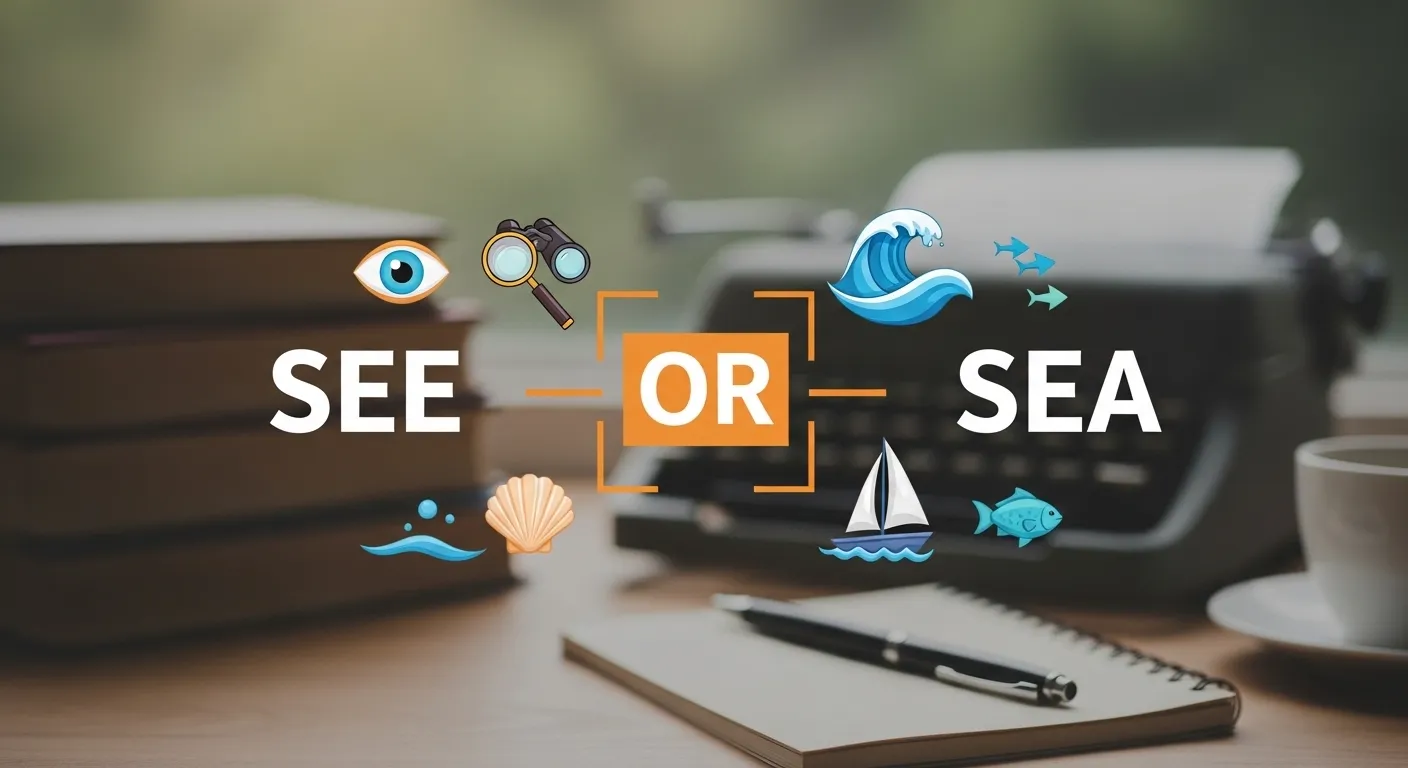
Many people search for “see or sea” because the words sound the same but mean different things. The confusion is common, but the solution is simple.
See is a verb. It relates to vision or understanding.
Sea is a noun. It refers to a large body of salt water.
One small spelling mistake can change your sentence and hurt your writing. If you want a quick, clear answer with examples and no confusion, this guide will solve it in minutes.
See or Sea – Quick Answer
See is a verb. It means to look at something with your eyes.
Sea is a noun. It means a large body of salt water.
Examples:
- I can see the mountains.
- I will see you tomorrow.
- The sea is calm today.
- They sailed across the sea.
Quick Comparison Table
| Word | Part of Speech | Meaning | Example |
| See | Verb | To look or understand | I see your point. |
| Sea | Noun | Large salt water body | The sea is blue. |
If you are talking about vision or understanding, use see.
If you are talking about water, use sea.
The Origin of See or Sea
Understanding history makes things clearer.
Origin of “See”
The word see comes from Old English “seon.” It meant “to perceive with the eyes.” Over time, spelling changed, but the meaning stayed the same. Today, it still means to look, notice, or understand.
Examples:
- I see the bird.
- I see what you mean.
Origin of “Sea”
The word sea comes from Old English “sǣ.” It meant large water or ocean. The spelling slowly changed to the modern form.
Famous seas include:
- Mediterranean Sea
- Arabian Sea
- Red Sea
Both words are very old. They look different but sound the same in modern English. That is why confusion happens.
British English vs American English Spelling
Good news: there is no spelling difference between British and American English for these words.
Unlike words such as “color” vs “colour,” both the UK and the US use:
- See
- Sea
The spelling does not change.
Comparison Table
| Meaning | British English | American English |
| To look | See | See |
| Ocean water | Sea | Sea |
So whether you write for the UK, the US, Pakistan, Australia, or Canada, the spelling stays the same.
Which Spelling Should You Use?
The answer depends on meaning, not country.
- Writing about vision? → Use see
- Writing about water? → Use sea
For US Audience
Use standard spelling:
- See
- Sea
For UK / Commonwealth Audience
Use standard spelling:
- See
- Sea
For Global Audience
Focus on clarity. Choose the word that matches your meaning.
There is no regional debate here. Only meaning matters.
Common Mistakes with Sea or See
Here are frequent errors people make:
1. Writing “sea you later”
❌ Sea you later
✔ See you later
“See” is correct because it means meeting or looking.
2. Writing “I can sea clearly”
❌ I can sea clearly
✔ I can see clearly
You use your eyes, not water.
3. Writing “The see is beautiful”
❌ The see is beautiful
✔ The sea is beautiful
We talk about water here, so “sea” is correct.
4. Mixing them in formal writing
In business emails:
❌ Please sea the attached file.
✔ Please see the attached file.
This is a very common office mistake.
See vs Sea in Everyday Examples
Let’s look at real-life use.
In Emails
- Please see the report below.
- I hope to see you next week.
In News
- Oil prices near the sea coast increased.
- Fishermen returned from the sea.
In Social Media
- Can’t wait to see this movie!
- Sunset by the sea 🌊
In Formal Writing
- As you can see, the results improved.
- The country borders the Arabian Sea.
Notice how meaning controls spelling.
Sea vs See – Google Trends & Usage Data
Search data shows that “see” is used much more often than “sea.” This is because “see” is a common verb used daily in conversation.
“Sea” is more specific. It appears in geography, travel, weather, and environmental topics.
Countries with long coastlines often search more for “sea.” For example:
- United Kingdom
- Australia
- United States
But globally, “see” remains more common because it is used in everyday speech.
In short:
- “See” = daily conversation
- “Sea” = geography and nature topics
Detailed Comparison Table
| Feature | See | Sea |
| Type | Verb | Noun |
| Meaning | To look or understand | Large body of salt water |
| Used in daily speech? | Yes, very often | Less frequent |
| British vs American spelling | Same | Same |
| Example sentence | I see your point. | The sea is calm. |
| Common mistake | Sea you later | The see is blue |
FAQs:
1. Are see and sea homophones?
Yes. They sound the same but have different meanings and spellings.
2. Is there any spelling difference in the UK and US?
No. Both countries spell them the same way.
3. How do I remember the difference?
Think of the letter “a” in sea as water waves. Sea = water.
4. Can “see” mean understand?
Yes. Example: I see what you mean.
5. Is “sea you later” ever correct?
No. It is always wrong in standard English.
6. Which word is more common?
“See” is much more common in everyday language.
7. Is “Holy See” related to vision?
No. The “Holy See” refers to the Vatican authority, not eyesight.
Conclusion:
The difference between see and sea is clear once you know the meaning. They sound the same, but they are not the same. See is a verb about vision or understanding. Sea is a noun about salt water.
There is no British or American spelling difference. The rule is simple: eyes and understanding mean see. Water and oceans mean sea.
Check your sentence before you send it. One small letter changes everything. Use the right word, and your writing will always look correct and professional.
Discover More About:
Personel or Personnel? The Correct Spelling
Analyses or Analysis: Using These Words Correctly
Devide or Divide: Which Is Correct?