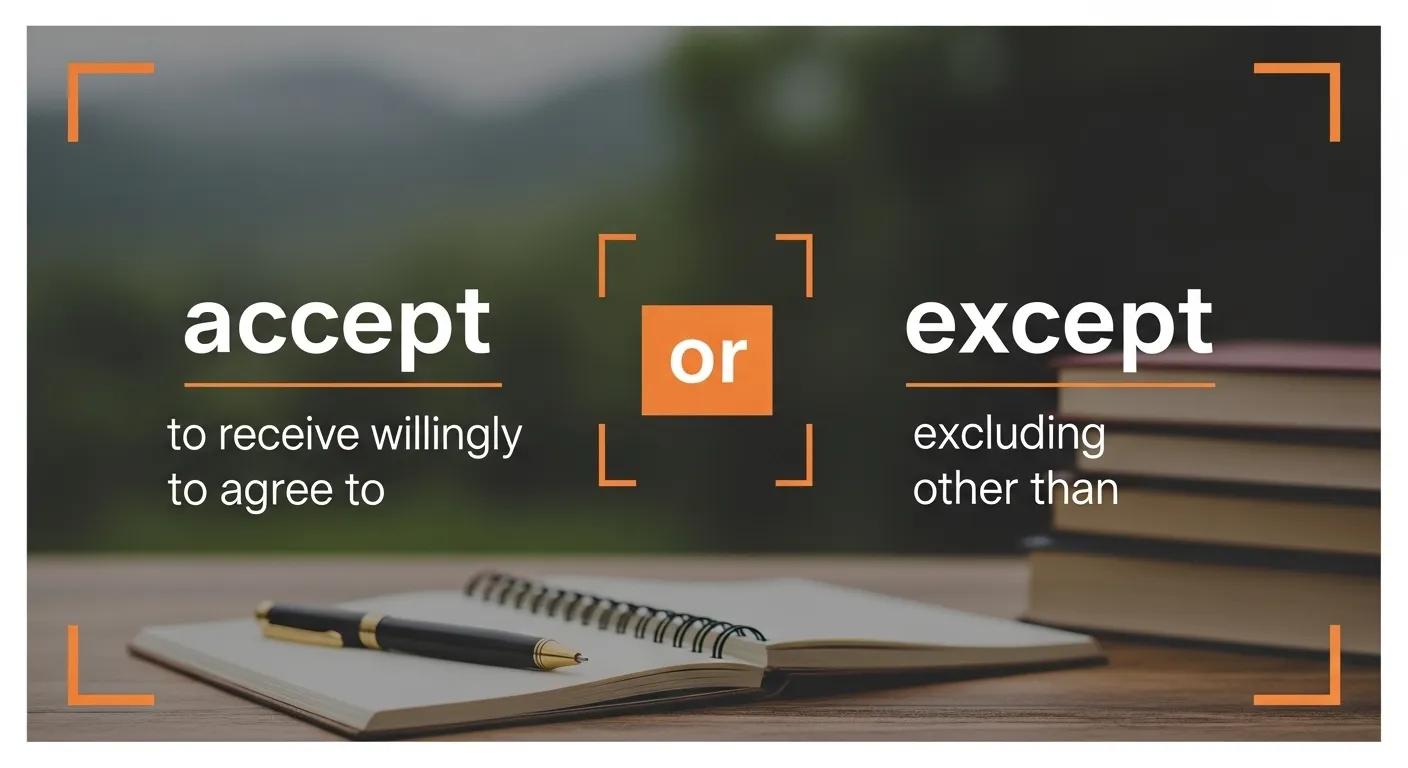
Have you ever stopped while writing and wondered whether to use accept or except?
You’re not alone. These two words look and sound similar, so many writers confuse them in emails, essays, and everyday writing.
Here is the quick answer: accept means to receive or agree to something, while except means to exclude or leave something out.
For example:
- I accept your invitation.
- Everyone came except John.
In this guide, you will quickly learn when to use accept and except, with easy explanations and real life examples.
Accept or Except – Quick Answer
The difference between accept and except is based on meaning.
| Word | Meaning | Example |
| Accept | To receive, agree to, or approve something | I accept your invitation. |
| Except | To exclude or leave something out | Everyone came except John. |
Simple explanation
Accept means to receive or agree to something.
Example:
- She accepted the job offer.
- Please accept my apology.
- He accepts the terms of the contract.
Except means excluding something or someone.
Example:
- All students passed the exam except Alex.
- The shop is open every day except Sunday.
- Everyone attended the meeting except the manager.
Quick trick to remember
- Accept = Agree
- Except = Exclude
If the sentence is about receiving or agreeing, use accept.
If the sentence is about leaving something out, use except.
The Origin of Accept or Except
Understanding where these words come from helps explain why they look similar but mean different things.
Origin of Accept
The word accept comes from the Latin word “acceptare.” This word means to take willingly or receive. Over time, it entered Old French as “accepter” and later became part of Middle English.
Because of this history, accept developed the meaning of receiving something positively or agreeing to something offered.
Examples of early uses included accepting gifts, accepting apologies, or accepting agreements.
Origin of Except
The word except has a different Latin origin. It comes from “exceptus,” which means taken out or excluded. The prefix ex- means out, while capere means to take.
So the original meaning was to take something out of a group.
That is why except is used to show exclusion.
Example:
- Everyone was invited except one person.
Why the Words Look Similar
The similarity between accept and except happens because both words share the Latin root capere, meaning to take.
However, the prefixes change the meaning:
| Prefix | Meaning | Result |
| ac- | toward | accept → receive |
| ex- | out of | except → exclude |
This small difference in prefixes completely changes the meaning.
British English vs American English Spelling
Unlike some English words, accept and except do not change spelling between British and American English. Both forms are written exactly the same in both language systems.
This means whether you are writing for readers in the United States, the United Kingdom, Canada, Australia, or anywhere else, the spelling remains identical.
Example Sentences
American English
- I accept the invitation to the conference.
- Everyone attended the meeting except Sarah.
British English
- The company accepts online payments.
- All shops are open except on Christmas Day.
As you can see, there is no difference in spelling.
Comparison Table
| Word | British English | American English | Meaning |
| Accept | Accept | Accept | To receive or agree |
| Except | Except | Except | To exclude or leave out |
The confusion between these words is not about spelling differences, but about meaning.
Which Spelling Should You Use?
Since both accept and except are spelled the same globally, the correct choice depends entirely on context and meaning.
If your audience is American
Use the standard meanings:
- Accept → receive or agree
- Except → exclude
Example:
- The company accepted the proposal.
- All departments agreed except finance.
If your audience is British or Commonwealth
The rules are exactly the same.
Example:
- She accepted the award.
- Everyone attended except Tom.
If your audience is global
The safest approach is to focus on clarity of meaning.
Professional writing across the world follows the same definitions for these words. That means readers everywhere will understand the difference.
Professional Advice
When writing for business, education, or publishing:
- Always check the sentence meaning.
- Ask whether you mean receive or exclude.
- Choose the correct word based on context.
This simple habit prevents common grammar mistakes.
Common Mistakes with Except or Accept
Because these words sound somewhat similar, people often mix them up in writing.
Here are some of the most common mistakes.
Mistake 1: Using “except” instead of “accept”
Incorrect:
- I except your apology.
Correct:
- I accept your apology.
Explanation:
The sentence is about receiving an apology, so accept is correct.
Mistake 2: Using “accept” instead of “except”
Incorrect:
- Everyone came accept David.
Correct:
- Everyone came except David.
Explanation:
David is excluded, so except is correct.
Mistake 3: Confusing pronunciation
Some speakers pronounce the words similarly, especially in fast speech. This leads to spelling mistakes when writing.
Example mistake:
- The store is open every day accept Sunday.
Correct:
- The store is open every day except Sunday.
Mistake 4: Misusing in formal writing
Incorrect:
- The university will except the application.
Correct:
- The university will accept the application.
Quick Correction Table
| Incorrect Sentence | Correct Sentence |
| I except your offer | I accept your offer |
| Everyone came accept him | Everyone came except him |
| The school excepts payments online | The school accepts payments online |
| All items are included accept tax | All items are included except tax |
Accept or Except in Everyday Examples
To understand the difference better, let’s look at how these words appear in everyday writing.
In Emails
Accept
- I accept your meeting request for Monday.
- Please accept my sincere apologies.
Except
- The office will be closed every day except Friday.
In News Articles
Accept
- The president accepted the proposal after discussion.
Except
- All flights were delayed except the early morning departure.
In Social Media Posts
Accept
- I finally accepted the challenge!
Except
- I love every season except winter.
In Formal Writing
Accept
- The committee accepts responsibility for the decision.
Except
- The rule applies to all employees except interns.
Except vs Accept – Google Trends & Usage Data
Search interest for “accept or except” is consistently high around the world. This happens because the words are commonly confused.
Countries with high search interest
- United States
- United Kingdom
- Canada
- Australia
- India
- Pakistan
Students, writers, and bloggers frequently search this phrase while proofreading their work.
Why People Search This Keyword
There are three main reasons:
- Homophone confusion – Words sound similar.
- Grammar checks – Writers want to avoid mistakes.
- Professional writing – Correct language improves credibility.
Context of Usage
Accept is used more often in business communication, such as:
- accepting offers
- accepting invitations
- accepting payments
Except appears frequently in rules and descriptions, such as:
- excluding people
- listing exceptions
- defining limits
Keyword Comparison Table: Accept vs Except
| Word | Meaning | Typical Context | Example |
| Accept | Receive or agree | Business, emails, agreements | I accept the offer |
| Except | Exclude | Rules, lists, conditions | Everyone came except him |
FAQs:
1. What is the difference between accept and except?
Accept means to receive or agree to something.
Except means to exclude or leave something out.
Example:
- I accept your invitation.
- Everyone came except John.
2. Are accept and except homophones?
They are near homophones. They sound somewhat similar but not exactly the same. This similarity causes spelling confusion.
3. Is except ever used as a verb?
Yes, but it is rare. In legal or formal contexts, except can mean to object or exclude formally.
Example:
- The lawyer excepted to the ruling.
However, this usage is uncommon in everyday English.
4. Can accept mean the same as except?
No. These words never share the same meaning. Accept always refers to receiving or agreeing, while except always refers to excluding something.
5. How can I remember the difference?
Use this memory trick:
- Accept = Agree
- Except = Exclude
Both meanings start with the same letter.
6. Do British and American English spell these words differently?
No. Both accept and except have identical spellings in British and American English.
7. Which word is more common?
Accept appears more frequently in everyday communication, especially in business and personal messages. However, except is also common when describing exceptions.
Conclusion
The confusion between accept or except is common, but the rule is simple.
Accept means to receive or agree, while except means to exclude or leave something out.
Both words share a similar origin, but their prefixes change the meaning. Also, there is no spelling difference between British and American English, so the correct choice depends only on the sentence meaning.
A quick trick to remember:
- Accept = Agree or receive
- Except = Exclude
Once you understand this small difference, your writing becomes clearer, more accurate, and more professional.
Discover More About:
Handle or Handel: Which One Is Right And Wrong (2026)
Analyses or Analysis: Using These Words Correctly