Ever wonder whether to write principal or principle? You’re not alone.
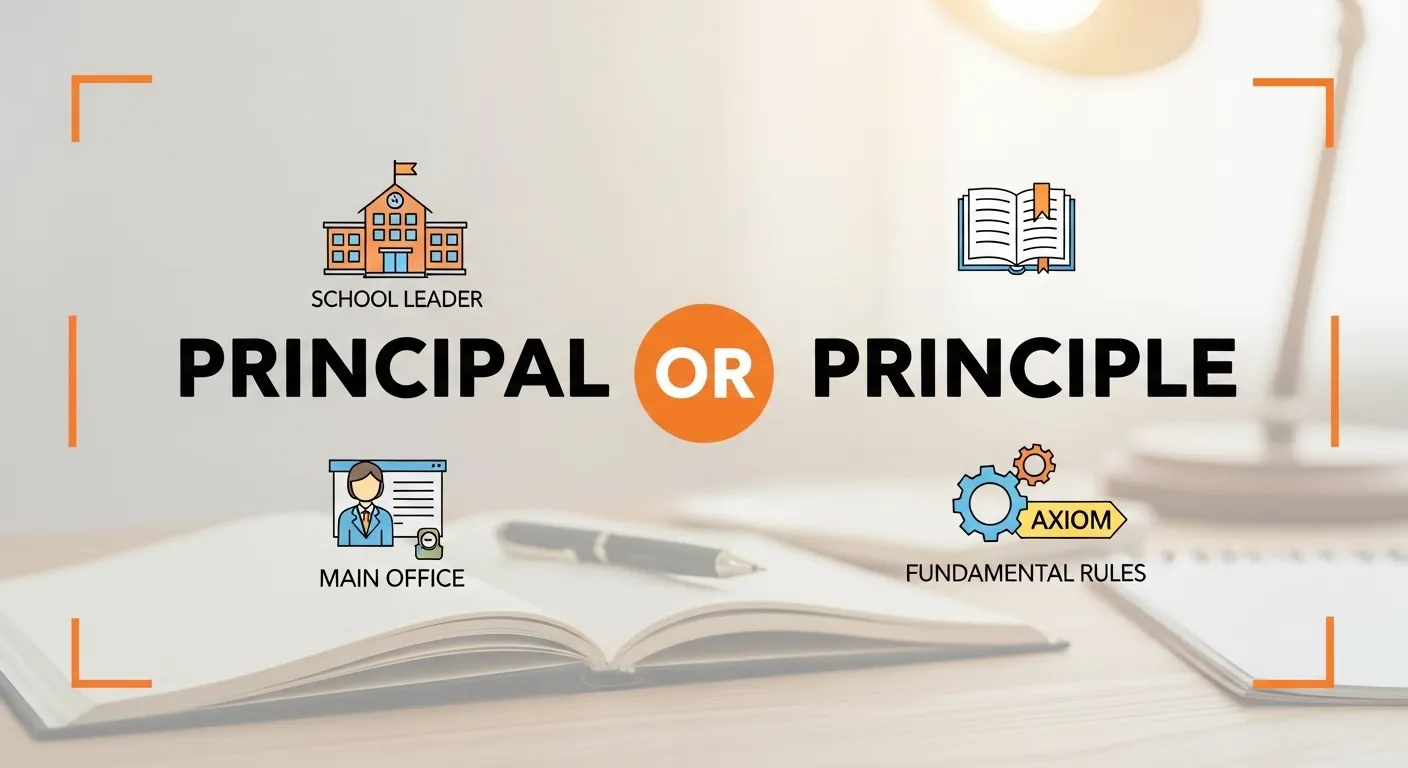
Quick answer: Principal = a person in charge or something most important, while principle = a rule, belief, or fundamental truth.
Many people confuse these homophones, but using the wrong one can change your sentence meaning like “school principle” instead of “school principal”.
This guide will help you always choose the right word, with simple tips, examples, and rules for English everywhere.
Principal or Principle – Quick Answer
The difference between principal and principle is simple once you understand their meanings.
| Word | Meaning | Example |
| Principal | A person in charge OR something most important | The school principal welcomed new students. |
| Principle | A rule, belief, or basic truth | Honesty is an important principle. |
Principal
Principal usually refers to a person in charge, especially the head of a school.
Example:
- The principal announced the new school policy.
It can also mean most important.
Example:
- The principal reason for the meeting was budget planning.
Principle
Principle refers to a rule, belief, or fundamental truth.
Examples:
- She believes in the principle of fairness.
- Scientific principles guide research.
Easy Memory Trick
A popular trick helps many writers remember the difference:
The principal is your “pal.”
Both principal and pal end with -pal, which reminds you that the principal is a person.
The Origin of Principal or Principle
Understanding the history of the words makes their difference clearer.
Both words come from the Latin root “principium,” which means beginning, foundation, or source.
Over time, English developed two different forms from this root.
Origin of Principal
The word principal comes from the Latin word “principalis,” which means first, chief, or leading.
By the 1300s, English speakers used principal to describe something most important.
Later, the word began to describe a person who leads an institution, such as a school.
Examples through history:
- Principal officer
- Principal leader
- School principal
Origin of Principle
The word principle comes more directly from “principium,” meaning foundation or rule.
By the 1400s, English writers used principle to describe fundamental truths, moral beliefs, or scientific rules.
Examples:
- Moral principles
- Scientific principles
- Political principles
Why the Spellings Are Different
English often creates different spellings when a single root word evolves into multiple meanings.
In this case:
- Principal → person or main thing
- Principle → rule or belief
Even though they share the same origin, their meanings separated over time.
British English vs American English Spelling
Unlike many English words, principal and principle have the same spelling in both British and American English.
There is no spelling difference between the two language systems.
Both countries use the same rules.
Example Sentences
| Context | British English | American English |
| School leader | The principal spoke at assembly. | The principal spoke at assembly. |
| Moral belief | She lives by strong principles. | She lives by strong principles. |
| Important reason | The principal cause was weather. | The principal cause was weather. |
Why People Think There Is a Difference
Many English words have British vs American spelling differences.
Examples include:
| British | American |
| Colour | Color |
| Centre | Center |
| Favourite | Favorite |
Because people know these differences exist, they sometimes assume principal/principle also follow that pattern.
But they do not.
Both spellings are universal across English dialects.
Which Spelling Should You Use?
Choosing the correct word depends on meaning, not location.
If You Are Writing for a US Audience
Use the same rules:
- Principal → person or main thing
- Principle → rule or belief
Example:
- The principal approved the new policy.
- The decision was based on ethical principles.
If You Are Writing for a UK or Commonwealth Audience
The rules remain exactly the same.
Example:
- The school principal addressed the students.
- The company follows strong business principles.
If You Write for a Global Audience
The safest strategy is simple:
Use the word based on meaning.
| Situation | Correct Word |
| School leader | Principal |
| Most important reason | Principal |
| Moral rule | Principle |
| Scientific law | Principle |
Because the spelling is the same worldwide, global readers will understand it easily.
Common Mistakes with Principal or Principle
Even experienced writers sometimes confuse these words.
Here are the most common mistakes.
Mistake 1: Writing “School Principle”
❌ The school principle spoke to the students.
✔ The school principal spoke to the students.
Remember: a person is the principal.
Mistake 2: Writing “Moral Principals”
❌ She believes in strong moral principals.
✔ She believes in strong moral principles.
A belief or rule is a principle.
Mistake 3: Confusing “Main” and “Rule”
❌ The principle reason for the delay was traffic.
✔ The principal reason for the delay was traffic.
When something is most important, use principal.
Mistake 4: Mixing Them in Business Writing
❌ Our company follows strict financial principals.
✔ Our company follows strict financial principles.
Policies and ethics are principles.
Principle or Principal in Everyday Examples
Understanding real-life examples helps make the difference clearer.
Emails
Correct:
- The principal will respond to your request tomorrow.
- Our company follows strict customer service principles.
Incorrect:
- The principle will respond to your request tomorrow.
News Articles
Example:
- The school principal announced a new safety program.
Another example:
- The report explained the economic principles behind inflation.
Social Media
Example:
- Respect is a basic principle everyone should follow.
Example:
- Our school principal just won an education award!
Academic Writing
Example:
- Newton’s laws are important principles of physics.
Example:
- The principal investigator led the research team.
Professional Writing
Example:
- The principal objective of the project is growth.
Example:
- The organization follows clear ethical principles.
Principle vs Principal – Google Trends & Usage Data
Search data shows that “principal or principle” is a very common grammar question.
Many people type the phrase directly into search engines because they want a quick answer.
Why People Search This Keyword
There are three main reasons:
- The words sound identical.
- They appear frequently in school and work writing.
- Spellcheck tools do not always catch the mistake.
Popular Countries Searching This Term
Search interest is high in:
- United States
- United Kingdom
- Canada
- Australia
- India
These countries have large English-speaking populations and strong education systems.
Contexts Where the Words Appear Most
| Context | Word Used |
| Education | Principal |
| Ethics | Principle |
| Science | Principle |
| Business | Both |
| Law | Principle |
Online Usage Pattern
Online writing shows a clear pattern:
- Principal is common in education and leadership.
- Principle appears more in philosophy, ethics, and science.
Because the words are similar, many writers still search “principal vs principle” before publishing.
Principal vs Principle Comparison Table
| Feature | Principal | Principle |
| Word Type | Noun / Adjective | Noun |
| Main Meaning | Leader or most important | Rule or belief |
| Example | School principal | Moral principle |
| Used for People | Yes | No |
| Used for Rules | No | Yes |
| Used for Importance | Yes | No |
FAQs
1. What is the difference between principal and principle?
Principal refers to a person in charge or something most important, while principle refers to a rule, belief, or fundamental truth.
2. Is it school principal or school principle?
The correct phrase is school principal, because the word refers to the leader of the school.
3. How can I remember the difference between principal and principle?
A simple trick is:
The principal is your pal.
Both words end with -pal, reminding you that a principal is a person.
4. Can principal mean “most important”?
Yes. Principal can also mean main or most important.
Example:
- The principal goal of the project is growth.
5. What does principle mean in science?
In science, a principle refers to a basic rule or law that explains how something works.
Example:
- The principle of gravity explains why objects fall.
6. Are principal and principle pronounced the same?
Yes. They are pronounced almost identically in most English accents, which is why people confuse them.
7. Do British and American English spell them differently?
No. Both principal and principle are spelled the same in British and American English.
Conclusion
The confusion between principal and principle is common, but the difference is simple:
- Principal = a person in charge or something most important.
- Principle = a rule, belief, or fundamental truth.
A quick memory trick: “the principal is your pal”. Both end with pal, reminding you that principal is a person.
Since spelling is the same in British and American English, meaning is all that matters. Remember this rule, and you’ll never mix them up again making your writing clear, professional, and confident.
Discover More About:
Analyses or Analysis: Using These Words Correctly
Maximise or Maximize: Which Is Correct?

I’m a U.S. based content writer and language researcher with a strong focus on English grammar, spelling differences, and frequently confused terms. My writing is aimed at helping readers write more clearly and correctly in daily use, workplace communication, and digital content.