Many people search “mediation or negotiation” when facing disputes in business, legal matters, workplaces, or personal relationships. Using the wrong term can cause confusion.
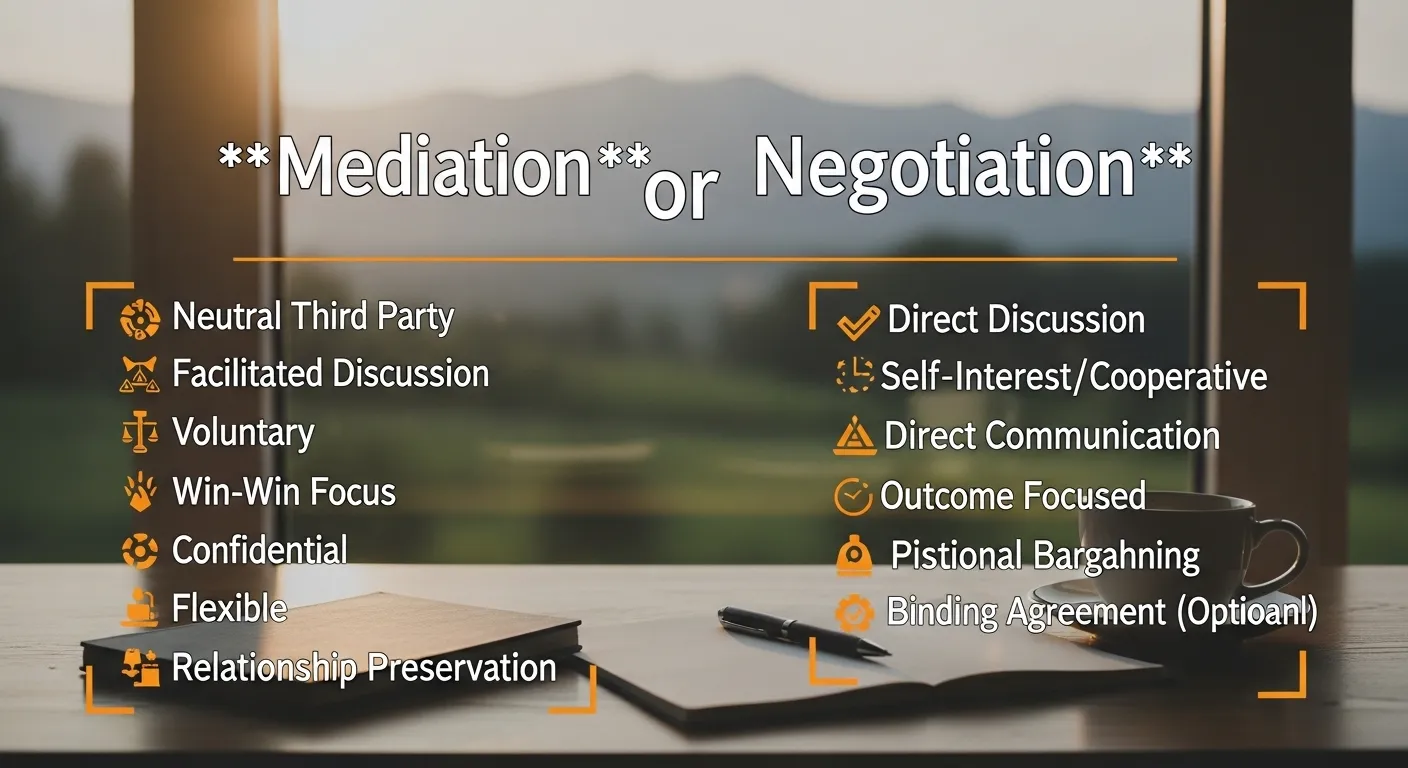
Negotiation is when parties discuss directly to reach an agreement, while mediation is when a neutral third party helps resolve the conflict.
This guide will explain the differences, origins, common mistakes, and real-life examples, helping you know exactly when to use mediation or negotiation.
Mediation or Negotiation – Quick Answer
Mediation and negotiation are both ways to resolve conflicts, but they are not the same.
- Negotiation: A direct discussion between two or more parties to reach an agreement.
- Mediation: A process where a neutral third person (mediator) helps both sides reach a solution.
Simple Examples:
- Negotiation:
“We negotiated the price of the car and agreed on $10,000.” - Mediation:
“The couple used mediation to settle their divorce peacefully.”
👉 Key Difference:
Negotiation = Direct talk
Mediation = Third-party help
The Origin of Mediation or Negotiation
Understanding the origin of these words makes their meaning clearer.
Mediation
The word mediation comes from the Latin word “mediare”, which means “to be in the middle.” This explains its role perfectly. A mediator stands between two sides and helps them find a middle ground.
Historically, mediation has been used in:
- Legal disputes
- Community conflicts
- International peace talks
It focuses on cooperation and fairness.
Negotiation
The word negotiation comes from the Latin “negotiatio”, meaning “to carry on business.” It was originally used in trade and commerce.
Over time, negotiation expanded into:
- Business deals
- Salary discussions
- Political agreements
It focuses on reaching a mutually beneficial agreement through discussion.
British English vs American English Spelling
Good news: There is NO spelling difference between mediation and negotiation in British and American English.
Both forms are spelled the same globally.
Comparison Table
| Term | British English | American English | Meaning |
| Mediation | Mediation | Mediation | Third-party conflict resolution |
| Negotiation | Negotiation | Negotiation | Direct discussion to reach agreement |
👉 Unlike words like “color/colour,” these terms are universal.
Which Spelling Should You Use?
Since there is no spelling difference, your choice depends on context, not region.
Use “Negotiation” when:
- You are talking about direct discussions
- No third party is involved
- Example: business deals, salaries, contracts
Use “Mediation” when:
- A neutral third party is involved
- The goal is to resolve conflict peacefully
- Example: legal disputes, family conflicts
Audience-Based Advice
- US audience: Use both terms correctly based on context
- UK/Commonwealth: Same usage rules apply
- Global audience: Be clear about the process to avoid confusion
👉 Tip: Always think, “Is there a mediator involved?” If yes → mediation.
Common Mistakes with Negotiation or Mediation
Many people mix these terms incorrectly. Here are common mistakes:
1: Using them as synonyms
- Wrong: “We used mediation to discuss the deal directly.”
- Correct: “We used negotiation to discuss the deal directly.”
2: Ignoring the third party
- Wrong: “The lawyer negotiated between the couple.”
- Correct: “The lawyer mediated between the couple.”
3: Using mediation in business deals
- Wrong: “We mediated the price of the product.”
- Correct: “We negotiated the price of the product.”
4: Confusing tone
- Negotiation can be competitive
- Mediation is usually cooperative
5: Misusing in legal writing
Legal systems clearly separate these processes. Using the wrong term can create confusion.
Mediation or Negotiation in Everyday Examples
Let’s see how these terms appear in real life.
1. Emails
- Negotiation:
“We would like to negotiate the terms of the contract.” - Mediation:
“We suggest mediation to resolve this dispute peacefully.”
2. News
- Negotiation:
“The two countries are in negotiation over trade policies.” - Mediation:
“The UN offered mediation to stop the conflict.”
3. Social Media
- Negotiation:
“Always negotiate your salary. Don’t accept the first offer.” - Mediation:
“Mediation saved our relationship. It really works.”
4. Workplace
- Negotiation:
“The manager negotiated a better deal with suppliers.” - Mediation:
“HR arranged mediation between two employees.”
5. Legal Writing
- Negotiation:
Used before legal action - Mediation:
Used as an alternative dispute resolution (ADR)
Negotiation vs Mediation – Google Trends & Usage Data
Search data shows that both terms are popular but used in different contexts.
Global Trends
- Negotiation is searched more frequently
- Common in business, sales, and career topics
- Mediation is searched less but is important in:
- Legal cases
- Divorce
- Conflict resolution
Country-Based Usage
- United States:
- High search for “salary negotiation”
- Strong use of “legal mediation”
- United Kingdom:
- Similar trends, especially in legal mediation
- India & Pakistan:
- Growing interest in negotiation (jobs, freelancing)
- Mediation rising in legal awareness
Context-Based Usage
| Context | Preferred Term |
| Business deal | Negotiation |
| Salary talk | Negotiation |
| Divorce case | Mediation |
| Workplace conflict | Mediation |
| International relations | Both |
Comparison Table: Mediation vs Negotiation
| Feature | Mediation | Negotiation |
| Third party | Yes (mediator) | No |
| Control | Shared | Direct control by parties |
| Goal | Resolve conflict peacefully | Reach agreement |
| Tone | Cooperative | Cooperative or competitive |
| Common use | Legal, disputes | Business, deals |
| Decision maker | Parties (with help) | Parties directly |
FAQs
1. What is the main difference between mediation and negotiation?
Mediation involves a neutral third party, while negotiation is a direct discussion between parties.
2. Is mediation better than negotiation?
Not always. Mediation is better for conflicts. Negotiation is better for deals.
3. Can mediation include negotiation?
Yes. During mediation, parties often negotiate with each other through the mediator.
4. Which is faster: mediation or negotiation?
Negotiation is usually faster because it does not involve a third party.
5. Is mediation legally binding?
Not always. It depends on the agreement signed after the mediation process.
6. When should I choose mediation?
Choose mediation when communication has broken down or emotions are high.
7. Is negotiation used in daily life?
Yes. People negotiate prices, salaries, and even daily decisions.
Conclusion
Negotiation is a direct discussion to reach an agreement, while mediation uses a neutral third party to help resolve conflicts.
Both terms are spelled the same in British and American English, but using them correctly improves communication, professionalism, and clarity in business, legal matters, or everyday life.
Discover More About:
Employees or Employee’s: Which One Is Correct?
Trialled or Trialed: Which Spelling Is Correct? (2026)

I’m a U.S. based content writer and language researcher with a strong focus on English grammar, spelling differences, and frequently confused terms. My writing is aimed at helping readers write more clearly and correctly in daily use, workplace communication, and digital content.