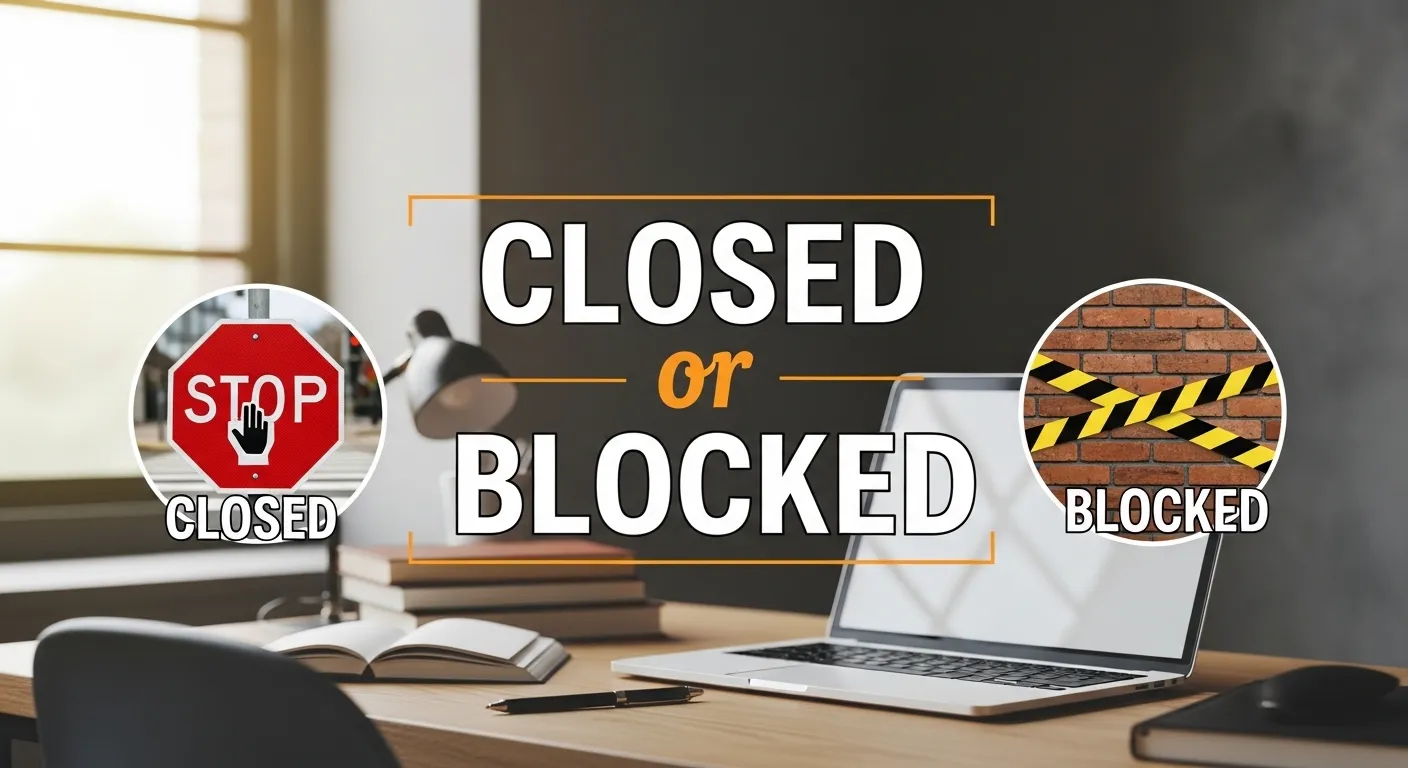
Have you ever wondered whether to say “closed” or “blocked”? You’re not alone. These two words sound similar but mean very different things. A road can be closed or blocked, and using the wrong word can confuse readers.
People search for this because they see these words in emails, notifications, news, or social media.
This guide will clear up the confusion, explain the difference, and show exactly when to use closed versus blocked.
Closed or Blocked – Quick Answer
Closed: Means something is shut or not open to access.
- Example: “The store is closed for the holiday.”
- Usage: Doors, shops, accounts, or services.
Blocked: Means something is obstructed or prevented from moving or being used.
- Example: “The road is blocked by a fallen tree.”
- Usage: Roads, pipes, messages, social media, or actions.
Quick Tip: If the focus is inaccessibility by restriction, use blocked. If it’s intentionally shut, use closed.
The Origin of Closed and Blocked
Closed:
- Originates from Old English closian, meaning “to shut.”
- Historically used for doors, gates, or areas.
- Emphasizes a deliberate action of shutting something off.
Blocked:
- Comes from the Middle English blok, meaning “a solid piece of wood.”
- Extended to mean obstruction or prevention.
- Focuses on obstruction rather than a formal shutdown.
Understanding the origins helps explain why they are not interchangeable. One conveys a state of being shut, the other conveys a state of obstruction.
British English vs American English Spelling
Both closed and blocked are spelled the same in British and American English. However, usage can vary slightly depending on context:
| Word | British English Usage | American English Usage | Notes |
| Closed | Shops, roads, offices | Shops, offices, events | Slight preference in formal notices |
| Blocked | Roads, drains, social media | Roads, drains, social media | Social media usage more common in US |
Key point: Spelling does not change, but context and frequency of use may differ slightly.
Which Spelling Should You Use?
- US Audience: Both words are understood; context is key.
- UK/Commonwealth Audience: Same words apply, slight regional phrasing may exist.
- Global Audience: Stick with standard closed and blocked to ensure clarity.
Professional Advice: Focus on meaning rather than spelling differences. Ensure your audience understands whether you mean “shut” or “obstructed.”
Common Mistakes with Blocked or Closed
- Incorrect: “The road is closed by a tree.”
- Correct: “The road is blocked by a tree.”
- Incorrect: “My account is blocked for the holiday.”
- Correct: “My account is closed for the holiday.”
- Incorrect: “The website is closed from access.”
- Correct: “The website is blocked from access.”
Tip: Always ask: Is it shut intentionally (closed) or obstructed/unusable (blocked)?
Closed or Blocked in Everyday Examples
Emails & Notifications:
- “Your account is blocked due to suspicious activity.”
- “The office will be closed tomorrow for maintenance.”
News & Social Media:
- “Highways blocked after heavy snowfall.”
- “Library closed for renovations until next week.”
Formal Writing:
- “Access to the laboratory is closed to unauthorized personnel.”
- “The drainage system is blocked, causing flooding in the area.”
Quick Rule: Think of closed as intentional and blocked as accidental or obstructed.
Blocked vs Closed – Google Trends & Usage Data
Analysis of Google search trends shows:
- Closed peaks during holidays, store shutdowns, or events.
- Blocked peaks during traffic incidents, social media outages, or technical errors.
- Top Countries Searching:
- Closed: UK, US, India
- Blocked: US, Canada, Australia
Insight: Businesses and tech services are the main drivers of confusion between these terms.
Comparison Table – Closed vs Blocked
| Aspect | Closed | Blocked |
| Meaning | Shut, not open | Obstructed, prevented |
| Usage Context | Shops, offices, events | Roads, messages, drains |
| Intentional? | Yes | Not always |
| Example | “Store is closed today.” | “Road is blocked by snow.” |
| Audience | General | General, technical |
FAQs
- Can I use closed instead of blocked?
- Only if you mean intentionally shut, not obstructed.
- Is blocked only for social media?
- No, it can be for roads, pipes, or messages too.
- Are there spelling differences in British vs American English?
- No, spelling is the same, only context usage may vary.
- Which word is more formal?
- Closed is often used in formal writing, blocked is common in technical contexts.
- Can a website be closed or blocked?
- A website can be closed temporarily (maintenance) or blocked (restricted access).
- Is blocked ever intentional?
- Yes, e.g., social media accounts can be intentionally blocked.
- Which is more common in everyday conversation?
- Closed for shops/events, blocked for obstacles or technical issues.
Conclusion
In summary, closed and blocked are often confused but serve different purposes. Closed refers to something intentionally shut, while blocked refers to something obstructed or inaccessible. Understanding the context is key to using them correctly in emails, news, social media, or formal writing.
Remember:
- Use closed for offices, shops, events, or accounts that are intentionally shut.
- Use blocked for roads, messages, drains, or access that is obstructed or restricted.
- Both spellings are standard in British and American English, so focus on meaning, not geography.
By applying these guidelines, you can write clearly, avoid mistakes, and communicate professionally. Mastering this distinction also improves readability and ensures your audience understands your message perfectly.
Discover More About:
Many or Meny: What’s the Right English Word? (2026)
Employees or Employee’s: Which One Is Correct?

I’m a U.S. based content writer and language researcher with a strong focus on English grammar, spelling differences, and frequently confused terms. My writing is aimed at helping readers write more clearly and correctly in daily use, workplace communication, and digital content.