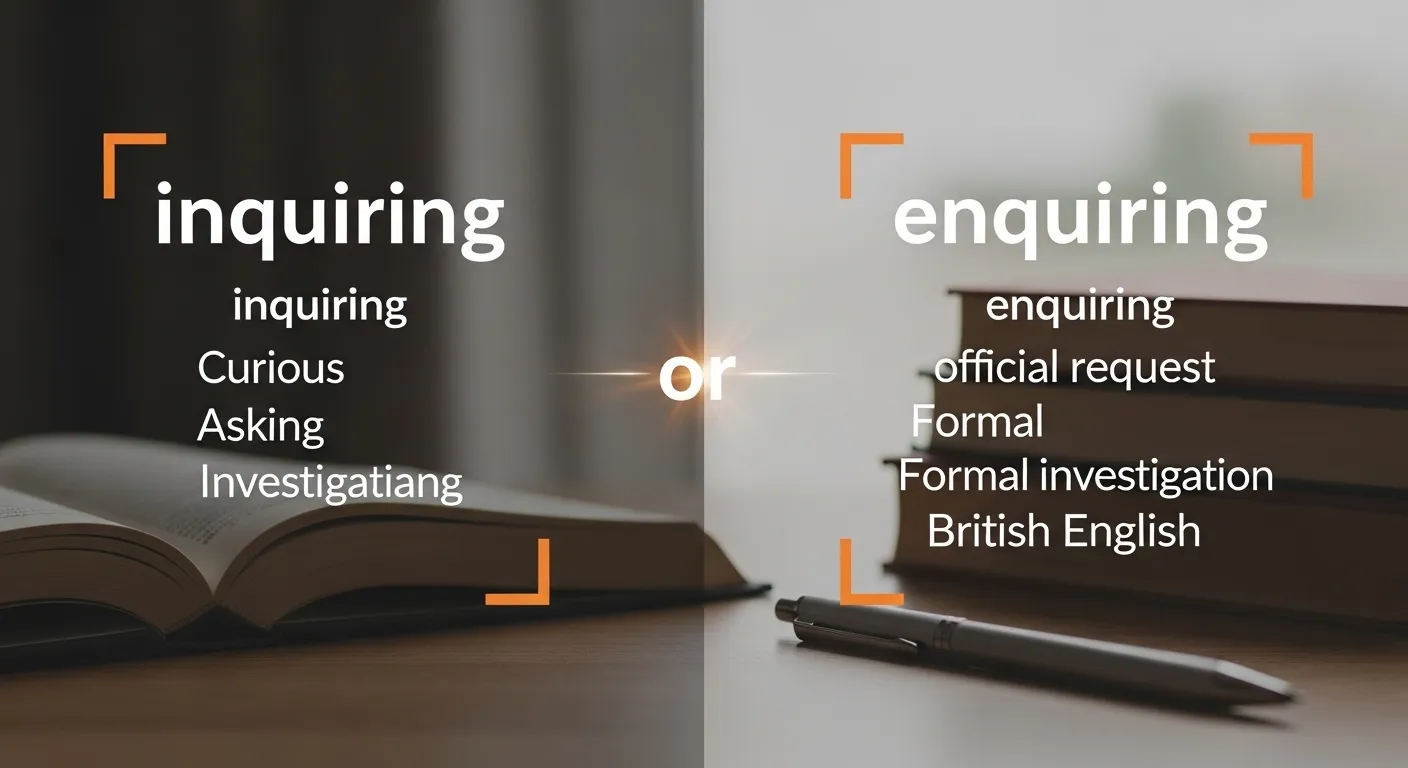
Many English learners often get confused between “inquiring” and “enquiring.” Both look correct and both mean the same thing to ask or seek information. But the real confusion is not meaning, it’s which spelling you should use in writing.
The simple truth is: both are correct, but used in different English styles. “Inquiring” is American English, while “enquiring” is British English.
In this guide, you will quickly understand the difference, when to use each form, and how to avoid mistakes in real writing.
Inquiring or Enquiring – Quick Answer
Both inquiring and enquiring are correct, and they mean the same thing: to ask or seek information.
- Inquiring → American English (preferred in the US)
- Enquiring → British English (preferred in the UK, Australia, and Commonwealth countries)
Simple Examples
- US English: She is inquiring about the job opening.
- UK English: She is enquiring about the job opening.
Key Point
The difference is only spelling, not meaning. Both are used in formal and informal writing depending on region.
The Origin of Inquiring and Enquiring
The word comes from the Latin root “inquirere”, which means to seek or search into.
- “in-” = into
- “quaerere” = to ask or seek
In Old French, the word became “enquerre”, which influenced British English spelling as “enquire.”
Over time, English split into two major spelling systems:
- American English simplified many spellings (inquiring)
- British English kept older forms (enquiring)
This is why both versions exist today. The meaning stayed the same, but spelling evolved differently across regions.
British English vs American English Spelling
The difference between inquiring and enquiring follows the general rule of spelling variation between UK and US English.
Key Differences
| Feature | Inquiring (American) | Enquiring (British) |
| Region | USA | UK, Australia, India, Pakistan |
| Usage | Modern American writing | Traditional British writing |
| Meaning | To ask or investigate | To ask or investigate |
| Formality | Standard in US media | Standard in UK media |
| Example | She is inquiring about prices | She is enquiring about prices |
Other Similar Word Patterns
- enquire → inquire
- enquiry → inquiry
- enquiring → inquiring
- enquired → inquired
Which Spelling Should You Use?
Choosing between inquiring and enquiring depends on your audience.
Use “Inquiring” if:
- You are writing for American readers
- Your website targets the US market
- You are following AP Style (US journalism)
- You are using modern SEO tools focused on US traffic
Use “Enquiring” if:
- You are writing for UK readers
- Your audience is in Commonwealth countries (UK, Australia, India, Pakistan)
- You are following British academic writing rules
- You are writing formal British English content
Global SEO Tip
If your audience is global, you can:
- Use “inquiring” (more widely indexed in US search engines)
- OR choose one form and stay consistent throughout your content
Common Mistakes with Enquiring or Inquiring
Many writers make small but important errors with this keyword.
1. Mixing both spellings in one article
❌ She is inquiring and enquiring about the issue.
✔ She is inquiring about the issue. (US)
✔ She is enquiring about the issue. (UK)
2. Thinking they have different meanings
❌ Inquiring = formal, Enquiring = informal
✔ Both have the same meaning.
3. Using both in SEO content
❌ Switching between both in one blog
✔ Stick to one spelling for better SEO ranking
4. Wrong noun form confusion
- enquiry (UK) vs inquiry (US)
Enquiring and Inquiring in Everyday Examples
1. Email Example
- US English:
“I am inquiring about your service packages.” - UK English:
“I am enquiring about your service packages.”
2. News Writing
- The journalist is inquiring into the case (US)
- The journalist is enquiring into the case (UK)
3. Social Media
- “Just inquiring if anyone has updates on the event.”
- “Just enquiring about ticket availability.”
4. Business Communication
- US: Clients are inquiring about pricing plans.
- UK: Clients are enquiring about pricing plans.
Enquiring vs Inquiring – Google Trends & Usage Data
Search behavior shows clear regional patterns:
- United States: “inquiring” dominates search results
- United Kingdom: “enquiring” is more common
- India, Pakistan, Australia: Mixed usage, but British spelling is more accepted in formal writing
SEO Insight
- “inquiring” has higher global search volume due to US dominance in web content
- “enquiring” is still widely used in academic and government documents in Commonwealth countries
What this means for writers
If your goal is SEO traffic:
- Use inquiring for global reach
- Use enquiring for regional targeting
Comparison Table: Inquiring vs Enquiring
| Word Type | American English | British English |
| Verb | inquiring | enquiring |
| Noun | inquiry | enquiry |
| Past tense | inquired | enquired |
| Example | I am inquiring about it | I am enquiring about it |
FAQs
1. Are inquiring and enquiring the same?
Yes, both have the same meaning. Only spelling differs by region.
2. Which is correct: inquiry or enquiry?
Both are correct. “Inquiry” is American English, “enquiry” is British English.
3. Can I use both in one article?
No, it is better to choose one spelling style for consistency.
4. Which spelling is more popular online?
“Inquiring” is more common globally due to American content dominance.
5. Is enquiring wrong in American English?
No, but it is considered non-standard in US writing.
6. What is the verb form of enquiry/inquiry?
The verb forms are enquire/inquire and enquiring/inquiring.
7. Which should I use for SEO content?
Use inquiring for global SEO unless targeting UK readers specifically.
Conclusion
The confusion between inquiring and enquiring is common, but the rule is simple: both are correct and mean to ask or seek information. The only difference is regional spelling.
American English uses inquiring, while British English uses enquiring. This difference is part of broader English spelling variations.
For global writing, consistency is key. Choose one form and use it throughout your content based on your audience.
Understanding this small detail helps you write more clearly, avoid mistakes, and improve professional and SEO writing quality.
Learn More About:
Employees or Employee’s: Which One Is Correct?
Handle or Handel: Which One Is Right And Wrong (2026)

I’m a U.S. based content writer and language researcher with a strong focus on English grammar, spelling differences, and frequently confused terms. My writing is aimed at helping readers write more clearly and correctly in daily use, workplace communication, and digital content.