Many confuse “assent” and “ascent” because they sound the same.
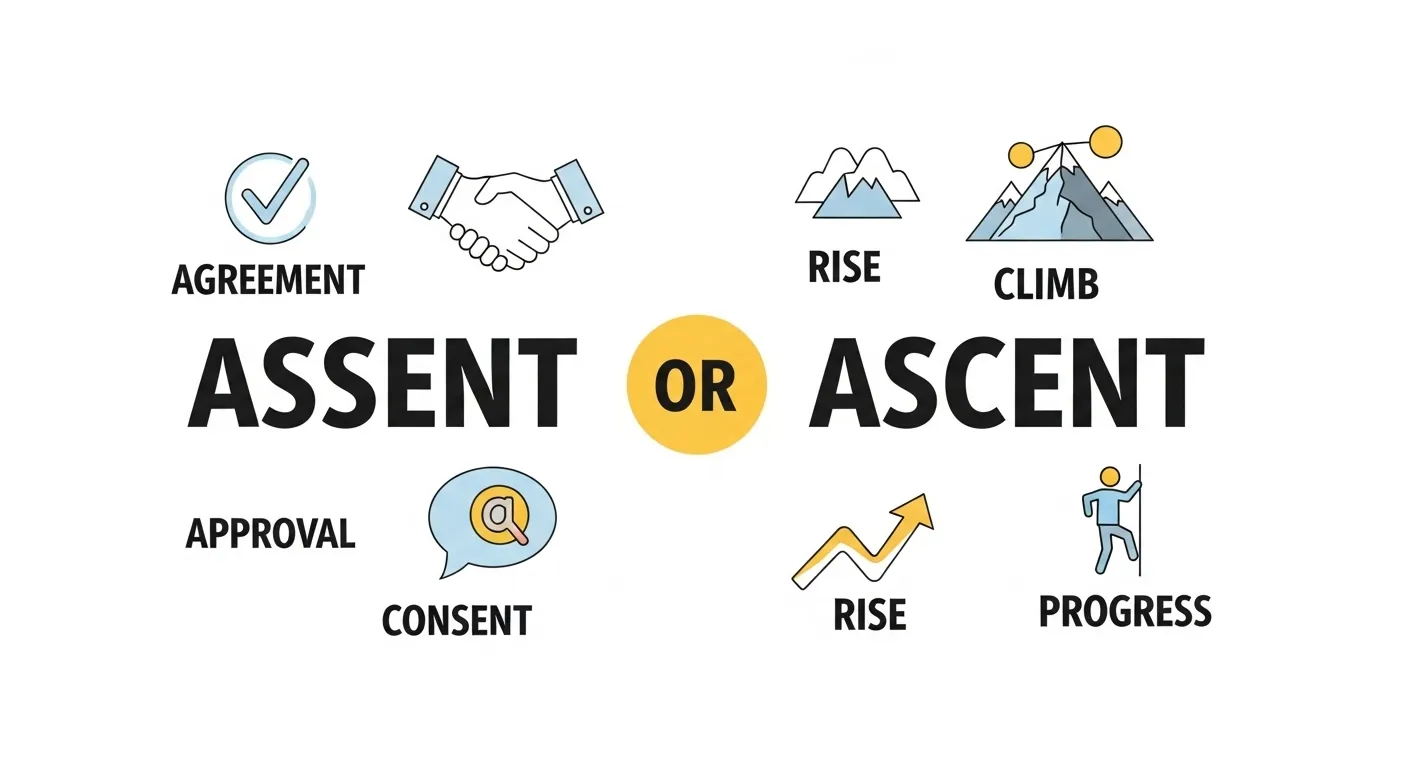
Assent means agreement, while ascent means rising or climbing. Using the wrong word can change your sentence’s meaning like saying “He gave his ascent to the plan” instead of “assent.”
This guide quickly explains the difference, with examples, tips, and easy rules to always use the right word.
Assent or Ascent – Quick Answer
Assent (noun/verb): Agreement or approval.
- Example (noun): She nodded in assent to the proposal.
- Example (verb): He assented to the new rules.
Ascent (noun): The act of rising, climbing, or moving upward.
- Example: The climbers began their ascent of the mountain.
Quick Tip:
- If you mean agree, use assent.
- If you mean go up or climb, use ascent.
The Origin of Assent and Ascent
Assent comes from Latin assentire, meaning “to agree” or “to approve.” It entered Middle English in the 14th century with a legal and formal usage.
Ascent comes from Latin ascendere, meaning “to climb.” It entered English in the late 14th century, mainly describing physical or metaphorical rising.
Although both words sound identical, their roots differ completely—one is about agreement, the other about elevation.
British English vs American English Spelling
Both assent and ascent are spelled the same in British and American English. There is no variation in spelling between regions.
| Word | Meaning | British Spelling | American Spelling | Notes |
| Assent | Agreement, approval | assent | assent | Formal or legal contexts |
| Ascent | Rising, climbing | ascent | ascent | Can be literal or metaphorical |
✅ Tip: The confusion is not about spelling; it’s about meaning.
Which Spelling Should You Use?
- United States: Use standard assent or ascent, following meaning.
- United Kingdom / Commonwealth: Same as above.
- Global English: Stick with standard spelling. Focus on meaning to avoid mistakes.
Pro Advice: Context matters more than geography. If unsure, check if your sentence is about agreement or rising.
Common Mistakes with Ascent or Assent
- Incorrect: He gave his ascent to the idea.
Correct: He gave his assent to the idea. - Incorrect: The balloon’s assent was slow.
Correct: The balloon’s ascent was slow. - Mixing metaphorical and literal meanings:
- Incorrect: She showed ascent to the plan.
- Correct: She showed assent to the plan.
Tip: Always substitute synonyms mentally:
- Assent → agreement, approval
- Ascent → climb, rise, upward movement
Assent or Ascent in Everyday Examples
Emails & Business Writing:
- Correct: Please confirm your assent to the terms by Friday.
- Wrong: Please confirm your ascent to the terms by Friday.
News Articles:
- Correct: The politician’s assent to the bill was widely reported.
- Correct: The plane’s ascent was delayed due to weather.
Social Media Posts:
- Correct: Feeling proud of my ascent to team leader!
- Correct: I gave my assent to the group decision.
Formal Writing:
- Correct: The committee’s assent is required before implementation.
- Correct: The hiker’s ascent up the ridge took four hours.
Ascent vs Assent – Google Trends & Usage Data
Data from Google Trends shows:
- “Assent” spikes in legal, academic, and business contexts.
- “Ascent” spikes in mountaineering, aviation, and motivational contexts.
Top countries searching for assent: US, UK, Canada.
Top countries searching for ascent: US, UK, Australia.
Insight: Search volume is not equal—people confuse the words but need precise definitions.
Assent vs Ascent – Comparison Table
| Word | Meaning | Example Sentence | Usage Context |
| Assent | Agreement, approval | She nodded in assent. | Legal, business, formal |
| Ascent | Rising, climbing | The climbers began their ascent. | Physical, metaphorical |
FAQs
1. Can “assent” and “ascent” be used interchangeably?
No, they have completely different meanings. Using one for the other is incorrect.
2. Is there a difference in British vs American spelling?
No, both words are spelled the same in all English-speaking regions.
3. Which one is used in formal writing?
Both can appear, but assent is more common in legal and academic writing, ascent in descriptive or technical contexts.
4. Can “ascent” refer to career progress?
Yes. Metaphorical use includes promotions or personal growth.
5. Is “assent” always a noun?
No, it can be a verb: He assented to the proposal.
6. How do I remember the difference?
Think: assent → agree, ascent → up.
7. Are there synonyms to avoid confusion?
Yes. Assent → approval, agreement. Ascent → rise, climb, escalation.
Q8: What is the difference between assent and ascent?
Assent means agreement or approval, while ascent means rising, climbing, or moving upward.
Conclusion
Confusing assent and ascent is common but easy to fix.
Remember: assent is about agreement, while ascent is about rising or climbing.
Context is key. Legal documents, emails, and formal writing require precise assent, whereas descriptions of mountains, planes, or metaphors for progress call for ascent.
British, American, and global English spell both words the same so meaning, not spelling, determines correctness. Using synonyms mentally or reading the sentence aloud can prevent errors.
With practice, you’ll confidently select the right word every time, making your writing clear, professional, and accurate.
Discover More About:
Analyses or Analysis: Using These Words Correctly
Handle or Handel: Which One Is Right And Wrong (2026)