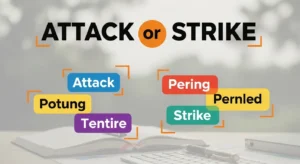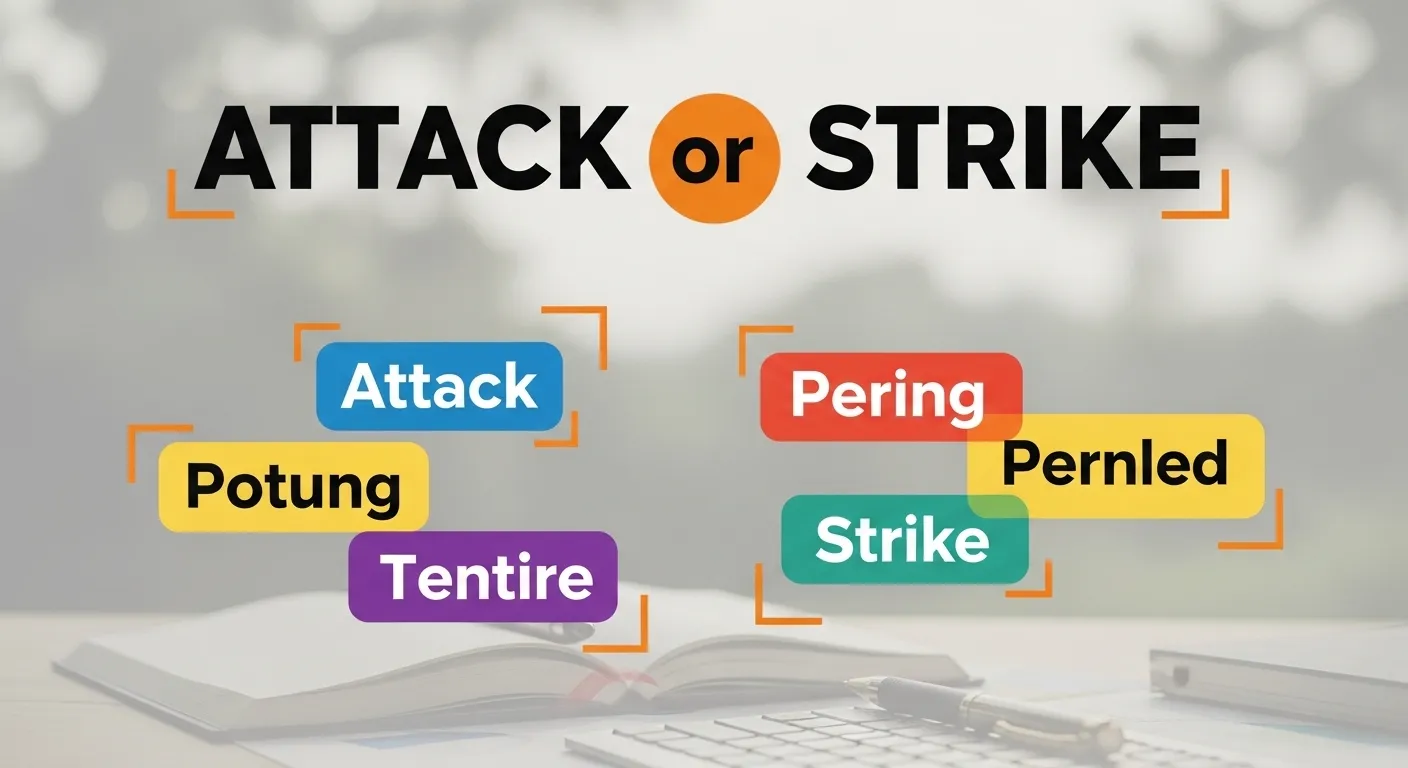
Many people search for “attack or strike” because the words seem similar but mean different things. They appear in news, sports, and daily talk, which creates confusion.
Should it be “missile attack” or “air strike”? Do you “attack” the ball or “strike” it? Small choices like these can change meaning and tone.
This guide makes it simple. You’ll learn the clear difference, with easy examples, so you can use the right word every time.
Attack or Strike – Quick Answer
Attack and strike are related but not identical.
- Attack = a direct act of aggression or harm
- Strike = a hit, action, or targeted blow (can be physical or planned)
Simple Examples:
- Military action → Attack
Example: The army launched an attack. - Targeted operation → Strike
Example: The air force carried out a strike. - Sports action → Strike
Example: He struck the ball hard. - Personal aggression → Attack
Example: The dog attacked the man.
👉 Key Idea:
“Attack” is broader and more emotional. “Strike” is more precise and controlled.
The Origin of Attack or Strike
The Word “Attack”
“Attack” comes from the French word attaquer, meaning “to seize” or “to assault.” It entered English in the 17th century.
Historically, it has been linked to:
- War and violence
- Sudden aggression
- Direct harm or force
Over time, it also gained metaphorical meanings, like:
- Attack a problem
- Attack an idea
The Word “Strike”
“Strike” comes from Old English strīcan, meaning “to hit” or “to move swiftly.” It is much older than “attack.”
It developed many meanings, including:
- To hit something
- To remove (strike out)
- Worker protest (labor strike)
- Military precision action
Why the Difference Exists
The difference exists because:
- “Attack” evolved as a general word for aggression
- “Strike” evolved as a specific word for hitting or targeted action
This is why “strike” often sounds more technical or controlled.
British English vs American English Spelling
Good news:
There is no spelling difference between British and American English.
Both use:
- Attack ✅
- Strike ✅
Style Differences
- American English: prefers “attack” in headlines for impact
- British English: often uses “strike” in formal or military contexts
Comparison Table
| Aspect | Attack | Strike |
| Spelling (US/UK) | Same | Same |
| Tone | Strong, emotional | Precise, controlled |
| Use in News | Dramatic headlines | Technical reporting |
| Scope | Broad | Specific |
Which Spelling Should You Use?
Spelling is the same, but word choice matters.
Use “Attack” when:
- You mean general aggression
- The tone is emotional or strong
- The action is broad or unclear
Examples:
- The city was under attack.
- He attacked his opponent verbally.
Use “Strike” when:
- You mean a targeted or precise action
- The context is military, sports, or technical
- You want a neutral tone
Examples:
- The military launched a strike.
- She struck the ball perfectly.
Audience-Based Advice
- US audience: “attack” is more common in media
- UK/Commonwealth: “strike” is often used in formal contexts
- Global audience: “strike” is safer in professional writing
👉 Pro Tip:
Use “attack” for emotion. Use “strike” for precision.
Common Mistakes with Strike or Attack
1. Using “Attack” in Sports ❌
- Wrong: He attacked the ball.
- Correct: He struck the ball.
2. Using “Strike” for General Violence ❌
- Wrong: The dog struck the man.
- Correct: The dog attacked the man.
3. Mixing Tone in News ❌
- Wrong: The army attacked a precise target strike.
- Correct: The army carried out a precise strike.
4. Overusing One Word ❌
Repeating “attack” or “strike” makes writing weak.
👉 Use both correctly based on context.
Attack or Strike in Everyday Examples
1. In Emails
- We need to address this issue before it becomes an attack on our system.
- The company faced a cyber strike.
2. In News
- The country suffered a major attack.
- The military launched an air strike.
3. On Social Media
- Stop personal attacks online.
- Lightning struck the building!
4. In Formal Writing
- The report analyzes cyber attacks.
- The study examines strategic strikes.
5. In Daily Life
- The cat attacked the toy.
- He struck the table in anger.
Strike vs Attack – Google Trends & Usage Data
Search behavior shows clear patterns.
Popularity by Context:
- Attack
- Common in news and daily speech
- Used in cybersecurity (cyber attack)
- Emotional and broad
- Strike
- Used in military reports
- Popular in sports and labor topics
- More precise
Popularity by Region:
- United States: “attack” is searched more
- UK & Europe: “strike” appears more in formal contexts
- Global: both are widely used but in different situations
Why This Matters
Choosing the right word improves:
- SEO ranking
- Content clarity
- Reader trust
Comparison Table: Attack vs Strike
| Feature | Attack | Strike |
| Meaning | Act of aggression | Targeted hit or action |
| Tone | Emotional, strong | Neutral, precise |
| Usage | General, wide | Specific contexts |
| Context | Violence, criticism | Military, sports, labor |
| Example | Cyber attack | Air strike |
| Flexibility | High | Moderate |
FAQs
1. Are attack and strike the same?
No. “Attack” is broader, while “strike” is more specific and precise.
2. Which word is stronger?
“Attack” sounds more emotional and aggressive.
3. Can strike mean attack?
Sometimes, yes. But “strike” usually suggests a planned or targeted action.
4. Which word is better for news writing?
It depends:
- Use “attack” for impact
- Use “strike” for precision
5. Can I use strike in daily conversation?
Yes, especially in sports or physical actions.
6. What is a cyber attack vs cyber strike?
“Cyber attack” is common. “Cyber strike” is less used and more technical.
7. Which is better for SEO?
Use both based on context:
- “Attack” for general topics
- “Strike” for niche or technical topics
Conclusion
“Attack” and “strike” both show action, but they are not the same. “Attack” is broad and emotional, while “strike” is precise and controlled.
Use “attack” for strong impact. Use “strike” for accuracy and a professional tone. Choosing the right word makes your writing clear, sharp, and effective.
Discover More About:
Strait or Straight: Meaning, Differences, and Uses (2026)
Rain or Rein: Simple Difference with Easy Examples

I’m a U.S. based content writer and language researcher with a strong focus on English grammar, spelling differences, and frequently confused terms. My writing is aimed at helping readers write more clearly and correctly in daily use, workplace communication, and digital content.