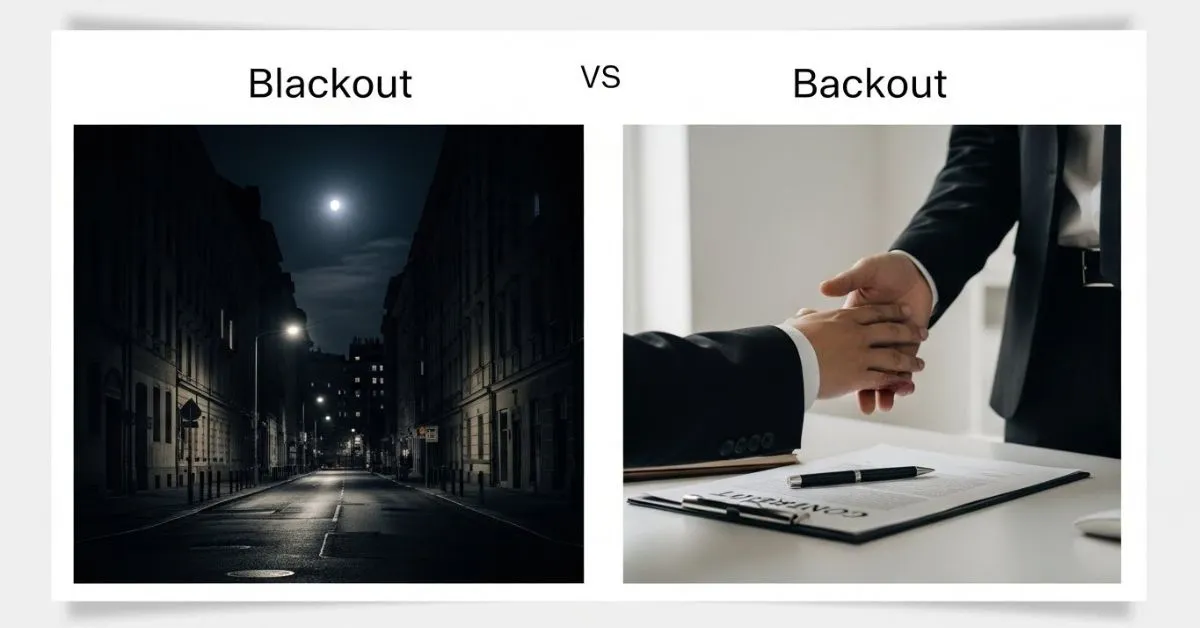
Have you ever searched blackout or backout into Google?
The problem exists because both words look similar, sound alike in conversation, and are real English terms but their meanings are completely different.
A small mistake can change the meaning of a sentence, especially in emails, contracts, news articles, or professional writing.
For example, a company can back out of a deal, but it cannot blackout from a deal. On the other hand, a citywide blackout refers to a loss of power, not a broken promise.
People search for blackout or backout because they want a quick, reliable answer and a clear explanation they can trust.
This article explains the difference, correct usage, common mistakes, and whether British or American English affects these words, so you can use them confidently every time.
Blackout or Backout – Quick Answer
Blackout and backout are both correct English words, but they have different meanings and uses.
- Blackout means a loss of power, loss of memory, or intentional hiding of information.
Example: The city faced a blackout after the storm. - Backout means to withdraw from a promise, deal, or agreement.
Example: He decided to back out of the contract.
They are not interchangeable. Using the wrong word can confuse readers or change your message completely.
The Origin of Blackout or Backout
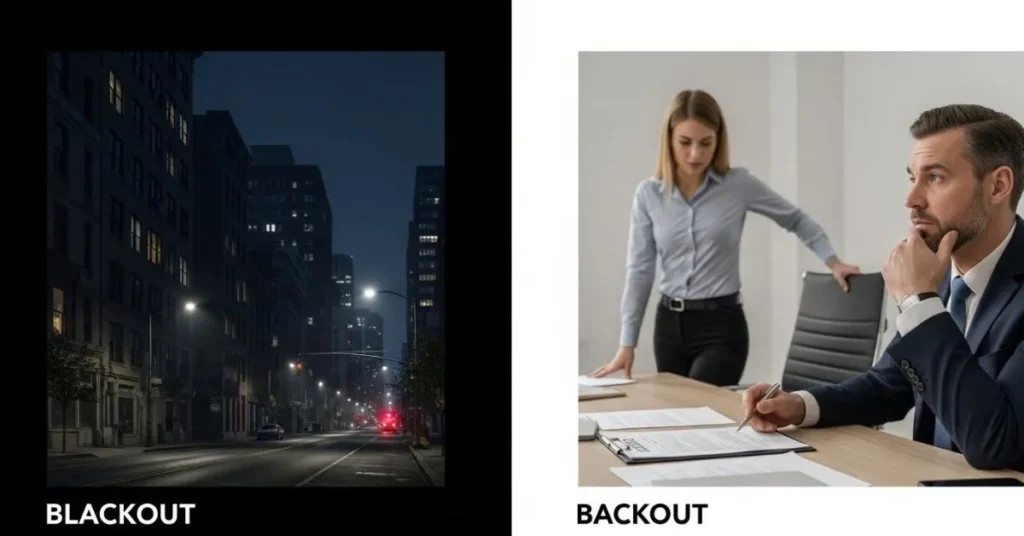
Origin of Blackout
The word blackout comes from the combination of black and out. It became widely used in the early 20th century, especially during wartime. Cities would turn off lights to avoid enemy detection, which was called a blackout. Over time, the meaning expanded to include power failures, memory loss, and censorship.
Origin of Backout
Backout comes from the verb phrase back out, meaning to move backward or withdraw. By the late 1800s, it was commonly used to describe someone withdrawing from a commitment, promise, or plan.
Why the Confusion Exists
The confusion exists because:
- Both words end with -out
- They sound similar when spoken quickly
- Both are used as verbs and nouns
- Autocorrect does not always catch the mistake
Find More About:
Boxes or Boxs: Which Spelling Is Correct?
Faint or Feint? Difference, and Correct Use (2026)
British English vs American English Spelling
Good news: there is no spelling difference between British and American English for blackout or backout. Both variants use the same spelling and meaning.
What differs is context and frequency, not spelling.
Comparison Table: British vs American English
| Word | British English Usage | American English Usage | Meaning |
| Blackout | ✔ Common | ✔ Common | Power loss, memory loss, censorship |
| Backout | ✔ Common | ✔ Common | Withdraw from a deal or promise |
Both words are standard across all major English-speaking regions.
Which Spelling Should You Use?
The correct choice depends on what you want to say, not where you live.
For US Audiences
- Use blackout for power failures, memory loss, or blocked information
- Use backout for contracts, plans, or promises
For UK and Commonwealth Audiences
- The same rules apply
- There are no regional spelling differences
For Global or Professional Writing
- Always choose based on meaning
- Double-check business and legal writing carefully
- Never assume they are interchangeable
Tip: If you mean electricity or memory, use blackout.
If you mean withdrawal or refusal, use backout.
Common Mistakes with Blackout or Backout
Here are the most frequent errors people make:
- ❌ He blacked out of the deal.
✅ He backed out of the deal. - ❌ The city backed out last night due to storms.
✅ The city had a blackout last night. - ❌ She had a back out after the accident.
✅ She had a blackout after the accident. - ❌ The company announced a back out of information.
✅ The company announced a blackout of information.
These mistakes often happen in fast typing, non-native writing, or informal communication.
Blackout or Backout in Everyday Examples
Emails
- There was a blackout in our area, so the meeting was delayed.
- I may need to back out of the project due to health reasons.
News
- A major blackout affected three cities last night.
- The investor decided to back out at the last moment.
Social Media
- Power blackout again 😩
- Thinking of backing out of this plan.
Formal Writing
- The report mentions a temporary information blackout.
- The client backed out before signing the agreement.
Blackout or Backout – Google Trends & Usage Data
Search data shows that blackout is searched more often globally. This is because it is used in:
- News reporting
- Power outages
- Health topics
- Internet censorship
Backout has lower search volume but high importance in:
- Business
- Legal writing
- Contracts
- Negotiations
Usage by Region
- Blackout is highly searched in the US, UK, India, and Europe
- Backout is commonly searched in business-focused regions
People often search blackout or backout together because they want to avoid embarrassing mistakes in professional writing.
Comparison Table: Blackout vs Backout
| Feature | Blackout | Backout |
| Part of Speech | Noun / Verb | Verb |
| Main Meaning | Power loss, memory loss | Withdraw from agreement |
| Business Use | Limited | Very common |
| Emotional Impact | Often serious | Often deliberate |
| Interchangeable? | ❌ No | ❌ No |
FAQs:
1. Are blackout and backout interchangeable?
No. They have completely different meanings and should never replace each other.
2. Is backout one word or two words?
Both forms exist. Back out is the verb phrase, while backout is often used as a noun or informal verb.
3. Can blackout be used as a verb?
Yes. Example: He blacked out during the speech.
4. Is blackout always related to electricity?
No. It can also mean memory loss or information suppression.
5. Is backout formal or informal?
It is acceptable in formal writing, especially in business and legal contexts.
6. Does British English prefer one over the other?
No. Both words are used the same way in British and American English.
7. Why do people confuse blackout or backout?
Because of similar spelling, pronunciation, and shared use of “out.”
Conclusion:
The confusion between blackout and backout is common, but their meanings are very different.
Blackout refers to a loss of power, memory, or information, while backout means withdrawing from a promise or agreement.
There is no difference in British or American English usage only context matters. Choosing the correct word makes your writing clearer, more professional, and easier to understand.