The confusion between continuous or continual is common in English. Many think they mean the same, but they don’t.
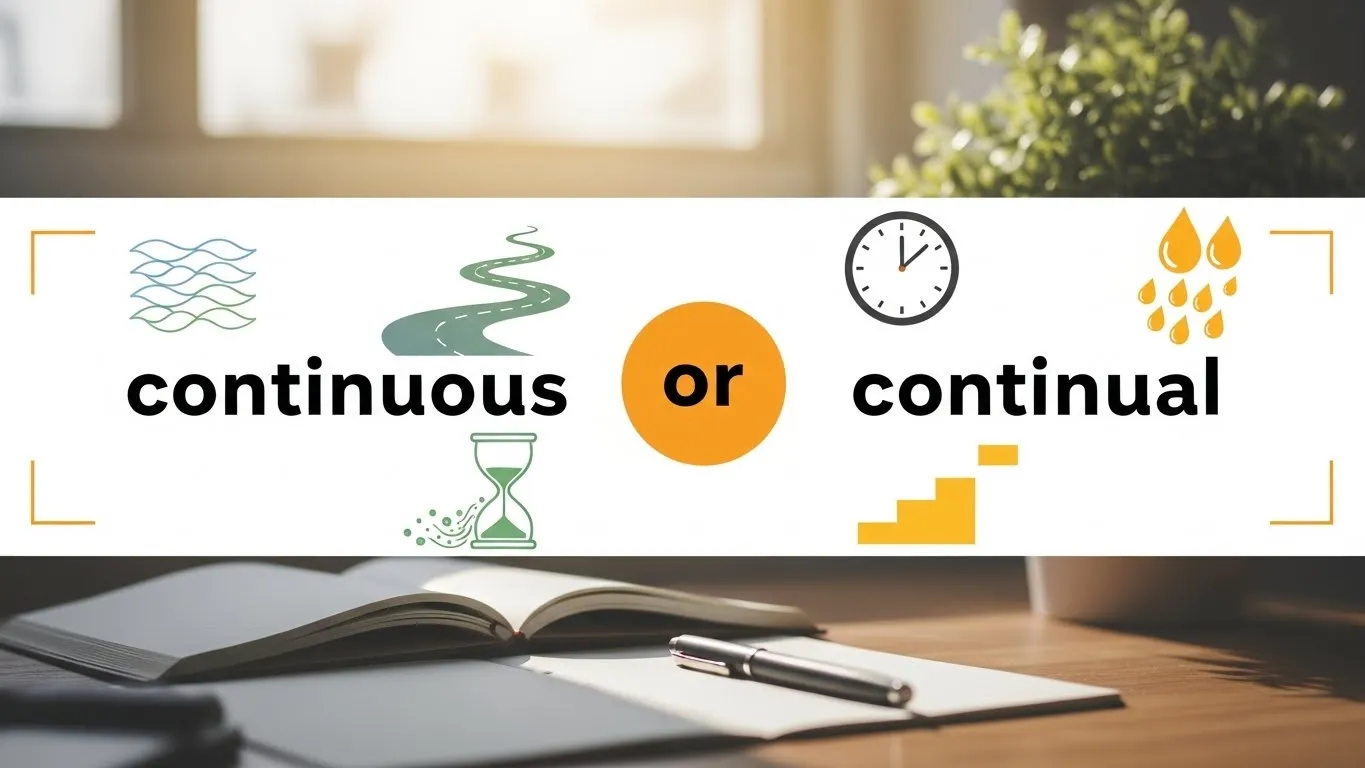
Continuous means nonstop, while continual means repeated with breaks. Using the wrong one can change your sentence’s meaning or make your writing unclear.
People search for continuous or continual to get quick, reliable answers: Is the rain continuous or continual? Is noise continuous or continual?
This guide gives simple explanations, clear examples, common mistakes, and tips for using each word correctly.
By the end, you’ll confidently know which word to choose every time.
Continuous or Continual – Quick Answer
Continuous means something happens without stopping.
Continual means something happens repeatedly, with breaks in between.
Simple examples:
- Continuous:
- The machine made a continuous noise for three hours.
- She worked continuously without a break.
- Continual:
- He received continual emails throughout the day.
- The office faced continual interruptions.
👉 Memory tip:
- Continuous = nonstop
- Continual = repeated, but not nonstop
The Origin of Continuous or Continual
Both continuous and continual come from Latin, which explains why they look and sound similar.
Continuous
- Origin: Latin continuus
- Meaning: “holding together” or “unbroken”
- Entered English in the 17th century
- Always referred to something without interruption
Continual
- Origin: Latin continualis
- Meaning: “occurring repeatedly”
- Also entered English in the 17th century
- Focused on frequency, not duration
Over time, English speakers blurred the distinction in casual speech. However, formal English, academic writing, and professional communication still preserve the difference.
There is no spelling difference based on region. The confusion exists because of meaning, not spelling.
British English vs American English Spelling
Unlike words such as colour/color or finalise/finalize, continuous and continual are spelled the same in both British and American English.
The difference is usage, not spelling.
Comparison Table: British vs American Usage
| Aspect | British English | American English |
| Spelling | Continuous / Continual | Continuous / Continual |
| Meaning rules | Strictly followed | Strictly followed |
| Casual mixing | Common in speech | Common in speech |
| Formal writing | Difference preserved | Difference preserved |
✅ Both UK and US writers:
- Use continuous for nonstop actions
- Use continual for repeated actions
Which Spelling Should You Use?
The choice between continuous or continual depends on meaning, not audience but audience still matters.
If your audience is American (US)
- Follow strict definitions in professional writing
- Casual writing may blur the line, but clarity matters
If your audience is British or Commonwealth (UK, Canada, Australia)
- The distinction is strongly expected
- Incorrect use can feel sloppy or uneducated
If your audience is global
- Always use the correct word
- Clear meaning improves SEO, readability, and trust
👉 Best practice:
If something never stops → continuous
If something keeps happening again → continual
Common Mistakes with Continuous or Continual
Many writers make the same errors. Here are the most frequent ones and how to fix them.
❌ Mistake 1: Using continual for nonstop actions
- ❌ The engine ran with continual noise.
- ✅ The engine ran with continuous noise.
❌ Mistake 2: Using continuous for repeated events
- ❌ She faced continuous complaints every week.
- ✅ She faced continual complaints every week.
❌ Mistake 3: Assuming they are always interchangeable
- While acceptable in casual speech, it weakens professional writing.
❌ Mistake 4: Overusing continuous in reports
- Many writers default to “continuous” because it sounds stronger.
- Precision matters more than strength.
Continuous or Continual in Everyday Examples
Emails
- Continuous:
- “We experienced continuous server downtime last night.”
- Continual:
- “We’ve had continual scheduling issues this month.”
News Writing
- Continuous:
- “The region faced continuous rainfall for 48 hours.”
- Continual:
- “The minister faced continual criticism from opposition parties.”
Social Media
- Continuous:
- “This song plays in continuous loop 🎧”
- Continual:
- “These app notifications are continual 😩”
Academic & Formal Writing
- Continuous:
- “The experiment required continuous observation.”
- Continual:
- “The policy faced continual revisions.”
Continuous or Continual – Google Trends & Usage Data
Search data shows that:
- “Continuous” is searched more often
- “Continual” is searched less, but spikes during grammar-related queries
Why this happens:
- Continuous is more common in:
- Technology
- Engineering
- Science
- Manufacturing
- Continual appears more in:
- News
- Complaints
- Social issues
- Human behavior topics
Regional trends:
- US & UK: Similar usage patterns
- ESL countries: Higher confusion rates
- SEO blogs & grammar sites: Strong interest in clarification
👉 This confirms that users want clarity, not just definitions.
Comparison Table: Continuous vs Continual
| Feature | Continuous | Continual |
| Meaning | Without stopping | Repeated with breaks |
| Time pattern | Unbroken | Frequent interruptions |
| Common contexts | Machines, rain, work | Complaints, emails, problems |
| Formal tone | Yes | Yes |
| Casual interchange | Sometimes | Sometimes |
| Correct in reports | Yes | Yes (when accurate) |
FAQs:
1. Are continuous and continual the same?
No. Continuous means nonstop. Continual means repeated with breaks.
2. Can I use continuous instead of continual?
Only in informal speech. In formal writing, it can be incorrect.
3. Is continual always negative?
No, but it often describes annoying or repeated events.
4. Which word sounds more professional?
Both are professional when used correctly.
5. Is there a spelling difference between US and UK?
No. The spelling is the same in both.
6. Can rain be continual?
Yes, if it stops and starts. If it never stops, it is continuous.
7. Which word is better for SEO writing?
Use the correct word based on meaning. Accuracy improves trust and ranking.
Conclusion:
The difference between continuous and continual is small but important.
Continuous means nonstop; continual means repeated over time. Using the right word makes your writing clear, professional, and easy to understand.
This rule works in emails, reports, news, and SEO content.
Both British and American English follow it, so clarity matters for all readers.
Once you get it, you’ll write with confidence and precision every time.
Find More About:
Employees or Employee’s: Which One Is Correct?
Ves or Vez: The Correct Spelling Rule (2026)