Many people search “dual or duel” because the words sound the same but have different meanings.
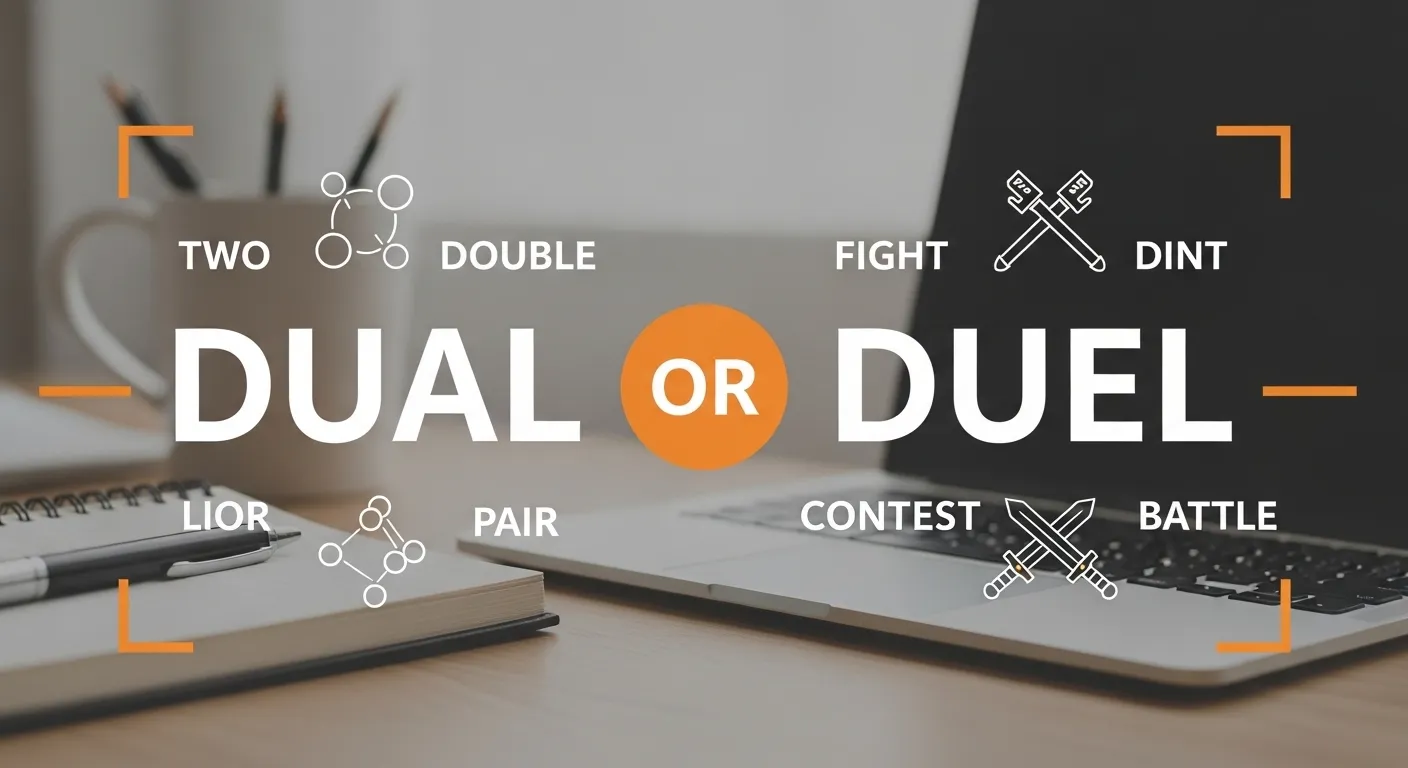
Dual means two or double, while duel means a fight between two people.
For example, dual cameras means two cameras, but a duel is a battle.
This guide explains the difference so you can use the correct word every time.
Dual or Duel – Quick Answer
The difference between dual and duel is simple once you know their meanings.
| Word | Meaning | Example |
| Dual | Something that has two parts or works in pairs | The phone has dual speakers. |
| Duel | A fight between two people, usually with weapons | The knights fought a duel. |
Dual
Dual means two, double, or having two parts.
Examples:
- She has dual citizenship in Canada and the UK.
- The laptop has dual screens.
- The company runs dual marketing campaigns.
Duel
Duel refers to a formal fight between two people, often in history or fiction.
Examples:
- The two rivals agreed to a duel at sunrise.
- The movie ended with a dramatic duel.
- In the past, nobles sometimes settled arguments with a duel.
Simple Trick to Remember
- Dual = Double (two)
- Duel = Fight
If your sentence talks about two things, use dual.
If it talks about a fight between two people, use duel.
The Origin of Dual or Duel
Understanding the history of these words makes their meanings easier to remember.
Origin of Dual
The word dual comes from the Latin word “dualis.”
The Latin root “duo” means two.
Over time, the word entered English through French and kept the same idea: something made of two parts.
Examples that developed from this root include:
- Dual system
- Dual identity
- Dual purpose
Today, the word appears in technology, law, politics, and everyday speech.
For example:
- Dual cameras in smartphones
- Dual monitors for computers
- Dual nationality
The meaning has remained consistent for centuries: two parts working together.
Origin of Duel
The word duel has a very different history.
It comes from the Latin word “duellum,” which originally meant war or combat.
Later, it evolved into the French word “duel,” meaning a fight between two people. The concept became popular in Europe during the Middle Ages and Renaissance.
In the past, nobles sometimes settled insults or disputes with formal duels using swords or pistols.
These fights followed strict rules and were often witnessed by others.
Famous historical duels include political disputes, military rivalries, and personal honor battles.
Today, duels rarely happen in real life. Instead, the word is used in:
- Movies
- Books
- Video games
- Historical discussions
British English vs American English Spelling
Unlike many English words, dual and duel have the same spelling in both British and American English. There is no regional spelling difference.
However, people still confuse them because of pronunciation.
Both words sound almost identical in conversation, especially in fast speech.
Pronunciation
Both words are pronounced like:
/doo-uhl/
Because they sound the same, the correct spelling depends entirely on context.
British vs American Usage Comparison
| Word | British English | American English | Meaning |
| Dual | Dual | Dual | Two parts or double |
| Duel | Duel | Duel | A fight between two people |
As you can see, the spelling remains the same in both English varieties.
The difference is not regional, it is semantic.
Which Spelling Should You Use?
Choosing between dual or duel depends on what you want to say, not where your audience lives.
Use “Dual” When Talking About Two Things
Use dual if something has two parts, two functions, or two roles.
Examples:
- Dual monitors
- Dual citizenship
- Dual purpose tools
- Dual engines
This spelling is common in:
- Technology
- Business
- Law
- Education
Example sentence:
The new smartphone has dual cameras for better photography.
Use “Duel” When Talking About a Fight
Use duel when describing a fight between two people.
Examples:
- Sword duel
- Pistol duel
- Final duel in a movie
Example sentence:
The two warriors prepared for a dramatic duel.
Advice for Global Writers
If you write for an international audience:
- Use dual for anything related to two features or functions.
- Use duel for combat or rivalry.
Most confusion happens when people accidentally write duel instead of dual in technology articles.
Example mistake:
❌ The phone has duel cameras.
✔ The phone has dual cameras.
Common Mistakes with Duel or Dual
Because the words sound identical, many writers make small spelling mistakes.
Here are some of the most common ones.
Mistake 1
❌ The phone has duel cameras.
✔ The phone has dual cameras.
Reason: Cameras are two features, not fighters.
Mistake 2
❌ The knights prepared for a dual.
✔ The knights prepared for a duel.
Reason: Knights fight each other.
Mistake 3
❌ She has duel citizenship.
✔ She has dual citizenship.
Reason: Citizenship involves two nationalities.
Mistake 4
❌ The rivals ended their argument with a dual.
✔ The rivals ended their argument with a duel.
Simple Rule
If the sentence includes two things, choose dual.
If the sentence includes a fight, choose duel.
Dual or Duel in Everyday Examples
Understanding the words in real-life contexts helps reinforce their meanings.
Emails
Correct:
Our laptop supports dual displays for better productivity.
Incorrect:
Our laptop supports duel displays.
News Articles
Example:
The country allows dual citizenship for people born abroad.
Another example:
The film ends with an intense duel between the two heroes.
Social Media
Example tweet:
Just bought a new phone with dual cameras and amazing battery life!
Gaming example:
The final boss battle feels like an epic duel.
Professional Writing
Technology article:
The processor supports dual-core performance.
History article:
The two officers settled the dispute with a formal duel.
Duel vs Dual – Google Trends & Usage Data
Search data shows that dual is used far more often than duel in everyday writing.
This is mainly because the word appears frequently in:
- Technology
- Smartphones
- Computers
- Engineering
- Business
Common searches include:
- dual camera
- dual monitor
- dual SIM
- dual citizenship
The word duel, on the other hand, appears mostly in:
- Movies
- History
- Video games
- Fiction
Popular searches include:
- sword duel
- duel scene
- duel meaning
Geographic Usage
| Country | More Common Search |
| United States | Dual |
| United Kingdom | Dual |
| Canada | Dual |
| Australia | Dual |
| Gaming communities worldwide | Duel |
Because modern technology uses the word dual often, it dominates search trends globally.
Comparison Table: Dual vs Duel
| Feature | Dual | Duel |
| Meaning | Two parts | A fight between two people |
| Word Type | Adjective | Noun / Verb |
| Origin | Latin dualis | Latin duellum |
| Common Contexts | Technology, law, business | History, fiction, movies |
| Example | Dual cameras | Sword duel |
FAQs
1. What is the difference between dual and duel?
Dual means two or double. Duel means a fight between two people.
2. Is dual or duel correct for cameras?
Dual cameras is correct because it refers to two cameras.
3. Are dual and duel pronounced the same?
Yes. They are pronounced the same, which is why people confuse them.
4. Can duel be used as a verb?
Yes. It can mean to fight a duel.
Example:
The two rivals decided to duel.
5. Is there a British vs American difference?
No. Both dual and duel are spelled the same in British and American English.
6. What does dual citizenship mean?
Dual citizenship means a person is legally a citizen of two countries.
7. Why do people confuse dual and duel?
They are homophones, meaning they sound the same but have different meanings and spellings.
Conclusion
The confusion between dual and duel is common because both words sound the same. However, their meanings are very different.
Dual means two or double, such as dual cameras, dual monitors, or dual citizenship.
Duel means a fight between two people, often seen in history, movies, or stories.
A simple trick to remember:
Dual = Double
Duel = Fight
If your sentence talks about two things, use dual. If it describes a fight, use duel. Using the correct word makes your writing clear and professional.
Discover More About:
Analyses or Analysis: Using These Words Correctly
Handle or Handel: Which One Is Right And Wrong (2026)

I’m a U.S. based content writer and language researcher with a strong focus on English grammar, spelling differences, and frequently confused terms. My writing is aimed at helping readers write more clearly and correctly in daily use, workplace communication, and digital content.