If you’ve ever stopped mid word wondering whether to write ei or ie, you’re not alone. This tiny spelling choice causes big confusion for students, writers, bloggers, and even native English speakers.
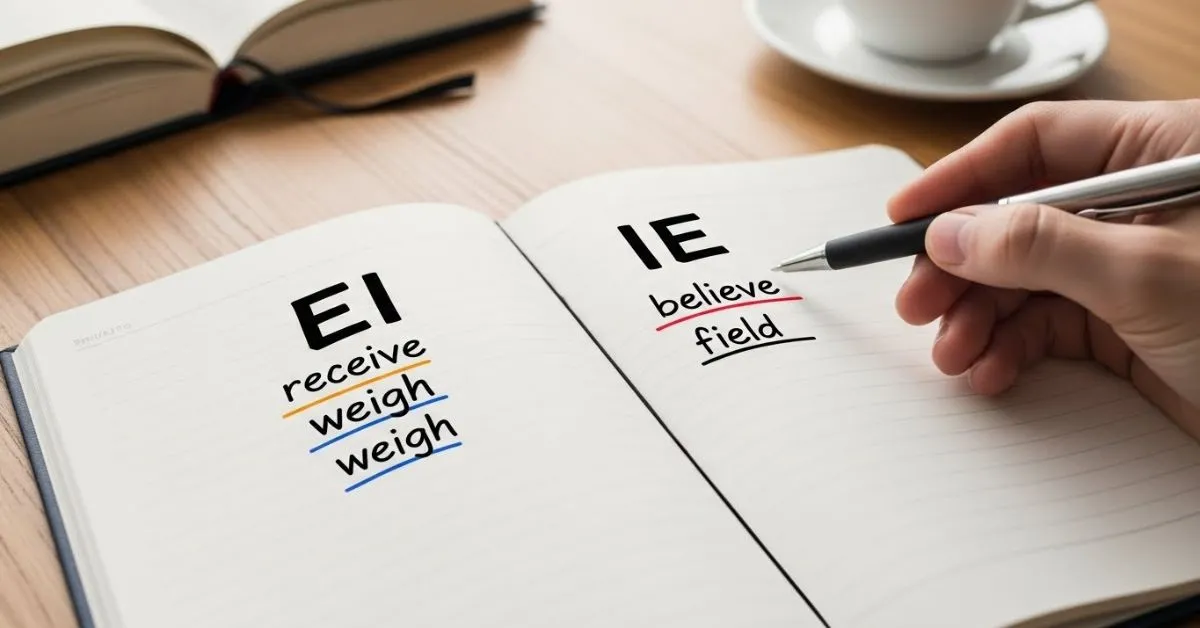
Words like receive, believe, field, and weird look similar, yet they follow different patterns. That’s exactly why so many people search for ei or ie every day.
The confusion usually starts with the famous rhyme: I before E, except after C. Sounds helpful, right? But then you see words like weird, seize, or science and the rule suddenly feels broken.
This leads to spelling mistakes in emails, exams, articles, and professional documents. This article solves that problem clearly and completely.
You’ll get a quick answer, learn where the rule came from, see how British and American English compare, and understand which spelling to use based on your audience.
We’ll also cover common mistakes, real-life examples, trends data, and FAQs all in simple language.
By the end, you won’t guess between ei or ie again. You’ll know why a word uses one spelling and how to choose the correct one with confidence.
EI or IE – Quick Answer
The basic rule is:
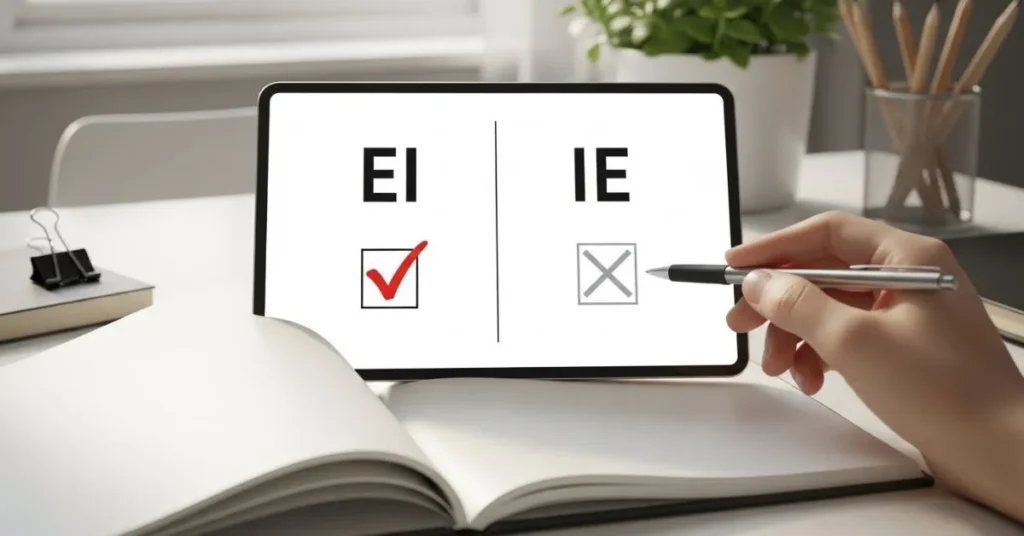
- Use IE in most words
Examples: believe, field, chief, friend - Use EI when it comes after C
Examples: receive, ceiling, deceive
there are exceptions:
Some common words break the rule, such as:
- weird
- seize
- either
- foreign
Simple examples:
- ✔ I believe you.
- ✔ I received your email.
- ❌ I recived your email. (wrong)
Short takeaway:
IE is more common. EI usually follows C but not always.
The Origin of EI or IE
The ei or ie spelling rule comes from the history of English, which borrows heavily from Latin, French, and German. These languages already had their own spelling patterns before English adopted the words.
The rhyme I before E, except after C became popular in the 19th century as a teaching aid. It was never meant to cover every word it was just a memory trick for common cases.
Why spelling differences exist:
- Latin influence: Words like receive come from Latin (recipere).
- German influence: Words like weird follow Germanic patterns.
- French influence: Many EI words entered English through French.
Over time, English kept these spellings instead of standardizing them. That’s why the rule works often, but not always.
Key point:
English spelling is historical, not logical.
Discover More About:
- Affect or Effect: Grammar Rules Explained Clearly ( 2026)
- Handle or Handel: Why One Is Right And The Other Is Wrong (2026)
British English vs American English Spelling

Good news:
EI or IE spellings are the same in both British and American English. Unlike words such as colour/color or centre/center, this rule does not change by region.
However, usage frequency can differ slightly based on vocabulary choices.
Examples used in both:
- believe (IE)
- receive (EI)
- field (IE)
- ceiling (EI)
Comparison Table
| Word | British English | American English |
| believe | believe | believe |
| receive | receive | receive |
| field | field | field |
| ceiling | ceiling | ceiling |
| weird | weird | weird |
Conclusion:
There is no British vs American spelling difference for ei or ie words.
Which Spelling Should You Use?
The right spelling depends less on location and more on knowing the word.
For US audiences
- Follow standard dictionary spellings.
- Avoid guessing spellcheck helps, but knowledge is better.
For UK & Commonwealth audiences
- Same spellings apply.
- Be careful with formal writing and exams.
For global or SEO writing
- Use the most common correct spelling.
- Misspellings reduce trust and rankings.
Pro advice:
- Memorize common EI-after-C words.
- Learn frequent exceptions like weird and seize.
Rule of thumb:
When unsure, look it up don’t invent spellings.
Common Mistakes with EI or IE
These errors appear often in blogs, emails, and student writing.
Mistake 1: Writing recieve
❌ I recieved your message.
✔ I received your message.
Mistake 2: Writing beleive
❌ I beleive in you.
✔ I believe in you.
Mistake 3: Forgetting exceptions
❌ That’s wierd.
✔ That’s weird.
Mistake 4: Overusing the rhyme
The rhyme is helpful but not universal.
Fix:
Learn patterns, not just the rule.
EI or IE in Everyday Examples
Emails
- I received your email yesterday.
- I believe this is correct.
News articles
- Police seized illegal goods.
- The foreign minister spoke today.
Social media
- That’s so weird 😂
- I can’t believe this happened.
Formal writing
- Please ensure the data is correct.
- The ceiling height meets regulations.
These examples show that correct spelling matters everywhere.
EI or IE – Google Trends & Usage Data
Search data shows that ei or ie is most commonly searched in:
- United States
- United Kingdom
- Canada
- Australia
- India
Why people search it:
- School exams and assignments
- Content writing and blogging
- ESL learning
- Professional proofreading
Usage insight:
- IE words appear more often overall
- EI spikes in searches because people doubt it more
This tells us one thing:
Users want a fast rule and clear examples.
EI vs IE – Comparison Table
| Pattern | Example Words | Frequency |
| IE (default) | believe, field, friend, chief | Very common |
| EI after C | receive, ceiling, deceive | Common |
| EI exceptions | weird, seize, foreign | Less common |
FAQs:
1. Is I before E except after C always correct?
No. It works often, but there are many exceptions.
2. Why is weird an exception?
It comes from Germanic roots, not Latin.
3. Are EI or IE spellings different in British and American English?
No. They are the same in both.
4. Which is more common, EI or IE?
IE is far more common overall.
5. How can I remember the exceptions?
Memorize the most common ones: weird, seize, either, foreign.
6. Is neighbour related to this rule?
No. That’s a British vs American spelling issue, not EI/IE.
7. Does spelling affect SEO?
Yes. Misspellings reduce trust and rankings.
Conclusion
The ei or ie confusion is one of the most frustrating parts of English spelling but it doesn’t have to be. While the rhyme I before E, except after C offers a helpful starting point, it’s not a perfect rule.
English spelling is shaped by history, borrowed languages, and tradition, which explains why exceptions exist.
The key takeaway is simple: IE is the default, EI usually follows C, and a small group of common words must be memorized.
The good news is that British and American English follow the same spellings, so you don’t need to adjust for location.
If you’re writing an email, a blog post, or an academic paper, choosing the correct spelling improves clarity and credibility.
For professionals, students, and content creators, mastering ei or ie isn’t about memorizing hundreds of words. it’s about understanding patterns and watching out for exceptions.
With practice, the right spelling will start to feel natural. And when in doubt, a quick check is always better than a guess.

I’m a U.S. based content writer and language researcher with a strong focus on English grammar, spelling differences, and frequently confused terms. My writing is aimed at helping readers write more clearly and correctly in daily use, workplace communication, and digital content.