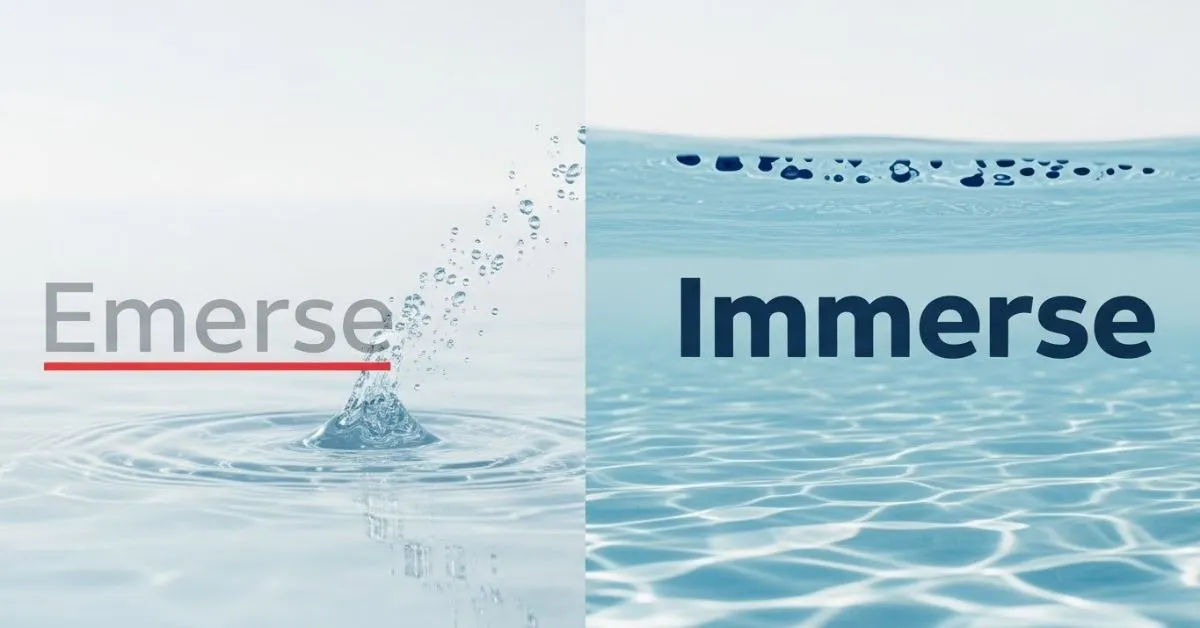
Have you ever stopped while writing and wondered is it emerse or immerse? You are not alone.
Many people search this question because the two words look similar and sound almost the same when spoken.
A small spelling mistake can make a correct sentence look wrong.
The confusion mostly comes from pronunciation. When people say immerse quickly, it can sound like emerse.
The problem gets worse because words like emerge and emersion also exist, which makes writers unsure. Students, bloggers, and professionals often pause to check the correct spelling.
This article makes the answer simple and clear. It explains which spelling is correct, why the confusion happens, and how to use the word properly.
By the end, you will know the right choice and use it confidently every time.
Emerse or Immerse: Quick Answer
Immerse is the correct word in modern English.
Emerse is not standard English and is considered incorrect or obsolete in most contexts.
Correct example:
- She was fully immersed in her studies.
- The diver immersed himself in the water.
Incorrect example:
- ❌ She was emerse in her studies.
- ❌ The object was emerse in water.
Quick rule:
If you mean to put something into liquid or to become deeply involved, always use immerse.
- Discover More About:
- Unvoluntary or Involuntary: Which One Is Correct (2026)
- Attendance or Attendence: Which Is Correct?
The Origin of Emerse or Immerse
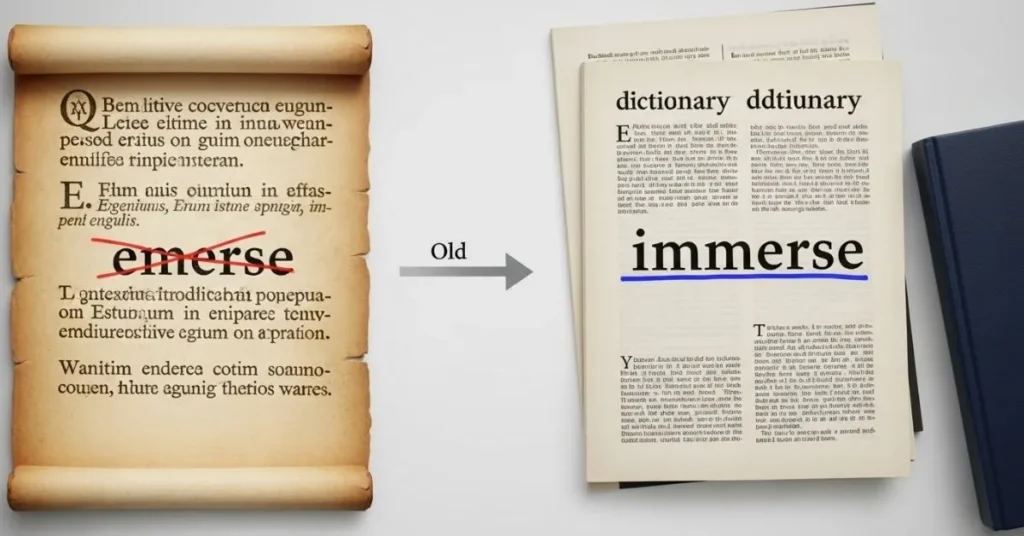
To understand the confusion, we need to look at word history.
Origin of immerse
The word immerse comes from the Latin immergere:
- in- = into
- mergere = to dip or plunge
It entered English in the early 1600s and has always meant:
- To dip into liquid
- To involve deeply in an activity or subject
What about emerse?
The word emerse is linked to Latin emergere, meaning to rise out of. In very old or technical texts, emerse appeared as an opposite of immerse, but it never became part of standard modern English.
Over time:
- Immerse survived and became common
- Emerse faded out and is now treated as an error
That’s why dictionaries recognize immerse but not emerse as a valid modern spelling.
British English vs American English Spelling
This is one area where British and American English fully agree.
There is no spelling difference between UK and US English for this word.
Comparison Table
| Aspect | British English | American English |
| Correct spelling | immerse | immerse |
| Accepted usage | Yes | Yes |
| Alternative spelling | None | None |
| “Emerse” accepted? | No | No |
Unlike words such as colour/color or catalogue/catalog, immerse remains the same worldwide.
Which Spelling Should You Use?
If your audience is in the US
Use immerse. It is the only accepted form in American English.
If your audience is in the UK or Commonwealth
Use immerse. British English also recognizes only this spelling.
If your audience is global
Use immerse. It is clear, professional, and universally understood.
Bottom line:
No matter who you are writing for, immerse is always the right choice.
Common Mistakes with Emerse or Immerse
Here are the most frequent errors writers make:
1. Using emerse instead of immerse
- ❌ I want to emerse myself in this topic.
- ✅ I want to immerse myself in this topic.
2. Confusing immerse with emerge
- Immerse = go into
- Emerge = come out
3. Misspelling verb forms
- ❌ imerse
- ❌ imerseed
- ✅ immersed
- ✅ immersing
4. Assuming emerse is British spelling
This is false. British English does not use emerse.
Emerse or Immerse in Everyday Examples
Emails
- I’m excited to immerse myself in this new role.
- Please take time to immerse yourself in the project details.
News Writing
- The documentary immerses viewers in village life.
- The athlete immersed himself in training.
Social Media
- Fully immersed in learning something new today!
- This book will immerse you in another world.
Formal Writing
- The course aims to immerse students in practical research.
- Participants were immersed in a controlled environment.
Emerse or Immerse: Google Trends & Usage Data
Search data shows a clear pattern:
- Immerse is searched far more often than emerse
- Searches for emerse or immerse indicate spelling confusion
- Native and non-native speakers search this keyword worldwide
Usage by region:
- US, UK, Canada, Australia: Immerse dominates
- Global English learners: Often search due to spelling doubt
- Academic and professional contexts: Immerse is standard
Key insight:
People are not choosing between two correct words. They are checking which one is correct and the answer is always immerse.
Comparison Table: Keyword Variations
| Word | Correct? | Meaning | Usage |
| immerse | ✅ Yes | Put into / deeply involve | Standard |
| immersed | ✅ Yes | Past tense | Standard |
| immersing | ✅ Yes | Present participle | Standard |
| emerse | ❌ No | Obsolete / incorrect | Avoid |
| emerge | ✅ Yes | Come out | Different meaning |
| emersion | ⚠️ Rare | Technical noun | Limited use |
FAQs:
1. Is emerse a real word?
Emerse exists only in rare, outdated, or technical contexts. It is not standard English.
2. Which is correct: emerse or immerse?
Immerse is correct in all modern English usage.
3. Is emerse British English?
No. British English uses immerse, not emerse.
4. Can emerse ever be used?
In modern writing, no. It is considered incorrect.
5. What does immerse mean?
It means to put into liquid or to become deeply involved in something.
6. Is immerse formal or informal?
It works in both formal and informal writing.
7. Why do people confuse emerse and immerse?
Because of pronunciation and confusion with the word emerge.
Conclusion:
he confusion between emerse and immerse may seem small, but it is important.
Immerse is the correct and accepted word in modern English.
Emerse is outdated and considered wrong.
There is no difference between British and American English here. No matter what you are writing an email, article, or report immerse is always the right choice. It makes your writing clear and professional.
Easy rule to remember:
If you mean to go into something or to be deeply involved, always use immerse.