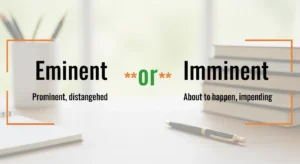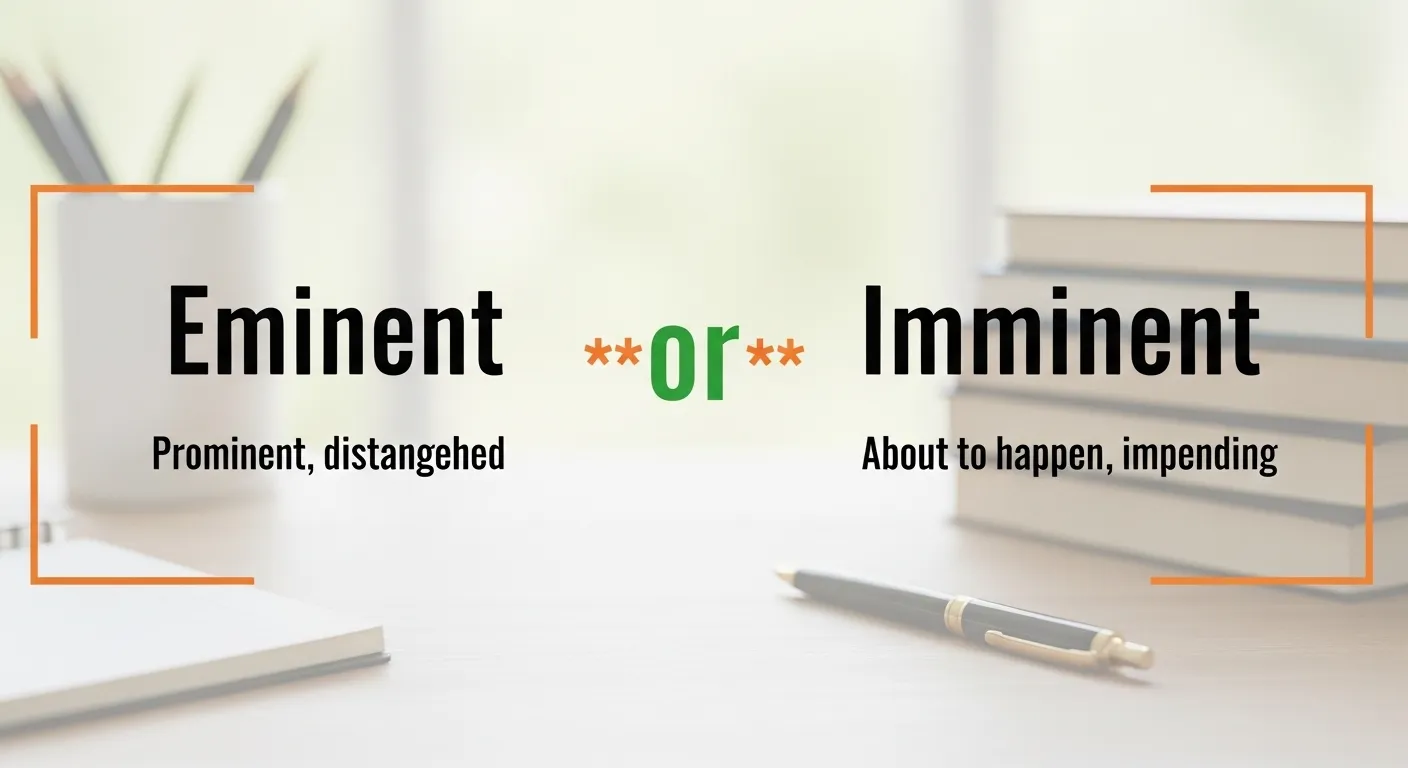
Confused between “eminent” and “imminent”? Here’s the quick answer:
- Eminent → important or famous
- Imminent → about to happen
Many writers mix these words because they sound alike.
This guide shows you the difference, common mistakes, and easy ways to remember which to use in US or UK English.
Eminent or Imminent – Quick Answer
- Eminent – Refers to someone or something famous, respected, or important.
Example: She is an eminent scientist in the field of genetics. - Imminent – Refers to something about to happen very soon.
Example: A storm is imminent, so we should prepare immediately.
Tip: If you’re talking about importance or fame, use eminent. If it’s about something happening soon, use imminent.
The Origin of Eminent and Imminent
Understanding the origin of words can help you remember their meanings.
- Eminent
Comes from Latin eminens, meaning “standing out, projecting”. Over time, it began referring to people of high status or importance. - Imminent
Comes from Latin imminens, meaning “overhanging, threatening”. The word historically implied that something was about to occur, often with urgency.
The confusion partly arises because both words share the “-minent” ending and sound similar. Remember: E → Elevation or importance, I → Imminent, impending event.
British English vs American English Spelling
The spelling of eminent and imminent remains consistent across British and American English. Unlike words like colour/color, these two do not change. However, pronunciation and usage frequency can vary slightly.
| Word | British English | American English | Meaning Summary |
| Eminent | eminent | eminent | Famous, respected, or important |
| Imminent | imminent | imminent | About to happen very soon |
Observation: Both spellings are identical in the UK, US, and most Commonwealth countries. Confusion arises mostly in meaning, not spelling.
Which Spelling Should You Use?
US Writers
- Stick with eminent for fame or importance.
- Use imminent for events happening soon.
UK/Commonwealth Writers
- Same rules apply. The key is context, not spelling.
Global English
- If your audience includes both US and UK readers, meaning is critical. Misusing imminent/eminent can confuse readers internationally.
- Tip: Use imminent for urgent alerts, eminent for formal praise.
Common Mistakes with Imminent and Eminent
Many people mix these words because they sound similar. Here are typical errors:
| Incorrect Usage | Correct Usage | Why It’s Wrong |
| An imminent professor spoke at the event. | An eminent professor spoke at the event. | “Imminent” means about to happen, not respected. |
| An eminent storm is approaching. | An imminent storm is approaching. | “Eminent” implies importance, not urgency. |
| She is imminent in her field. | She is eminent in her field. | “Imminent” cannot describe fame or status. |
Tip: If the word is describing people or achievements, think Eminent. If it’s describing time or events, think Imminent.
Eminent and Imminent in Everyday Examples
Emails
- Correct: “We are expecting an imminent software update.”
- Incorrect: “We are expecting an eminent software update.”
News Headlines
- Correct: “Imminent elections may change the government.”
- Incorrect: “Eminent elections may change the government.”
Social Media
- Correct: “The celebrity is an eminent figure in fashion.”
- Incorrect: “The celebrity is an imminent figure in fashion.”
Formal Writing
- Correct: “The lecture was given by an eminent scholar.”
- Incorrect: “The lecture was given by an imminent scholar.”
Imminent vs Eminent – Google Trends & Usage Data
Google Trends shows searches for “eminent or imminent” spike during:
- Academic writing season
- Business or legal document preparation
- News cycles with urgent events
Insights:
| Country | Most Common Search Context |
| USA | Legal documents, urgent news |
| UK | Academic papers, journalism |
| India | Education, exam preparation |
| Canada/Australia | Professional writing, media |
Usage data indicates “imminent” is searched slightly more during emergencies, while “eminent” appears in professional or academic contexts.
Comparison Table: Eminent vs Imminent
| Feature | Eminent | Imminent |
| Meaning | Famous, respected, important | About to happen soon |
| Usage | People, achievements | Events, situations |
| Word Origin | Latin eminens | Latin imminens |
| Common Mistake | Used for urgency | Used for importance |
| Spelling | Same in UK/US | Same in UK/US |
FAQs
1. Can eminent and imminent be used interchangeably?
No. Eminent refers to importance, imminent to timing.
2. Is eminent used for events?
Rarely. Eminent describes people or things of high status.
3. Which word is more common in American English?
Both are common; usage depends on context, not region.
4. How do I remember the difference?
Think E → Elevation/fame, I → Imminent/impending.
5. Are there other words similar to eminent/imminent?
Yes, renowned (similar to eminent) and impending (similar to imminent).
6. Can “imminent” describe positive events?
Yes, it only indicates timing, not tone. Example: “An imminent celebration.”
7. Do dictionaries differentiate them clearly?
Yes, most dictionaries clearly define the meanings and give usage examples.
Conclusion
Knowing the difference between eminent (important or famous) and imminent (about to happen) is key for clear, professional writing.
Pay attention to context, audience, and simple memory tips like E → Elevation and I → Impending.
With practice, you’ll write confidently and avoid common mistakes, keeping your communication precise and credible.
Discover More About:
Trialled or Trialed: Which Spelling Is Correct? (2026)
Tier or Teir? Which One Is Right?(2026)