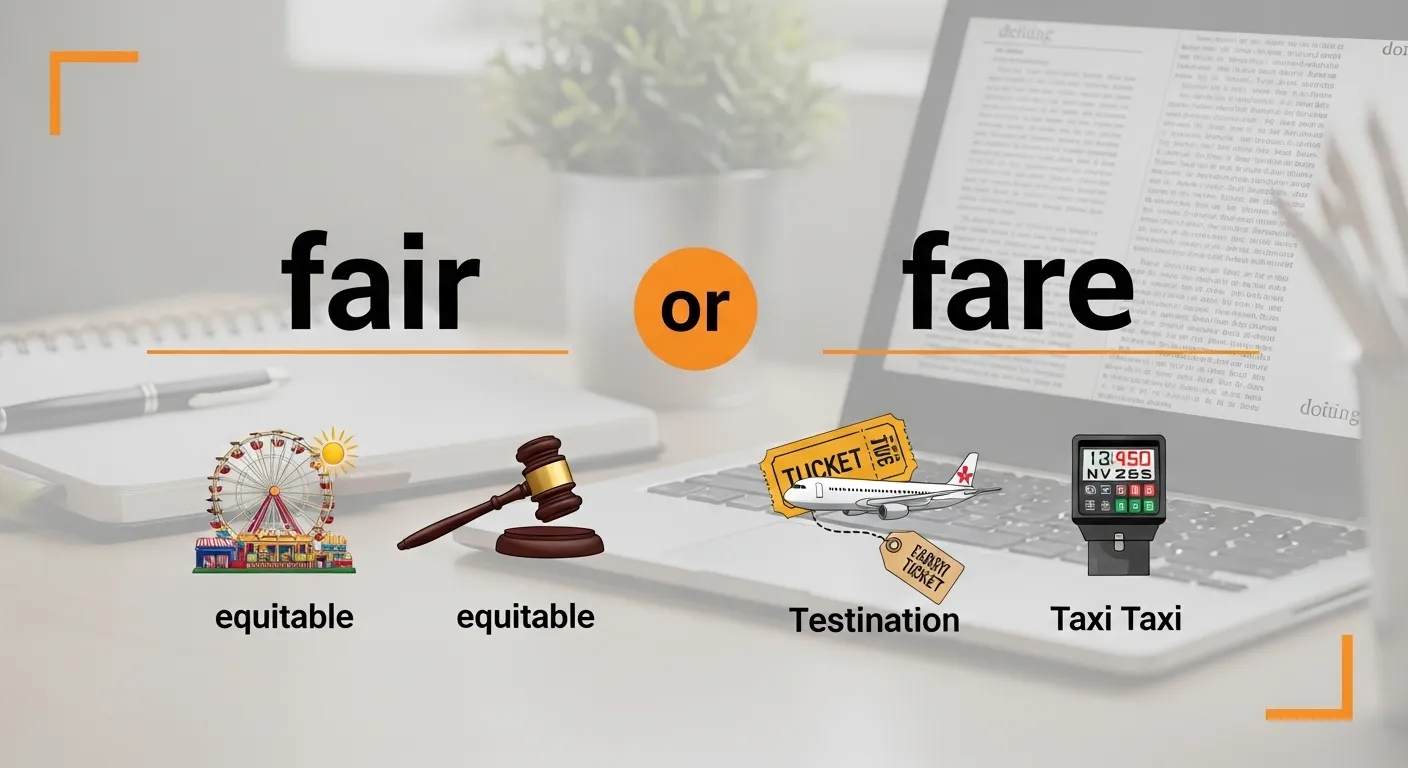
Have you ever typed fair or fare and felt confused for a second? You are not alone. These two words sound the same, but they have different meanings. That is why many people search for this keyword.
Here is your quick answer:
- Fair = just, equal, or an event (like a school fair).
- Fare = money paid for travel or how someone performs.
Examples:
- That’s not fair.
- The bus fare is $2.
- She fared well in the exam.
If you are talking about justice or equality, use fair.
If you are talking about travel money, use fare.
Now you know the difference clearly and quickly.
Fair or Fare – Quick Answer
Fair and fare sound the same, but they have different meanings.
- Fair = just, equal, light-colored, or an event (like a market).
- Fare = money paid for travel or how someone performs.
Simple Examples
- That decision is not fair.
- She has fair skin.
- The school fair starts at 10 AM.
- The bus fare is $2.
- The taxi fare was expensive.
- How did you fare in the exam?
If you are talking about justice or equality, use fair.
If you are talking about money for travel, use fare.
The Origin of Fair or Fare
Understanding the origin makes things easier.
Origin of “Fair”
The word fair comes from Old English fæger. It meant beautiful, pleasing, or attractive. Over time, the meaning expanded. It began to include ideas like justice, balance, and equality.
That is why today “fair” can mean:
- Beautiful
- Light in color
- Just or equal
- A public event or market
Origin of “Fare”
The word fare comes from Old English faran, which meant “to travel” or “to journey.” This is why fare is connected to travel and movement.
Later, it also came to mean:
- The price paid for travel
- How someone manages or performs
So the spelling difference exists because the words developed from different roots, even though they now sound the same.
British English vs American English Spelling
Good news: There is no spelling difference between British and American English for fair and fare.
Both countries use:
- Fair
- Fare
Unlike words such as “color/colour” or “judgment/judgement,” these spellings stay the same.
Comparison Table
| Word | Meaning | Example Sentence | UK Spelling | US Spelling |
| Fair | Just or equal | That is a fair decision. | Fair | Fair |
| Fair | Event | We visited the trade fair. | Fair | Fair |
| Fare | Travel cost | The train fare is high. | Fare | Fare |
| Fare | Perform/manage | She fared well in school. | Fare | Fare |
So, you do not need to worry about country-based spelling rules here.
Which Spelling Should You Use?
The correct spelling depends on meaning, not country.
If Your Audience Is in the US
Follow the same rules:
- Use fair for justice or events.
- Use fare for travel cost.
If Your Audience Is in the UK or Commonwealth
The rule is identical:
- Fair = equal or event
- Fare = travel money or performance
For Global Writing (Websites, Blogs, Business)
Choose based on meaning. Search engines treat both words as separate keywords. If you are writing about ticket prices, use fare. If you are writing about fairness or equality, use fair.
Always check the context of your sentence.
Common Mistakes with Fare or Fair
Here are common errors people make:
❌ The bus fair is too expensive.
✅ The bus fare is too expensive.
❌ That’s not fare!
✅ That’s not fair!
❌ We enjoyed the food fare at the festival.
✅ We enjoyed the food fair at the festival.
(Unless you mean “cuisine,” where fare can mean food style.)
❌ How did you fair in the test?
✅ How did you fare in the test?
The biggest confusion happens with:
- Bus fare
- That’s not fair
- Trade fair
- Fared well
If you remember travel = fare, justice = fair, you will avoid 90% of mistakes.
Fare vs Fair in Everyday Examples
Let’s see how these words appear in daily life.
In Emails
- Please confirm the taxi fare before booking.
- We aim to provide fair service to all clients.
In News Headlines
- Government promises fair elections.
- Airline increases baggage fare.
On Social Media
- Life is not always fair.
- Why is the metro fare so high?
In Formal Writing
- The company ensures fair treatment of employees.
- The passenger paid the required fare.
In Travel Websites
- Compare flight fares before booking.
- Children under five travel at half fare.
Context always decides the correct word.
Fair or Fare – Google Trends & Usage Data
Search data shows interesting patterns.
- Fair is searched more often worldwide.
- Fare spikes in travel seasons.
- Countries like the US, UK, Canada, and Australia show high searches for “bus fare” and “airfare.”
- Searches for “that’s not fair” are common in educational and parenting content.
Why is “fair” more popular?
Because it has many meanings:
- Justice
- Events
- Weather
- Appearance
“Fare” is more specific. It is often linked to:
- Travel
- Transport
- Airlines
- Exams (fared well)
So, if you see more online content using fair, that is normal.
Fair vs Fare – Comparison Table
| Feature | Fair | Fare |
| Pronunciation | Same | Same |
| Part of Speech | Adjective / Noun | Noun / Verb |
| Main Meaning | Just, equal, event | Travel cost |
| Related to Travel? | No | Yes |
| Used in Exams? | No | Yes (fared well) |
| Example | That’s fair. | The fare is $5. |
This table helps you quickly compare both words.
FAQs
1. Is it bus fair or bus fare?
It is bus fare. Fare means money paid for travel.
2. Is it fair enough or fare enough?
It is fair enough. This phrase means reasonable or acceptable.
3. What does fare mean in exams?
It means how someone performed. Example: She fared well in the test.
4. What is a trade fair?
A trade fair is a business event or exhibition.
5. Why do fair and fare sound the same?
They are homophones. They developed from different Old English words but now share the same pronunciation.
6. Is airfare spelled air fare?
Both forms exist, but airfare (one word) is more common in modern writing.
7. How can I remember the difference?
Remember:
Fare = travel (both have “ar”)
Fair = fairness
Conclusion
The difference between fair or fare is simple but important.
- Fair = justice, equality, beauty, or an event.
- Fare = travel cost or performance.
British and American English use the same spelling, so focus only on meaning. If it’s about buses, taxis, or flights, choose fare. If it’s about fairness or events, choose fair.
Quick tip:
Justice = Fair
Travel = Fare
Pause for one second before writing, and you’ll always choose the right word.
Learn More About:
Maximise or Maximize: Which Is Correct?
Handle or Handel: Why One Is Right And The Other Is Wrong (2026)
Affect or Effect: Grammar Rules Explained Clearly ( 2026)