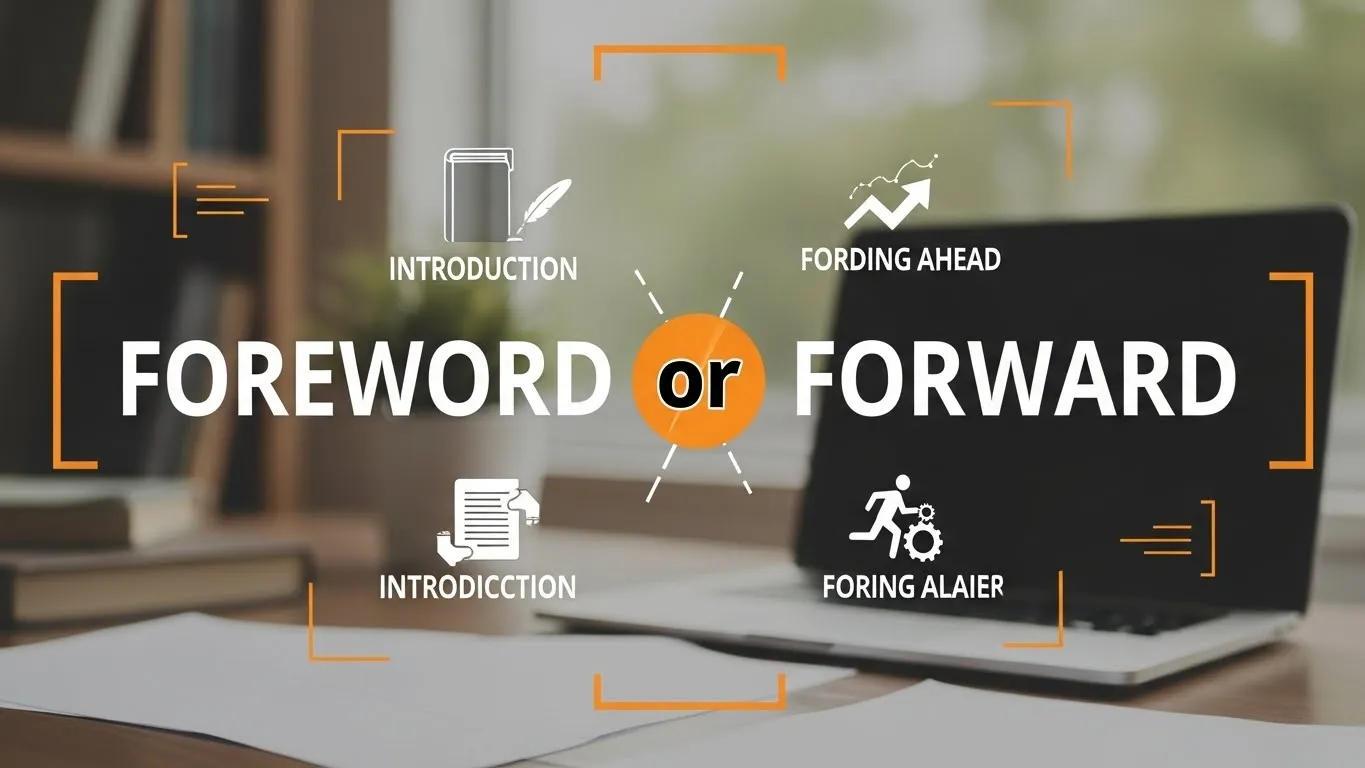
Many English learners often get confused between “foreword” and “forward.” Although they sound similar, their meanings are very different.
“Foreword” is used for a book’s introduction, while “forward” relates to movement, progress, or sending something on.
Using the wrong word can make writing look unprofessional.
This guide explains the difference clearly, with examples, origins, and common mistakes, so you’ll know exactly when to use each word and write confidently.
Foreword or Forward – Quick Answer
Foreword is a noun. It refers to an introductory note or preface in a book, usually written by someone other than the author. Example: “The foreword by the famous historian added credibility to the book.”
Forward is usually an adverb, adjective, or verb. It refers to movement ahead or to sending something on. Examples:
- Adverb: “She moved forward quickly.”
- Verb: “Please forward this email to your manager.”
- Adjective: “The forward section of the ship was damaged.”
Quick Tip: Use foreword for books and literary contexts. Use forward for motion, progress, or sending information.
The Origin of Forward and Foreward
Forward has roots in Old English forweard, meaning “toward the front or future.” Over centuries, it evolved to describe physical movement, progress, or the act of sending information onward. Its usage in modern English covers both literal and figurative motion.
Foreword comes from Middle English forword, meaning a preface or introduction to a book. It is related to the Old English fore, meaning “before,” and word, meaning “speech or writing.” Historically, a foreword is meant to introduce readers to a book, often by a respected person, offering insight or context.
British English vs American English Spelling
Both words are spelled the same in British and American English. There is no regional spelling difference. However, their usage may vary slightly in style and frequency:
| Word | British English Example | American English Example |
| Foreword | “The book includes a foreword by J.K. Rowling.” | “The foreword by the professor was insightful.” |
| Forward | “Move forward with your plan carefully.” | “She moved forward with confidence.” |
While spelling is consistent, remember that foreword is strictly literary, whereas forward is versatile across contexts.
Which Spelling Should You Use?
Since spelling does not differ between regions, focus on context:
- US audience: Follow standard usage; use foreword for book introductions, forward for movement or emails.
- UK/Commonwealth audience: Same rules apply. “Foreword” is used in literature; “forward” for everything else.
- Global audience: Clarity is key. Avoid using foreword outside of books to prevent confusion.
Pro Tip: If your content is digital or business-related, forward will almost always be correct.
Common Mistakes with Foreword or Forward
- Using “forward” to describe a book introduction. ❌
- Incorrect: “The forward of the book is interesting.”
- Correct: “The foreword of the book is interesting.”
- Using “foreword” when referring to sending emails. ❌
- Incorrect: “Please foreword this email to John.”
- Correct: “Please forward this email to John.”
- Confusing physical movement with literary terms.
- Incorrect: “He read the forward before the chapter.”
- Correct: “He read the foreword before the chapter.”
- Mispronunciation leading to misuse (sounds similar but context matters).
Foreword or Forward in Everyday Examples
Emails:
- “Can you forward the meeting notes to me?” ✅
- “The foreword of the report is well-written.” ✅
News Articles:
- “The city is moving forward with its new plan.” ✅
- “The foreword of the biography highlighted her achievements.” ✅
Social Media:
- “Forward this post to anyone interested.” ✅
- “Reading the foreword really inspired me.” ✅
Formal Writing:
- “The foreword by the editor gives context to the research.” ✅
- “The company is moving forward with its quarterly strategy.” ✅
Foreword or Forward – Google Trends & Usage Data
According to Google Trends, forward is far more commonly searched and used worldwide because it applies to multiple contexts, including email, business, and physical movement. Foreword sees peak searches among students, writers, and readers interested in literature or academic writing. Regionally:
- US: High usage of both, but forward dominates.
- UK: Similar pattern, foreword slightly more frequent in literary contexts.
- India & Commonwealth countries: Forward is commonly used in daily communication, foreword is mostly seen in academic or literary content.
| Keyword | Relative Popularity | Typical Contexts |
| Forward | 80% | Email, motion, business |
| Foreword | 20% | Books, literary works, academia |
Comparison Table: Foreword vs Forward
| Feature | Foreword | Forward |
| Part of Speech | Noun | Verb, Adverb, Adjective |
| Meaning | Introduction to a book | Movement, progress, sending |
| Usage | Books, literature, prefaces | Email, motion, planning |
| Example | “Read the foreword first.” | “Please forward this email.” |
| Region | Universal | Universal |
FAQs:
1. Can I use “forward” instead of “foreword” in a book?
No. Use “foreword” only for the book introduction.
2. Is “foreword” ever a verb?
No. “Foreword” is strictly a noun.
3. Can “forward” be used as a noun?
Rarely, mostly in sports (soccer or hockey: “He plays as a forward”).
4. Which word is more common in emails?
Forward is commonly used in emails; foreword is rarely used.
5. Is there a pronunciationdifference?
Yes. Foreword is pronounced /ˈfɔːr.wɜːd/, forward is /ˈfɔːr.wərd/, but they are very close.
6. Can I use “foreword” in social media posts?
Only if referring to book introductions or literary content.
7. Which word should I use for professional writing?
Use context-based choice: foreword for literature, forward for business or emails.
Conclusion:
Knowing the difference between “foreword” and “forward” is key for clear writing.
“Foreword” is a noun for a book’s introduction, while “forward” shows movement, progress, or sending something.
Spelling is the same in US and UK English, but context matters.
Forward is common in emails and business, while foreword is for books and academic writing.
Remember: foreword introduces, forward moves.
Learn More About:
Handle or Handel: Why One Is Right And The Other Is Wrong (2026)
Many or Meny: What’s the Right English Word? (2026)