Many people search for “its or it’s” because the words look the same and sound the same. But they do not mean the same thing.
This small difference causes big mistakes in emails, blog posts, school work, and business writing.
Just one apostrophe can change the meaning of a sentence. Use the wrong form, and your writing may look careless.
Teachers mark it wrong. Clients notice it. Clear grammar builds trust.
The confusion happens because English often uses apostrophes to show possession, like John’s car.
So many people think it’s shows ownership too. But here, the rule is different.
In this simple guide, you will get the quick answer, clear examples, common mistakes, and easy tips. By the end, you will never confuse its and it’s again.
Its or It’s – Quick Answer
Here is the simple rule:
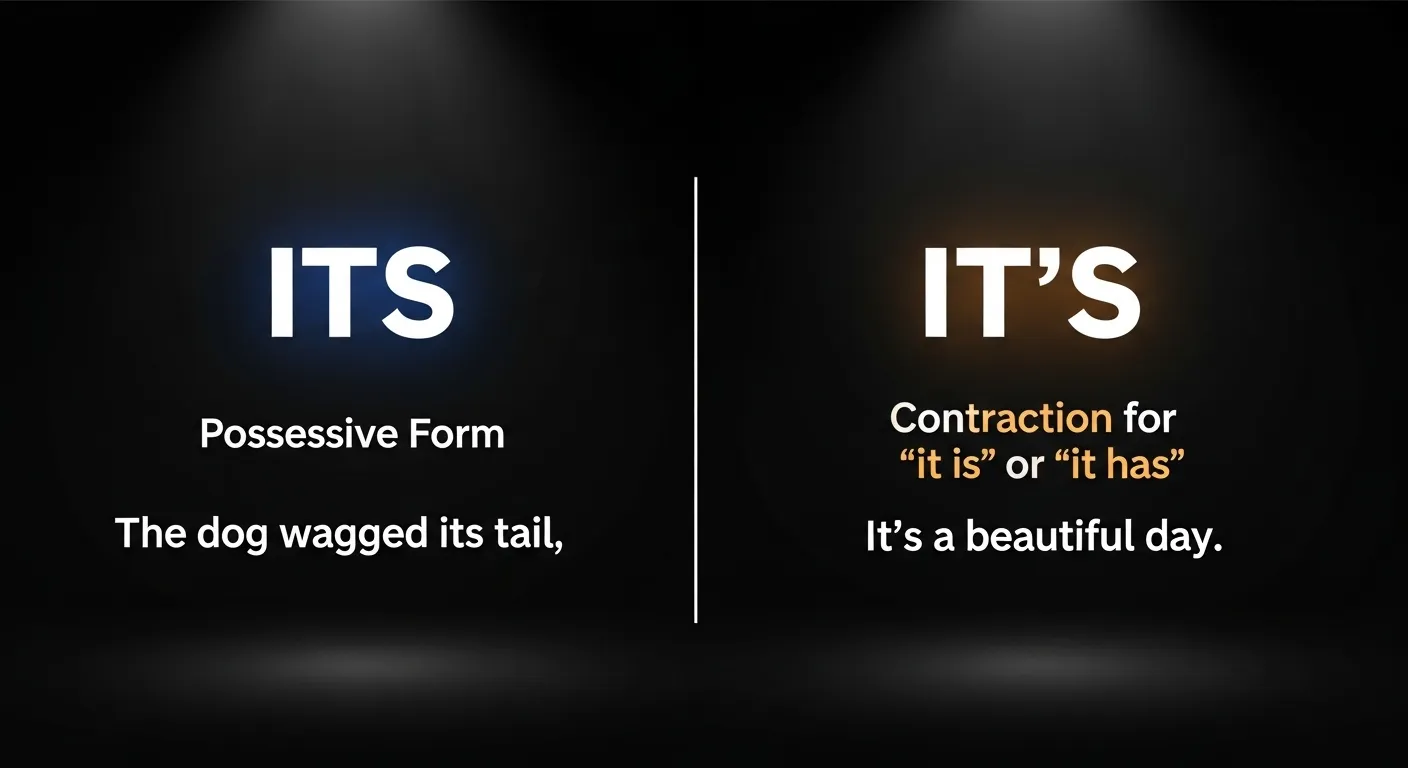
- Its = shows possession (something belongs to “it”)
- It’s = short form of “it is” or “it has”
Examples:
- The dog wagged its tail. ✅ (The tail belongs to the dog.)
- It’s raining today. ✅ (It is raining.)
- It’s been a long day. ✅ (It has been a long day.)
- The company changed it’s policy. ❌ (Wrong)
Easy Trick:
If you can replace the word with “it is” or “it has,” then use it’s.
If not, use its.
The Origin of Its or It’s
To understand the confusion, we need to look at history.
The word “it” comes from Old English hit. Over time, it became simply it. Like other nouns, English added ’s to show possession. For example:
- John’s car
- The girl’s book
So people expected it’s to mean “belonging to it.” In early English writing, writers actually did use it’s for possession sometimes.
But by the 17th century, grammar rules became more fixed. Writers decided that:
- It’s would only mean “it is” or “it has.”
- Its would show possession (without an apostrophe).
This made the rule different from normal nouns.
That is why this pair confuses so many people today.
British English vs American English Spelling
Good news: there is no spelling difference between British and American English.
Both use:
- Its for possession
- It’s for “it is” or “it has”
The rule is the same in:
- The United States
- The United Kingdom
- Canada
- Australia
- New Zealand
Comparison Table
| Form | Meaning | Example | Correct? |
|---|---|---|---|
| Its | Possession | The cat licked its paws. | ✅ |
| It’s | It is | It’s cold outside. | ✅ |
| It’s | It has | It’s been fun. | ✅ |
| It’s (for possession) | Incorrect usage | The dog lost it’s toy. | ❌ |
There is no regional variation. The rule is universal.
Which Spelling Should You Use?
The answer depends on your sentence — not your country.
If you write for US readers:
Follow standard grammar. Use its for possession and it’s for “it is/it has.”
If you write for UK or Commonwealth readers:
The rule is exactly the same.
If you write for a global audience:
Stick to the standard rule. It is accepted everywhere.
Professional advice:
- In business writing → double-check apostrophes.
- In academic writing → always proofread carefully.
- In blogs and SEO content → correct grammar improves trust.
This is not a style choice. It is a grammar rule.
Common Mistakes with Its or It’s
Here are the most common errors people make.
1. Using “it’s” for possession ❌
Wrong: The company updated it’s website.
Correct: The company updated its website.
2. Forgetting the apostrophe in contractions ❌
Wrong: Its raining.
Correct: It’s raining.
3. Confusing it with other possessive pronouns
Remember:
- His (no apostrophe)
- Hers (no apostrophe)
- Theirs (no apostrophe)
- Its (no apostrophe)
Possessive pronouns never use apostrophes.
4. Auto-correct errors
Sometimes phones change its to it’s. Always proofread.
Its Vs It’s in Everyday Examples
Let’s see how this works in real life.
Emails
- It’s great to hear from you.
- The company has updated its privacy policy.
News Writing
- The government announced its decision.
- It’s expected to pass next week.
Social Media
- It’s Monday again!
- The brand launched its new product.
Academic Writing
- The study reached its conclusion.
- It’s clear that more research is needed.
Business Reports
- The company increased its profits.
- It’s been a strong quarter.
You can see the pattern clearly.
It’s or Its – Google Trends & Usage Data
Search data shows that many people type “its or it’s” into Google every month. This happens because:
- The words sound identical.
- Spell-check tools do not always catch context errors.
- English learners struggle with apostrophe rules.
The confusion appears most in:
- Student writing
- Online content
- Social media posts
- Business emails
Countries with high English usage, such as the United States, United Kingdom, Canada, and Australia, show strong search interest in this keyword.
This proves one thing: even native speakers make this mistake.
Side-by-Side Comparison Table
| Feature | Its | It’s |
|---|---|---|
| Type | Possessive pronoun | Contraction |
| Meaning | Belonging to it | It is / It has |
| Apostrophe | No | Yes |
| Example 1 | The car lost its wheel. | It’s broken. |
| Example 2 | The tree dropped its leaves. | It’s been windy. |
| Common Error | Rare | Used wrongly for possession |
FAQs
1. Is “its” ever a contraction?
No. Its is only possessive. It never means “it is.”
2. Why doesn’t “its” have an apostrophe?
Because possessive pronouns do not use apostrophes. The same rule applies to his, hers, and theirs.
3. Is “it’s” formal or informal?
It is acceptable in both formal and informal writing. In very formal academic writing, some prefer writing “it is” fully.
4. How can I quickly check which one to use?
Replace the word with “it is.” If the sentence still makes sense, use it’s.
5. Do British and American English treat this differently?
No. The rule is exactly the same in both.
6. Why is this mistake so common?
Because apostrophes usually show possession. This word is an exception.
7. Can grammar tools catch this error?
Sometimes. But not always. Manual proofreading is best.
Conclusion:
The difference between its and it’s is small but important. One shows possession.
The other is a short form of “it is” or “it has.” The rule is simple, yet many writers still make mistakes.
There is no difference between British and American English. The spelling stays the same worldwide.
The confusion exists because apostrophes usually show ownership. But possessive pronouns break that rule.
The best way to avoid errors is to remember one trick: test the sentence with “it is.” If it works, use it’s. If not, use its.
Correct grammar builds trust. It makes your writing clear and professional.
If you write emails, blog posts, business reports, or academic papers, using the right form matters.
Now you know the rule. Use it with confidence.
Discover More Post:
Cell or Sell – Difference and Correct Usage (2026)
Write or Right – Which One Should You Use?

I’m a U.S. based content writer and language researcher with a strong focus on English grammar, spelling differences, and frequently confused terms. My writing is aimed at helping readers write more clearly and correctly in daily use, workplace communication, and digital content.