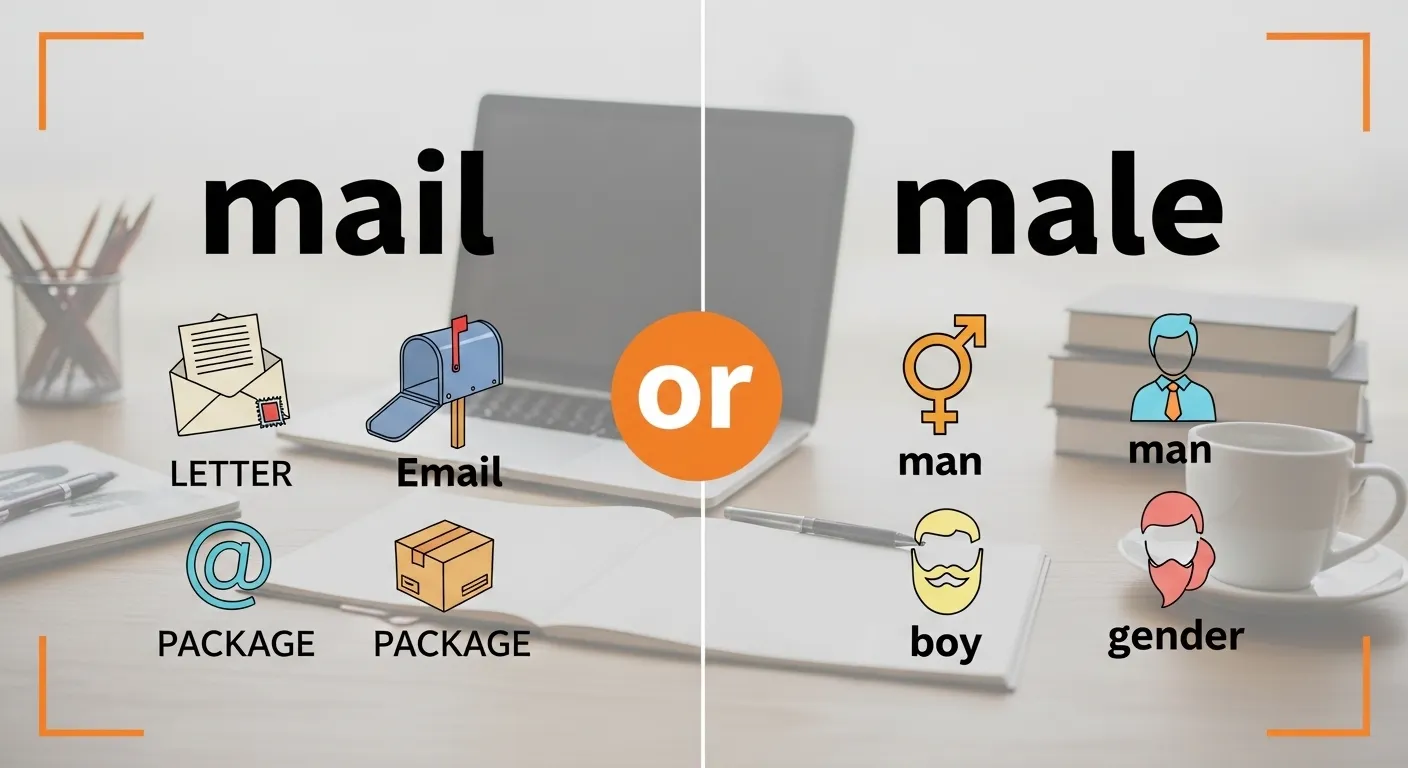
Many people search for “mail or male” because both words sound exactly the same. They are pronounced alike, but their meanings are completely different. This often causes confusion in writing.
For example, you might type “send me a male” instead of “send me a mail,” or write “mail lion” instead of “male lion.” A small spelling mistake can change the whole meaning of a sentence.
If you feel confused about which word to use, this guide will give you a clear and simple answer. After reading, you will understand the difference and use the correct word with confidence.
Mail or Male – Quick Answer
Mail and male are both correct words, but they mean different things.
- Mail = letters, packages, or messages sent by post or email.
- Male = a man, boy, or the masculine gender of a person or animal.
Examples:
- I sent you an email yesterday.
- The mail arrived late today.
- The male dog is larger than the female dog.
- He is the only male in the group.
👉 Quick tip:
If you are talking about letters or messages, use mail.
If you are talking about gender, use male.
The Origin of Mail or Male
Understanding the history of these words makes the difference clearer.
Origin of Mail
The word mail comes from the Old French word male, which meant a bag. In the past, letters were carried in bags. Over time, the word changed in spelling and meaning. It began to mean the letters and packages inside the bag.
Later, with technology, we got the word email (electronic mail). Even today, we still use the word mail for digital messages.
Origin of Male
The word male comes from the Latin word masculus, meaning masculine or manly. It entered English through Old French. It has always referred to gender.
So even though mail and male sound the same, they come from different roots and have different meanings.
British English vs American English Spelling
Good news: There is no spelling difference between British English and American English for mail and male.
Both countries use:
- Mail (letters and messages)
- Male (gender)
However, there is a small usage difference.
In the United States, people mostly say mail.
In the United Kingdom, people often say post instead of mail.
For example:
| Meaning | American English | British English |
| Letters delivery | Post | |
| Send a letter | Send mail | Send post |
| Digital message | ||
| Masculine gender | Male | Male |
So the spelling is the same. Only usage may change slightly.
Which Spelling Should You Use?
The answer depends on what you mean.
If You Are in the US:
Use mail for letters and email.
Use male for gender.
If You Are in the UK or Commonwealth Countries:
You can use mail, but post is more common for physical letters.
Use male for gender.
For Global Writing:
If your audience is international:
- Use mail for email or general communication.
- Use male for gender.
- Avoid confusing the two in formal writing.
Always double-check before publishing business emails, blog posts, or academic papers.
Common Mistakes with Male or Mail
Here are frequent errors people make:
❌ I sent you a male yesterday.
✔ I sent you a mail yesterday.
❌ The mail cat is very strong.
✔ The male cat is very strong.
❌ She is the only mail student.
✔ She is the only male student.
❌ Check your male box.
✔ Check your mail box.
Why These Mistakes Happen
- They sound the same.
- Spellcheck may not catch it because both are real words.
- Fast typing causes errors.
Always read your sentence again. Ask yourself:
Am I talking about messages or gender?
Mail or Male in Everyday Examples
Let’s look at real-life usage.
In Emails
- Please check your mail for the invoice.
- I did not receive your email.
In News Writing
- The company sent an official mail to customers.
- The zoo welcomed a baby male tiger.
On Social Media
- DM me or send a mail.
- The male actor won the award.
In Formal Writing
- All official mail must be recorded.
- The study included 50 male participants.
As you can see, the context clearly changes the meaning.
Male vs Mail – Google Trends & Usage Data
Search data shows that both words are popular, but in different contexts.
- Mail is searched more in countries like the United States, Canada, and India.
- In the UK, people often search for post instead of mail.
- Male is searched worldwide, often in topics about health, animals, and gender.
Digital growth has increased the use of the word email, which contains “mail.”
Usage context:
| Word | Common Search Context |
| Email, mailbox, send mail | |
| Male | Male vs female, male health, male animals |
Mail is more common in business and communication searches.
Male is common in biology, gender, and education topics.
Mail vs Male – Comparison Table
Here is a simple side-by-side comparison:
| Feature | Male | |
| Meaning | Letters or messages | Masculine gender |
| Part of Speech | Noun / Verb | Adjective / Noun |
| Example | Send me the mail | The male teacher |
| Related Words | Email, mailbox | Female, masculine |
| Used in US & UK | Yes | Yes |
FAQs:
1. Is “male” ever used for letters?
No. Male is only about gender.
2. Is “mail” ever used for gender?
No. Mail refers to messages or postal items.
3. Why do mail and male sound the same?
They are homophones. English has many words that sound alike but have different meanings.
4. Is it “email” or “emale”?
The correct spelling is email. “Emale” is incorrect.
5. Which word is more common?
Both are common, but in different contexts. Mail is common in communication. Male is common in gender discussions.
6. Can spellcheck detect this mistake?
Not always. Both words are correct spellings.
7. Is there a grammar rule to remember?
Yes.
Mail = Message
Male = Man
Both start with the same first letter sound.
Conclusion:
Mail and male sound the same, but they have different meanings. Mail means letters or messages, while male refers to gender.
There is no spelling difference in British or American English, though the UK often uses “post” instead of mail. Mistakes happen because both words are homophones and spellcheck may not catch them. Always check the context to choose the correct word.
If you remember one rule, remember this:
Mail is for messages.
Male is for gender.
Once you understand this, you will write with confidence and clarity.
Find More About:
Employees or Employee’s: Which One Is Correct?
Devide or Divide: Which Is Correct?
Trialled or Trialed: Which Spelling Is Correct? (2026)