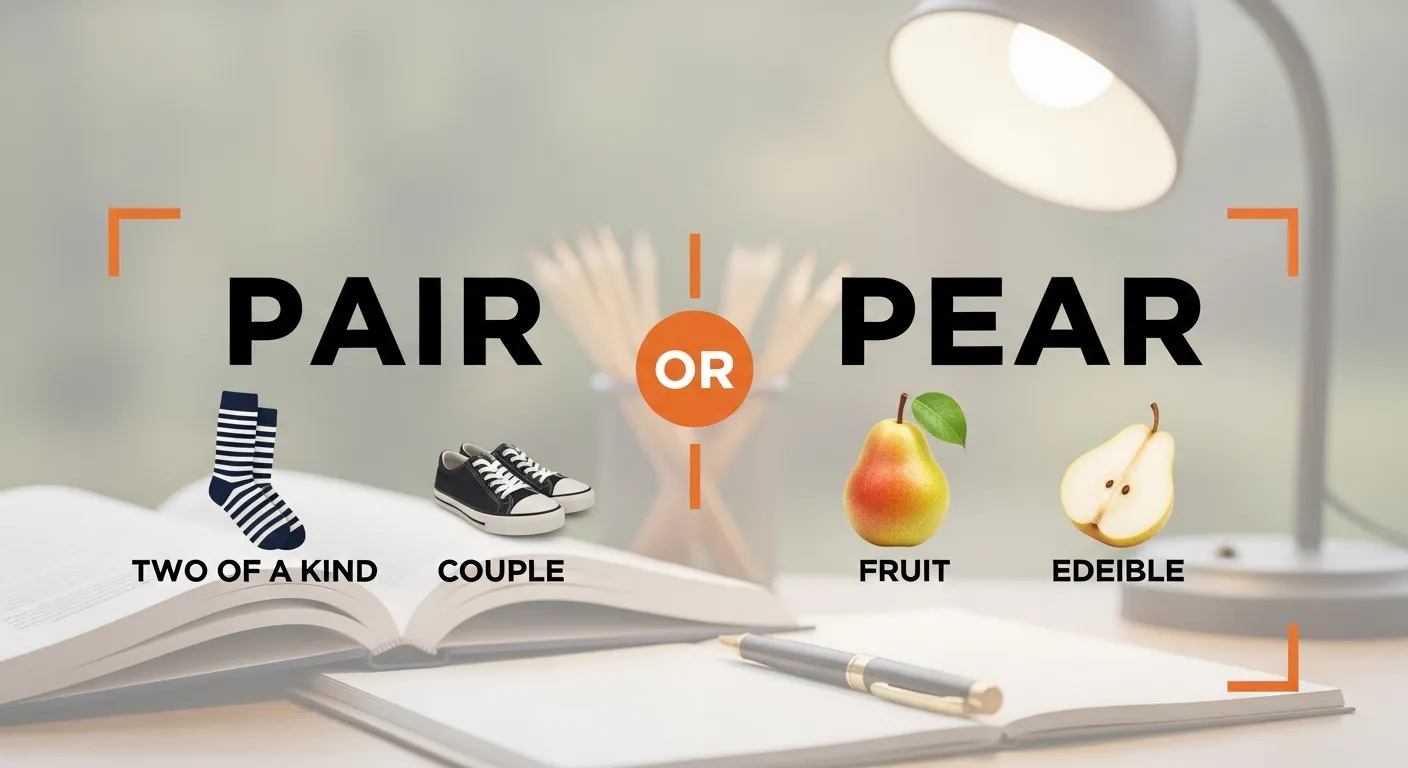
The words pair and pear sound the same but have different meanings. Many people search “pair or pear” online to avoid mistakes in writing.
Pair refers to two items that match or belong together.
pear is the fruit we eat.
This guide explains the difference, shows their origins, compares UK and US usage, and gives practical tips, examples, and common mistakes for correct everyday use.
Pair or Pear – Quick Answer
- Pair: Refers to two similar or matching items grouped together.
- Example: I bought a new pair of shoes.
- Pear: A type of fruit.
- Example: I ate a ripe pear for breakfast.
Quick Tip: If you’re talking about numbers or items together, use pair. If it’s about the fruit, use pear.
The Origin of Pair and Pear
- Pair: Comes from the Latin word par, meaning equal. Over time, it evolved in Middle English to describe two items that match or are connected.
- Pear: Derived from the Old English word pere, influenced by French poire. It has always referred to the fruit we eat today.
The spelling difference exists because these words come from entirely different roots, even though they sound identical in modern English. Understanding their history helps explain why confusing them is incorrect.
British English vs American English Spelling
The good news is that pair and pear are spelled the same in both British and American English. However, the way these words are used can slightly differ depending on context.
| Word | British English Usage | American English Usage | Example |
| Pair | Shoes, socks, or objects | Shoes, socks, or objects | She bought a pair of gloves. |
| Pear | Fruit | Fruit | He ate a juicy pear. |
Unlike words such as “colour/ color” or “centre/ center,” pair and pear do not have alternative spellings, so no adjustments are needed for UK vs US English.
Which Spelling Should You Use?
- Use “pair” when referring to two items or a duo.
- Use “pear” when talking about the fruit.
- Audience consideration:
- US readers: Standard spellings remain the same.
- UK/Commonwealth readers: Also standard; no variant needed.
- Global English: Stick to these spellings for clarity.
Pro Tip: If in doubt, read the sentence aloud. Context usually makes the correct choice obvious.
Common Mistakes with Pair or Pear
- Incorrect: I bought a pear of shoes.
- Correct: I bought a pair of shoes.
- Incorrect: She ate a pair for dessert.
- Correct: She ate a pear for dessert.
- Confusing homophones in writing: Ensure your spell checker doesn’t auto-correct incorrectly.
Other frequent mistakes include:
- Using pair for singular items.
- Using pear in idioms that require pair (like “a perfect pair”).
Pear or Pair in Everyday Examples
Emails & Professional Writing:
- Correct: I’ve attached a pair of reports for your review.
- Incorrect: I’ve attached a pear of reports.
News & Media:
- Correct: The couple walked hand-in-hand, a perfect pair.
- Correct: The farmer harvested ripe pears from his orchard.
Social Media Posts:
- Correct: Just got a new pair of sneakers!
- Correct: Enjoying a juicy pear for snack time.
Formal Writing:
- Correct: Each pair of gloves was labeled with a size.
- Correct: The pear is rich in vitamins and fiber.
Pear vs Pair – Google Trends & Usage Data
- Searches for pair or pear spike during academic seasons when students are writing essays.
- Geographically, searches are higher in English-speaking countries: US, UK, Canada, Australia.
- Contextually, queries often include “difference between pair and pear”, “pair vs pear meaning”, or “how to use pair and pear correctly”.
- Insight: Confusion is common, even among fluent speakers, which makes this topic perfect for educational content.
Comparison Table: Pair vs Pear
| Feature | Pair | Pear |
| Meaning | Two similar items grouped together | Fruit |
| Part of Speech | Noun | Noun |
| Example Sentence | A pair of socks | A sweet pear |
| Spelling | Same in UK & US | Same in UK & US |
| Common Mistakes | Using for singular items | Using in non-fruit context |
FAQs
1. Can “pair” ever refer to fruit?
- No, use pear for fruit only.
2. Is “pear” ever used in idioms?
- Rarely, except in phrases like “pear-shaped” (meaning something went wrong).
3. Are there other words that sound like pair and pear?
- Yes, pare (to trim) is another homophone.
4. How do I remember the difference?
- Pair = two items. Pear = fruit. Context and sentence meaning will guide you.
5. Can I use “pair” in singular form?
- No, pair always implies two.
6. Does pronunciation differ?
- They are pronounced the same, making spelling crucial.
7. Is “pair or pear” a common Google search?
- Yes, many learners and writers search for clarification.
Conclusion
The difference between pair and pear is simple once you understand their meanings.
Pair refers to two items that match or belong together, while pear is the fruit we eat.
Their spellings are consistent across British and American English, making them easy to standardize in writing. Avoid common mistakes by paying attention to context, and use the quick tip of reading sentences aloud.
If you’re drafting emails, writing essays, or posting on social media, mastering pair and pear ensures clarity and professionalism. Remember the history and meaning behind each word it helps reinforce correct usage in everyday English.
By following this guide, you can confidently choose between pair and pear, improve your writing accuracy, and reduce common homophone mistakes.
Find More About:
Employees or Employee’s: Which One Is Correct?
Analyses or Analysis: Using These Words Correctly

I’m a U.S. based content writer and language researcher with a strong focus on English grammar, spelling differences, and frequently confused terms. My writing is aimed at helping readers write more clearly and correctly in daily use, workplace communication, and digital content.