Have you ever typed stair when you meant stare? You are not alone. Many people search for “stair or stare” because both words sound the same but have different meanings.
Here is the quick answer:
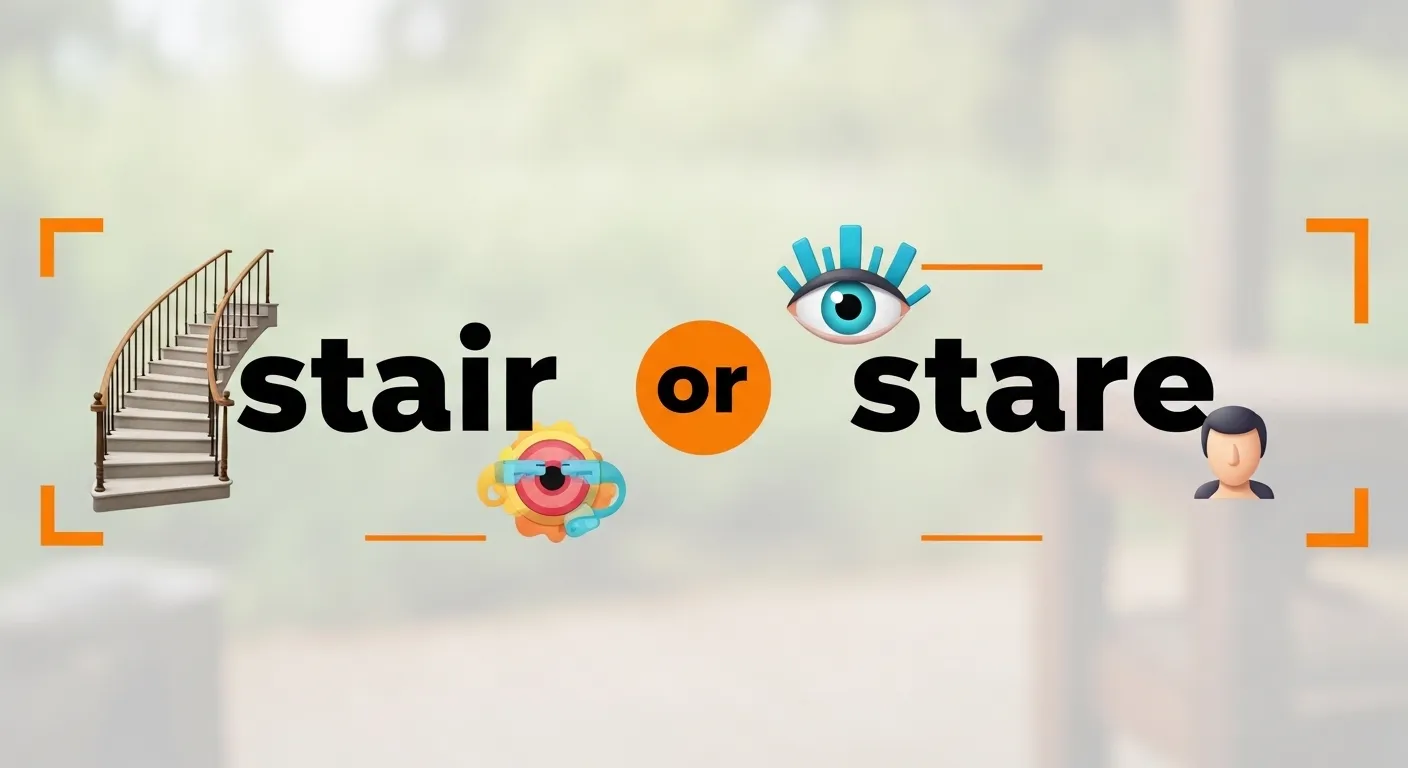
- Stair = a step in a staircase.
- Stare = to look at someone for a long time.
For example, “She walked up the stair” is correct.
But “She gave me a long stare” is also correct in a different meaning.
This guide will explain the difference clearly so you can choose the right word every time.
Stair or Stare – Quick Answer
Here is the simple rule:
- Stair = A step or part of a staircase.
- Stare = To look at someone or something for a long time.
Examples:
- I walked up the stair to the second floor.
- He gave me a cold stare.
Think of it this way:
- Stair → Building word (stairs in a house).
- Stare → Eye word (looking at someone).
Both words sound the same, but they have different meanings and spellings.
The Origin of Stair or Stare
Understanding word history helps reduce confusion.
Origin of Stair
The word stair comes from Old English stǣger. It meant a step or ladder. Over time, the word changed into stair, meaning one step in a staircase or the staircase itself.
Related words:
- Staircase
- Upstairs
- Downstairs
It always refers to steps used to go up or down.
Origin of Stare
The word stare comes from Old English starian. It meant to gaze fixedly or look steadily.
The meaning stayed almost the same for hundreds of years. Today, stare means to look at someone or something for a long time, often in surprise, anger, or curiosity.
So, the spelling difference exists because the words come from different roots. They only sound alike by chance.
British English vs American English Spelling
Good news: there is no spelling difference between British and American English for these words.
Both forms use:
- Stair
- Stare
Unlike words such as Oxford English Dictionary, which may show regional spelling differences for other words, stair and stare remain the same worldwide.
Comparison Table
| Word | Meaning | British English | American English |
| Stair | A step or staircase | Stair | Stair |
| Stare | To look fixedly | Stare | Stare |
So this confusion is not about US vs UK spelling. It is about meaning.
Which Spelling Should You Use?
The answer depends on what you want to say.
Use Stair if:
- You are talking about a building.
- You mean steps.
- You refer to movement up or down.
Example:
- Please fix the broken stair.
Use Stare if:
- You are talking about eyes.
- You describe looking at someone.
- You mention emotion through eye contact.
Example:
- She gave him a silent stare.
Audience-Based Advice
- US Audience: Use the same rule. No change.
- UK/Commonwealth Audience: Same spelling.
- Global Writing: Choose based on meaning, not location.
Always check context. That is what matters most.
Common Mistakes with Stare or Stair
Here are frequent errors and how to fix them:
❌ Wrong: He gave me an angry stair.
✔ Correct: He gave me an angry stare.
❌ Wrong: She walked up the stare.
✔ Correct: She walked up the stair.
❌ Wrong: Stop stairing at me.
✔ Correct: Stop staring at me.
Notice another common mistake:
People spell staring as stairing. That is incorrect.
Remember:
- Stare → Staring
- Stair → Stairs
Different meanings. Different usage.
Stare vs Stair in Everyday Examples
Let’s see how these words appear in real life.
In Emails
- Please repair the broken stair near the entrance.
- I noticed your confused stare during the meeting.
In News Headlines
- Fire damages wooden stair in old building.
- Suspect avoids reporter’s stare in court.
Social Media Posts
- Why do people stare at strangers?
- Just tripped on the last stair. Ouch.
In Formal Writing
- The marble stair was installed in 1920.
- His intense stare made the room silent.
In every case, the meaning is clear based on context.
Stair or Stare – Google Trends & Usage Data
Search data shows that many people type “stair or stare” because they are unsure which word fits their sentence.
Popular Countries Searching This Term
- United States
- United Kingdom
- Canada
- Australia
- India
Why?
Because English learners and even native speakers confuse homophones. Voice typing also increases mistakes. Speech-to-text tools may not choose the correct spelling automatically.
Usage frequency:
- Stair appears more in architecture and home-related searches.
- Stare appears more in emotional, storytelling, and behavioral contexts.
The confusion is common but easy to fix once you know the difference.
Stair vs Stare – Comparison Table
Here is a clear side-by-side view:
| Feature | Stair | Stare |
| Meaning | Step in a staircase | To look fixedly |
| Part of Speech | Noun | Verb / Noun |
| Related Words | Stairs, Staircase | Staring, Stared |
| Context | Buildings, homes | Emotions, eye contact |
| Example | The stair is broken. | She gave me a stare. |
This table makes it simple to remember.
FAQs
1. Are stair and stare pronounced the same?
Yes. They are homophones. They sound identical in most accents.
2. Is “stairing” a real word?
No. The correct spelling is staring.
3. Can stare be a noun?
Yes. Example: He gave me a long stare.
4. Is stair only singular?
No. The plural form is stairs.
5. Why do people confuse stair and stare?
Because they sound the same when spoken.
6. Is there a British spelling difference?
No. Both words are spelled the same in UK and US English.
7. Which word is more common?
Both are common but used in different contexts. Stair is common in building topics. Stare is common in emotional or behavioral writing.
Conclusion
The confusion between stair or stare is common but easy to fix. Both words sound the same, but their meanings are different.
Stair means a step in a building.
Stare means to look at someone for a long time.
There is no US or UK spelling difference. You just need to understand the context. Use stair for steps. Use stare for eye contact.
Now you can choose the right word with confidence.
Discover More About:
Maximise or Maximize: Which Is Correct?
Handle or Handel: Why One Is Right And The Other Is Wrong (2026)
Affect or Effect: Grammar Rules Explained Clearly ( 2026)

I’m a U.S. based content writer and language researcher with a strong focus on English grammar, spelling differences, and frequently confused terms. My writing is aimed at helping readers write more clearly and correctly in daily use, workplace communication, and digital content.