Many English words sound the same but mean different things. Strait and straight are a common example, and they often confuse writers.
Here’s the quick answer: straight means not curved or direct, while strait means narrow or is used in phrases like “in dire straits.”
For example, we say “a straight road” but “in serious straits.”
In this guide, you will quickly learn the difference between strait or straight, with simple meanings and easy examples so you never mix them up again.
Strait or Straight – Quick Answer
The difference between strait and straight is simple:
| Word | Meaning | Example |
| Straight | Not curved, direct, honest | The road is straight. |
| Strait | Narrow or difficult situation | He is in dire straits. |
Straight Meaning
Straight means:
- Not curved
- In a direct line
- Honest or correct
Examples:
- Go straight ahead.
- She gave a straight answer.
- Draw a straight line.
Strait Meaning
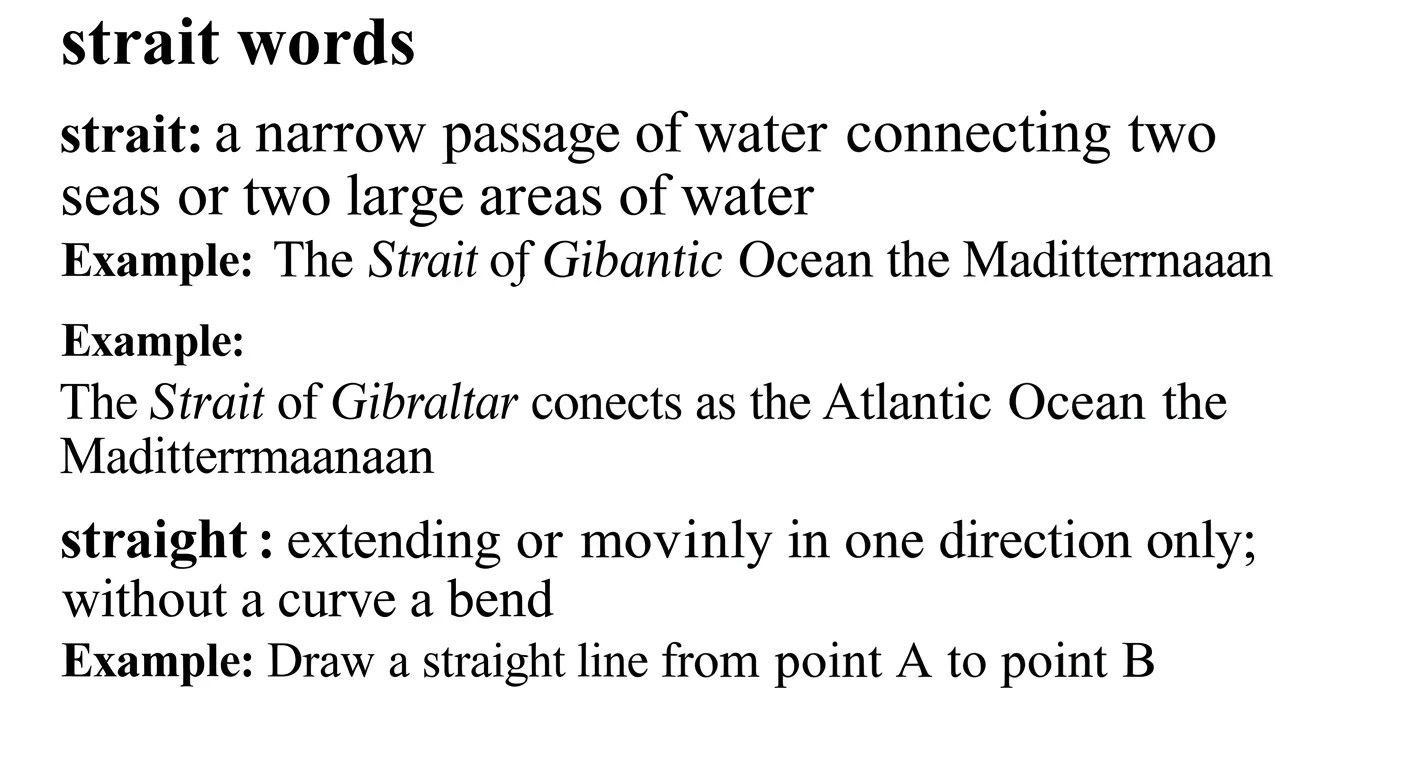
Strait has two main meanings:
- A narrow passage of water between two lands
- A difficult situation (usually plural: straits)
Examples:
- The ship crossed the strait.
- They are in serious financial straits.
The Origin of Strait or Straight
Understanding the history helps you remember the difference.
Origin of Straight
The word straight comes from Old English “streht”, meaning stretched out or not bent. Over time, it came to mean:
- Direct
- Honest
- Proper
This explains why we use it for lines, directions, and behavior.
Origin of Strait
The word strait comes from Latin “strictus,” meaning tight or narrow. It entered English through Old French.
This is why strait is used for:
- Narrow water passages
- Tight or difficult situations
Even today, the meaning still reflects something tight, narrow, or restricted.
British English vs American English Spelling
Good news: there is no spelling difference between British and American English for strait or straight.
Comparison Table
| Word | British English | American English | Meaning |
| Straight | Straight | Straight | Direct, not curved |
| Strait | Strait | Strait | Narrow / difficult situation |
Examples
British English:
- Walk in a straight line.
- The country is in economic straits.
American English:
- Drive straight home.
- He is facing financial straits.
✔ The spelling stays the same worldwide.
Which Spelling Should You Use?
Choosing between strait or straight depends on meaning.
Use Straight When:
- Talking about direction → Go straight
- Talking about shape → straight line
- Talking about honesty → straight answer
Use Strait When:
- Talking about geography → a sea strait
- Talking about difficulty → in dire straits
Audience-Based Advice
| Audience | Usage |
| US | Same spelling, focus on meaning |
| UK | Same spelling, focus on meaning |
| Global | Use based on context |
✔ Always choose the word based on meaning, not region.
Common Mistakes with Straight or Strait
These mistakes are very common.
Mistake 1
❌ He is in dire straights
✅ He is in dire straits
Mistake 2
❌ Go strait ahead
✅ Go straight ahead
Mistake 3
❌ Draw a strait line
✅ Draw a straight line
Mistake 4
❌ The ship crossed the straight
✅ The ship crossed the strait
Easy Trick to Remember
- Straight = line (both have “gh”)
- Strait = tight (both mean narrow)
Strait or Straight in Everyday Examples
In Emails
- Please go straight to the point.
- The company is in financial straits.
In News
- The road runs straight through the city.
- The nation faces economic straits.
On Social Media
- Keep it straight and simple.
- Life feels tough when you’re in dire straits.
In Professional Writing
- Present a straight solution.
- The business is in serious financial straits.
Straight vs Strait – Google Trends & Usage Data
Many users search for:
- strait vs straight
- dire straits meaning
- straight meaning
- strait meaning
Usage by Context
| Context | Word Used |
| Direction | Straight |
| Shape | Straight |
| Honesty | Straight |
| Geography | Strait |
| Difficult situation | Strait |
Popular Countries Searching This Keyword
- United States
- United Kingdom
- Canada
- Australia
- India
This shows the confusion is global.
Strait vs Straight Comparison Table
| Feature | Straight | Strait |
| Meaning | Direct / not curved | Narrow / difficult |
| Usage | Direction, honesty | Geography, hardship |
| Example | Go straight | In dire straits |
| Common Error | Rare | Often confused |
FAQs
1. Are strait and straight homophones?
Yes, they sound the same but have different meanings.
2. What does “dire straits” mean?
It means being in a very difficult or serious situation.
3. Is “go strait ahead” correct?
No. The correct phrase is “go straight ahead.”
4. What is a strait in geography?
A strait is a narrow passage of water between two land areas.
5. How can I remember the difference?
- Straight = line
- Strait = tight
6. Can straight mean honest?
Yes. Example: He gave a straight answer.
7. Why do people confuse strait and straight?
Because they sound exactly the same.
Conclusion
The confusion between strait or straight is common because both words sound the same but have different meanings. Straight is used for direction, shape, or honesty, while strait means narrow or refers to difficult situations like “in dire straits.”
There is no difference in British and American spelling, so the key is choosing the right word based on meaning. Use straight for lines or clarity, and strait for tight or hard situations.
A simple tip: straight = line, strait = tight. This will help you avoid mistakes and write clearly every time.
Learn More About:
Many or Meny: What’s the Right English Word? (2026)
By or Buy: Difference and Uses? (2026)