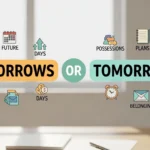
Ever wondered if it’s “tomorrows” or “tomorrow’s”? You’re not alone! Many writers and learners get confused between these tiny but important differences.
Use “tomorrow’s” for possession (something belonging to tomorrow) and “tomorrows” only when talking about multiple future days.Using the wrong form can change your meaning and make your writing look sloppy.
In this guide, we’ll give you a quick answer, reveal the origin, explain British vs American usage, show common mistakes, and share real life examples so you’ll always know which spelling to use.
Tomorrows or Tomorrow’s – Quick Answer
- Tomorrow’s → Possessive form of “tomorrow.” Used when something belongs to or relates to tomorrow.
Example: “Tomorrow’s weather looks sunny.” - Tomorrows → Plural form of “tomorrow.” Rarely used, mostly in literary or poetic contexts.
Example: “We cannot control all our tomorrows.”
Quick tip: If you’re talking about ownership or something happening tomorrow, use tomorrow’s. If you mean multiple future days in a general sense, use tomorrows.
The Origin of Tomorrows and Tomorrow’s
The confusion between tomorrows and tomorrow’s is rooted in English grammar history.
- Tomorrow comes from Old English “to morgen”, meaning “on the morrow” or “the next day.”
- The apostrophe in tomorrow’s indicates possession, a convention in English that started in the 16th century. Writers needed a way to show that something belonged to a day or time.
- Plurals like tomorrows were used more in poetry or philosophical texts, emphasizing multiple future days, e.g., “dreams of endless tomorrows.”
Over time, common usage favored the possessive form for everyday writing, making tomorrow’s the one you’ll see in newspapers, emails, and textbooks.
British English vs American English Spelling
Both British and American English use tomorrow’s with an apostrophe for possession. However, minor stylistic preferences exist:
| Aspect | British English | American English |
| Possessive | tomorrow’s | tomorrow’s |
| Plural | tomorrows (rare, poetic) | tomorrows (rare, poetic) |
| Example Sentence | “Tomorrow’s meeting is important.” | “Tomorrow’s meeting is important.” |
| Informal Writing | Same | Same |
Key insight: There is no difference in spelling for daily usage. The main variation appears in literature or creative writing when multiple future days are referenced.
Which Spelling Should You Use?
- Everyday Writing (Emails, News, Social Media): Use tomorrow’s. Example: “Tomorrow’s schedule is ready.”
- Poetry or Literary Writing: You may see tomorrows. Example: “We chase our tomorrows with hope.”
- Audience Advice:
- US audiences: Stick to tomorrow’s.
- UK/Commonwealth: Same rule applies.
- Global audiences: Using tomorrow’s is safest and universally understood.
Rule of thumb: If you are unsure, always use tomorrow’s. It will rarely be incorrect.
Common Mistakes with Tomorrows or Tomorrow’s
Many mistakes occur because people confuse plural vs possessive.
- Incorrect: “I can’t wait for tomorrows meeting.”
Correct: “I can’t wait for tomorrow’s meeting.” - Incorrect: “We must plan all tomorrow’s in advance.”
Correct: “We must plan all tomorrows in advance.” (poetic/literary) - Incorrect: Using tomorrows when referring to ownership or schedule.
Tip: If you are talking about something related to the next day, always use tomorrow’s.
Tomorrow’s and Tomorrows in Everyday Examples
Emails
- Correct: “Please check tomorrow’s agenda before the meeting.”
- Incorrect: “Please check tomorrows agenda before the meeting.”
News Headlines
- Correct: “Tomorrow’s election results will be announced at noon.”
Social Media
- Correct: “Can’t wait for tomorrow’s party!”
Formal Writing
- Correct: “Tomorrow’s financial report must be submitted by 9 AM.”
Literary Example
- Correct (poetic use): “Our dreams belong to the tomorrows we imagine.”
Tomorrow’s vs Tomorrows – Google Trends & Usage Data
- Keyword Popularity: Searches for “tomorrow’s” are far more common than “tomorrows”, especially in the US, UK, and Australia.
- Context: Most searches involve grammar questions or writing tips.
- Insights: Confusion peaks in January (new year, planning, resolutions) and September (school/work schedules).
- Practical takeaway: Most people are looking for possession guidance, not plural forms.
Comparison Table: Tomorrows vs Tomorrow’s
| Feature | Tomorrows | Tomorrow’s |
| Form | Plural | Possessive |
| Usage | Rare, literary | Common, everyday |
| Example | “We cannot predict all our tomorrows.” | “Tomorrow’s weather will be sunny.” |
| Correct in emails? | ❌ | ✅ |
| Correct in poetry? | ✅ | ✅ |
FAQs
- Q: Can I say “tomorrows meeting”?
A: No, you should say “tomorrow’s meeting”. Apostrophe shows possession. - Q: Is “tomorrows” ever correct?
A: Yes, mainly in poetry or literary writing to mean multiple future days. - Q: Is this difference the same in British and American English?
A: Yes, both use tomorrow’s for possession; plural tomorrows is rare in both. - Q: Can “tomorrow’s” be used in informal writing?
A: Absolutely. It works in casual and formal contexts. - Q: How do I remember the difference?
A: If it belongs to tomorrow, use tomorrow’s; if talking about multiple days, use tomorrows. - Q: Why do some writers use “tomorrows” in novels?
A: For a poetic or reflective tone emphasizing the future in general. - Q: Can I see an example in a newspaper?
A: “Tomorrow’s sports fixtures will be exciting.” Newspapers almost always use tomorrow’s.
Conclusion
Understanding tomorrows vs tomorrow’s is easier than it seems. Use tomorrow’s for possession like schedules, emails, or social posts.
Tomorrows appears rarely, mostly in poetry or creative writing to talk about multiple future days.
For clarity and correctness, stick to tomorrow’s in everyday writing. Just ask yourself: does it belong to tomorrow, or is it about multiple days? That simple check clears up the confusion every time.
Learn More About:
Handle or Handel: Which One Is Right And Wrong (2026)
Devide or Divide: Which Is Correct?