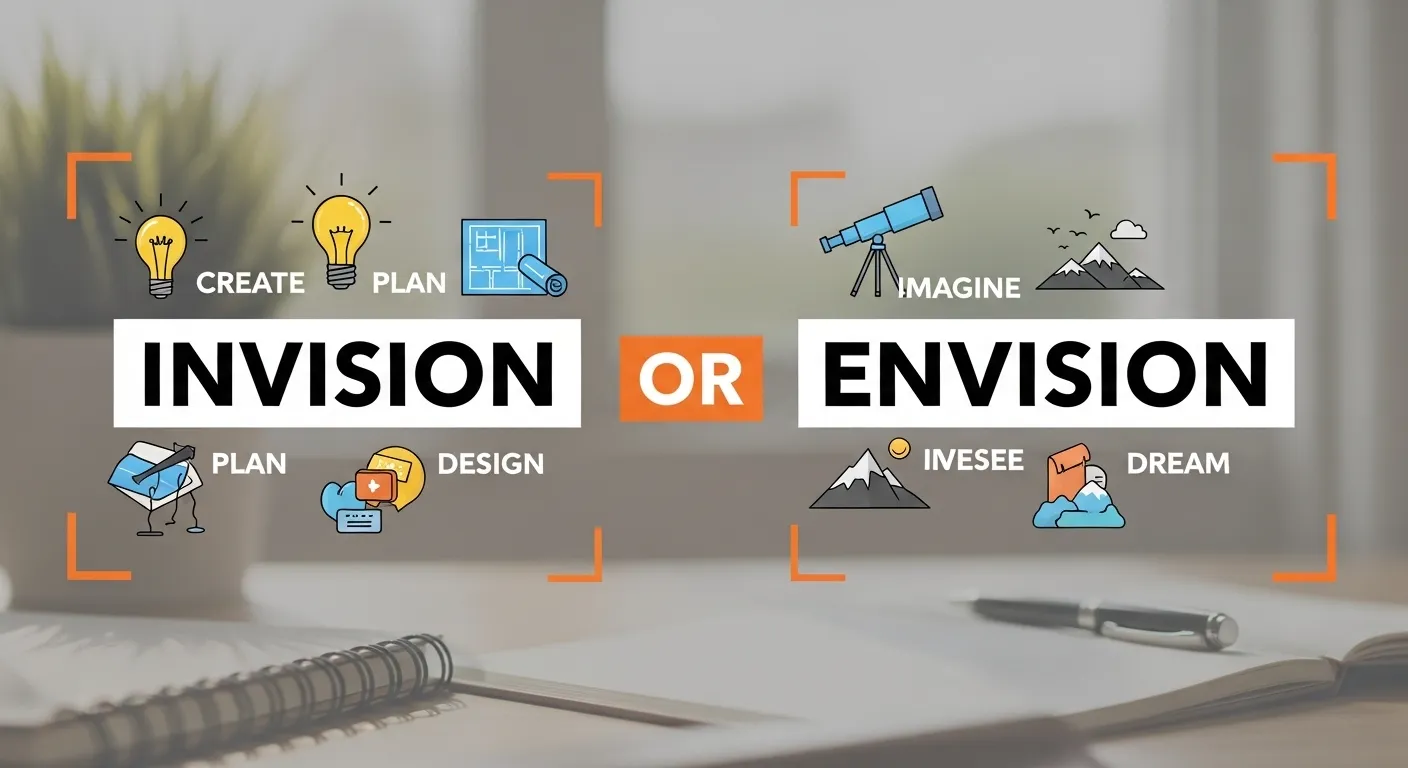
Many writers confuse these spellings because both look believable and sound similar.
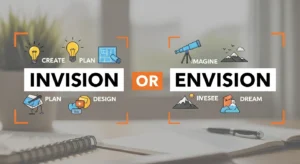
The quick answer is simple: envision is the correct English word. It means to imagine, picture, or mentally see something in the future.
Invision is usually a misspelling, although it is also known as the name of a design software platform.
In this guide, you’ll learn the exact difference between invision and envision, their meanings, common usage, and which spelling you should confidently use in professional writing.
Invision or Envision – Quick Answer
The correct English word is envision.
It means:
- to imagine something
- to picture the future
- to mentally plan or visualize an idea
Examples
- I envision a better future.
- She envisioned a modern office design.
- The company envisions global growth.
What About “Invision”?
Invision is usually a spelling mistake of envision.
However, it may also refer to:
- a brand name
- a company name
- a software platform
In normal English writing, you almost always need envision.
The Origin of Invision and Envision
Understanding the history of these words makes the difference easier.
Origin of Envision
The word envision comes from:
- the prefix en- meaning “to cause” or “to put into”
- the word vision, meaning sight or imagination
The word developed in English to describe mentally imagining something clearly.
Over time, it became common in:
- business writing
- education
- leadership
- motivational language
Origin of Invision
The form invision does not have a recognized historical role as a standard English verb.
Instead, it mostly appears:
- as a misspelling of envision
- as a brand or company name
For example, InVision Platform was a well-known digital design company.
This is one reason many people think “invision” might be correct.
British English vs American English Spelling
Unlike many English spelling differences, envision is spelled the same in both British and American English.
There is no regional spelling variation here.
Comparison Table
| Feature | British English | American English |
| Correct spelling | Envision | Envision |
| Alternative form | None | None |
| Meaning | Imagine or visualize | Imagine or visualize |
| Standard usage | Yes | Yes |
Examples
British English
- We envision a cleaner future.
American English
- They envision a stronger economy.
The spelling stays the same worldwide.
Which Spelling Should You Use?
The answer is simple.
Use “Envision” In:
- essays
- emails
- blogs
- business writing
- professional communication
- academic content
Avoid “Invision” Unless:
- you are referring to a brand name
- you are discussing design software
- it is part of a company title
Audience Based Advice
| Audience | Recommended Spelling |
| United States | Envision |
| United Kingdom | Envision |
| Canada | Envision |
| Australia | Envision |
| Global audience | Envision |
Simple Rule
If you mean:
- imagine
- picture mentally
- see in the future
→ always use envision
Common Mistakes with Envision or Invision
Many people accidentally write “invision” because it sounds similar to envision.
Here are the most common errors.
Mistake 1: Using Invision in Normal Writing
❌ I invision a successful future.
✔ I envision a successful future.
Mistake 2: Confusing It With a Brand Name
Some writers see the company name “InVision” online and assume it is standard English.
✔ Correct:
- The company uses InVision software.
- I envision better results next year.
Mistake 3: Spellcheck Confusion
Some devices fail to clearly mark “invision” as incorrect because brand names exist online.
Always double-check context.
Quick Tip to Remember
“Envision” Contains “Vision”
Since envision means to mentally see or imagine something, the connection with “vision” helps you remember the correct spelling.
✔ envision = mentally visualize
Envision and Invision in Everyday Examples
Real life examples make the difference easier.
In Emails
- We envision strong growth next year.
- I envision a more efficient workflow.
In Business Writing
- The company envisions global expansion.
- Leaders envision long-term success.
On Social Media
- I envision a peaceful future.
- Can you envision living abroad?
In Academic Writing
- Researchers envision new medical solutions.
- Experts envision cleaner energy systems.
In Motivational Writing
- Envision your goals clearly.
- Successful people envision progress.
Invision vs Envision: Comparison Table
| Word | Correct English Word? | Meaning | Usage |
| Envision | Yes | Imagine or visualize | Standard English |
| Invision | Usually no | Brand name or misspelling | Limited use |
Envision vs Invision – Google Trends & Usage Data
Search trends show that envision is searched far more often than invision.
Why People Search “Invision”
People search “invision” because:
- they hear the word spoken
- they confuse the spelling
- they know the software brand
- autocorrect mistakes occur
Popular Usage Contexts for “Envision”
Business
- envision growth
- envision strategy
Education
- envision success
- envision the future
Leadership
- envision change
- envision innovation
Personal Development
- envision your goals
- envision happiness
Popular Countries Searching These Terms
High search interest appears in:
- United States
- United Kingdom
- India
- Pakistan
- Canada
- Australia
This shows the confusion is global.
Why People Confuse Invision and Envision
There are several reasons behind the confusion.
1. Similar Sound
Both words sound nearly identical when spoken quickly.
2. Prefix Confusion
English contains many words beginning with:
- in-
- en-
This makes both spellings appear believable.
3. Online Brand Recognition
The popularity of the InVision company increased visibility for the spelling “invision.”
As a result, many users assume it is standard English.
4. Typing Errors
Fast typing often changes:
- envision → invision
This is one of the most common causes.
Simple Memory Trick
A quick way to remember the correct spelling is:
“Envision helps you see a vision.”
Because the word relates to imagination and visualization, “envision” matches the meaning perfectly.
Related Words Similar to Envision
Learning related vocabulary can improve understanding.
| Word | Meaning |
| Imagine | Form a mental picture |
| Visualize | See mentally |
| Predict | Expect future events |
| Foresee | Anticipate |
| Dream | Think hopefully about future |
These words are closely connected to envision.
When to Use Envision
Use envision whenever you mean:
- imagine
- mentally picture
- think about the future
- visualize possibilities
Examples
- I envision success.
- They envision new opportunities.
- She envisioned a better system.
When to Use Invision
Use InVision only when discussing:
- the company
- software tools
- branding
Example
- Designers once used InVision for prototypes.
Outside of brand references, avoid using “invision.”
FAQs
1. Is it envision or invision?
The correct English word is envision.
2. What does envision mean?
Envision means to imagine, picture, or mentally visualize something.
3. Is invision a real word?
Not as a standard English word. It is mostly used as a brand name or misspelling.
4. Why do people write invision?
People confuse the spelling because both words sound similar.
5. Is envision used in British English?
Yes. Both British and American English use “envision.”
6. Can I use invision in formal writing?
No, unless you are referring to a company or product name.
7. What is a simple way to remember envision?
Think:
- envision = vision = mentally see
Conclusion
The difference between invision and envision is simple: envision is the correct English word. It means to imagine or picture something in the future.
Invision is usually a misspelling, except when referring to a brand or company name.
A simple trick to remember:
Envision helps you see a vision.
Discover More About:
Unattentive or Inattentive: Meaning, Difference And Usage
Devide or Divide: Which Is Correct?

I’m a U.S. based content writer and language researcher with a strong focus on English grammar, spelling differences, and frequently confused terms. My writing is aimed at helping readers write more clearly and correctly in daily use, workplace communication, and digital content.