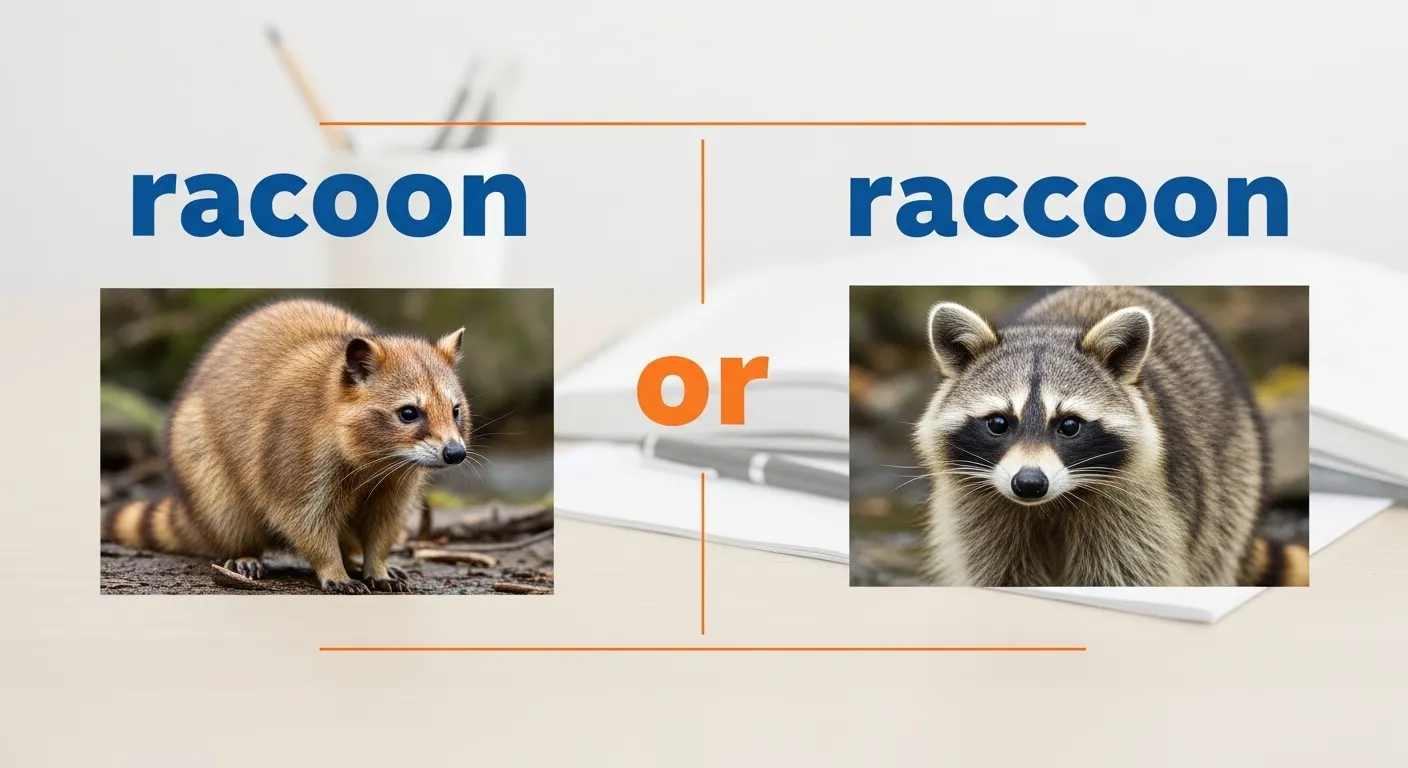
Have you ever wondered: Is it racoon or raccoon? You’re not alone. Many students, writers, and wildlife lovers get confused because both spellings appear online.
The confusion comes from historical texts and informal writing some use a single “o,” but the correct modern spelling is raccoon. Using the wrong form can make your writing look unprofessional, especially in articles, SEO content, or academic work.
This guide clears it all up. You’ll learn the correct spelling, its origin, British vs American usage, common mistakes, examples, and search trends so you can confidently write raccoon every time.
Racoon or Raccoon – Quick Answer
The correct modern spelling is raccoon with two c’s.
Racoon is a common misspelling and is not recommended in professional or academic writing.
Examples:
- Correct: The raccoon scavenged through the trash last night.
- Incorrect: The racoon scavenged through the trash last night.
Quick tip: Always use raccoon. It is widely recognized by dictionaries, wildlife organizations, and modern English style guides.
The Origin of Raccoon or Racoon
The word raccoon comes from the Powhatan Native American language word arakun, which roughly means “animal that scratches with its hands.”
History:
- Early European settlers adopted the term from the Powhatan people in the 1600s.
- Early spellings in English texts were inconsistent: sometimes racoon, sometimes raccoon.
- Over time, raccoon with double “c” became standard in dictionaries and scientific writing.
Why confusion exists:
- Historical texts sometimes show racoon, leading to its continued informal use.
- Digital content, blogs, and casual writing often repeat the older spelling.
- Mispronunciation or guessing also contributes to errors.
British English vs American English Spelling
Interestingly, there is no real difference between British and American English for this word. Both officially accept raccoon as the standard spelling.
| Spelling | British English | American English | Notes |
| Raccoon | ✔ Correct | ✔ Correct | Modern standard |
| Racoon | ❌ Incorrect | ❌ Incorrect | Historical/incorrect |
Key takeaway: Regardless of where you are US, UK, Canada, or Australia raccoon is the accepted spelling.
Which Spelling Should You Use?
Always use raccoon:
- US audience: Raccoon is recognized by American dictionaries and wildlife guides.
- UK/Commonwealth audience: Also use raccoon; “racoon” may be seen as a typo.
- Global writing: For SEO, blogs, and academic writing, stick with raccoon.
Situations where racoon appears:
- Informal social media posts
- User-generated content
- Old books or casual storytelling
Even here, raccoon is preferred for clarity and professionalism.
Common Mistakes with Racoon or Raccoon
Mistake 1: Dropping a “c”
❌ The racoon was climbing the fence.
✅ The raccoon was climbing the fence.
Mistake 2: Confusing with “rakuon” or other variants
❌ Rakuon is not correct; stick to raccoon.
Mistake 3: Using racoon in formal writing
Avoid racoon in essays, news articles, scientific papers, or professional content.
Mistake 4: Assuming regional spelling differences
There is no UK vs US variation; both use raccoon.
Racoon or Raccoon in Everyday Examples
Emails
- Correct: “A raccoon was seen near the campsite last night.”
- Incorrect: “A racoon was seen near the campsite last night.”
News
- “City officials are warning residents about raccoon activity in urban areas.”
Social Media
- Users may write: Look at this cute racoon! (informal, but technically wrong)
Formal Writing
- “The raccoon (Procyon lotor) is native to North America and often adapts to urban environments.”
Using the correct spelling improves credibility and readability across platforms.
Racoon or Raccoon – Google Trends & Usage Data
Search trends show raccoon dominates globally.
Insights:
- United States: Searches mostly use raccoon, particularly for wildlife articles.
- United Kingdom: Slightly more people type racoon, but it’s still considered incorrect.
- Global audience: “Raccoon” is overwhelmingly more common, appearing in scientific, educational, and entertainment content.
Key takeaway: Using raccoon ensures your content aligns with popular search terms and improves SEO.
Racoon or Raccoon – Comparison Table
| Feature | Raccoon | Racoon |
| Correctness | ✔ Correct | ❌ Incorrect |
| Usage | Worldwide | Historical/rare |
| Dictionaries | ✅ Recognized | ❌ Not standard |
| Professional writing | ✅ Yes | ❌ Avoid |
| SEO & Google | ✅ Popular | ❌ Low volume |
FAQs:
1. Which is correct: racoon or raccoon?
Raccoon with double “c” is correct; racoon is a misspelling.
2. Is racoon ever acceptable?
Informally, it appears online, but it’s not recommended for professional or academic use.
3. Why do some people write racoon?
Historical texts, informal writing, or simple spelling mistakes.
4. Is raccoon used the same in British and American English?
Yes, both regions officially recognize raccoon.
5. How do I remember the correct spelling?
Think of the double “c” as representing the animal’s two curious eyes or claws—it’s distinctive like the raccoon’s mask.
6. Are there other similar animals with spelling confusion?
Yes, like opossum/possum, but raccoon is universally standardized.
7. Can I use racoon in social media captions?
You can, but for accuracy and SEO, stick with raccoon.
Conclusion:
The confusion between racoon and raccoon is common but easy to fix.
The correct, modern spelling is raccoon with two c’s, recognized worldwide.
Its origin comes from the Powhatan language, and historical variations like racoon are now outdated.
There’s no British vs American difference. For clarity, professionalism, and SEO, always use raccoon in writing.
Discover More About:
Calvary or Golgotha: What’s the Difference? (2026)
Dieing or Dying: A Simple Guide To The Correct Spelling In 2026