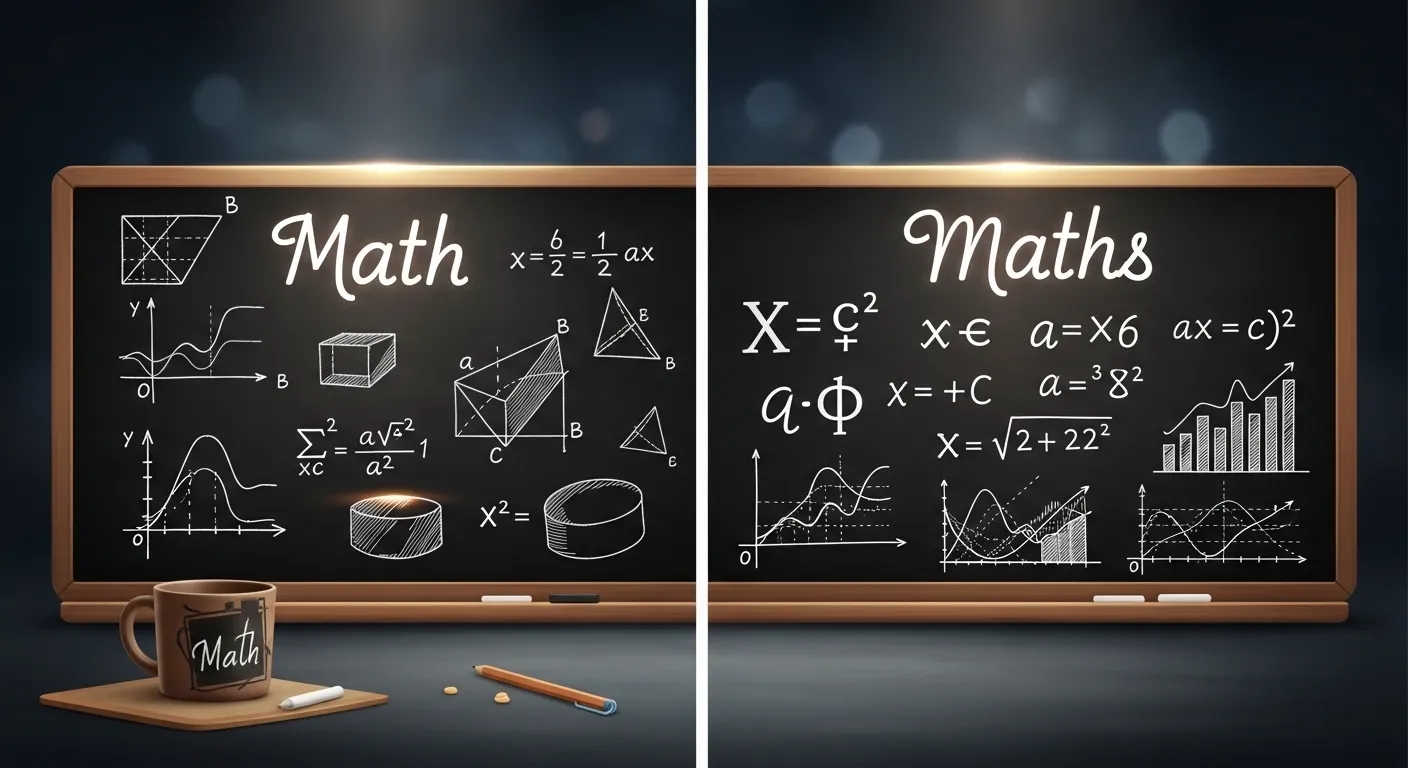
When it comes to numbers, many wonder: Is it math or maths?
Both refer to the same subject, but the correct spelling depends on your audience.
Students, writers, and professionals often search for this to ensure clear communication.
This guide explains the history, regional differences, and proper usage so you can write confidently without mistakes.
Math or Maths – Quick Answer
Quick Answer:
- Math → Used primarily in American English.
- Example: I enjoy learning math every day.
- Example: I enjoy learning math every day.
- Maths → Used primarily in British English and Commonwealth countries.
- Example: I have a maths test tomorrow.
- Example: I have a maths test tomorrow.
Both words are correct in their respective regions, and the meaning does not change. The difference is purely spelling and audience preference.
The Origin of Math/Maths
The words math and maths come from the word mathematics, which itself originates from the Greek word “mathema” meaning “knowledge, study, or learning.”
- Mathematics → Formal, long form of the subject.
- Over time, English speakers shortened it:
- In America, the shortened form became math.
- In Britain, the shortened form became maths, keeping the plural feel of mathematics.
- In America, the shortened form became math.
Historically, both forms have been in use for centuries, but modern style guides standardize the choice based on regional conventions.
British English vs American English Spelling
The difference between math and maths is a classic example of regional spelling variation. Here’s a simple breakdown:
| Feature | American English | British English / Commonwealth |
| Shortened form of mathematics | Math | Maths |
| Plural sense | Singular | Plural |
| Usage in schools & textbooks | Math | Maths |
| Example sentence | Math is fun. | Maths is fun. |
Key point: If you are writing for an American audience, always use math. For British or Commonwealth readers, maths is correct.
Which Spelling Should You Use?
Choosing the correct spelling depends on your audience:
- US Audience: Always use math.
- Example: She is excellent at math.
- Example: She is excellent at math.
- UK/Commonwealth Audience (UK, Australia, India, Canada): Use maths.
- Example: He struggles with maths homework.
- Example: He struggles with maths homework.
- Global Content / Online Articles: Consider your audience. If writing internationally, British English is often preferred in education topics.
Tip: Consistency matters. Avoid switching between math and maths in the same text.
Common Mistakes with Math/Maths
Even native speakers sometimes get confused. Here are common mistakes and corrections:
| Incorrect | Correct (US) | Correct (UK) |
| I love learning maths. | I love learning math. | I love learning maths. |
| Math is difficult, isn’t it? | Math is difficult, isn’t it? | Maths is difficult, isn’t it? |
| She failed mathes. | She failed math. | She failed maths. |
| Math’s is my favorite subject. | Math is my favorite subject. | Maths is my favorite subject. |
Tip: Avoid adding apostrophes unnecessarily. “Math’s” is almost always wrong unless you mean “math is.”
Math or Maths in Everyday Examples
Here’s how the words appear in different writing contexts:
Emails & Professional Writing:
- US: I will help you with math homework this weekend.
- UK: I will help you with maths homework this weekend.
News Articles:
- US: New methods are improving math education in schools.
- UK: New methods are improving maths education in schools.
Social Media:
- US: Who else struggles with math?
- UK: Who else struggles with maths?
Formal Academic Writing:
- US: The research focuses on applied math.
- UK: The research focuses on applied maths.
Math or Maths – Google Trends & Usage Data
Google Trends shows clear regional differences in search behavior:
- United States: Searches almost exclusively use math.
- United Kingdom, Australia, India, Canada: Searches prefer maths.
Observation: Global websites sometimes rank better using maths because educational content often targets British English audiences.
Example Search Comparison Table:
| Keyword | US Searches | UK Searches | Global Relevance |
| Math | High | Low | Medium |
| Maths | Low | High | High |
This confirms the strong regional preference and helps content creators choose the right form for SEO optimization.
Comparison Table: Math vs Maths
| Feature | Math | Maths |
| Region | United States | UK & Commonwealth |
| Short for | Mathematics | Mathematics |
| Plural Sense | No | Yes |
| Example Sentence | Math is fun. | Maths is fun. |
| Google Search Popularity | High in US | High in UK |
FAQs
1. Is math or maths correct?
- Both are correct. Use math for US audiences and maths for UK/Commonwealth audiences.
2. Why do Americans say math and Brits say maths?
- Americans simplified the word by dropping the “s” for convenience, while British English kept the plural feel.
3. Can I use math and maths interchangeably?
- It’s best not to. Use the form that matches your audience to avoid confusion.
4. Which is better for international writing?
- Maths is generally preferred for global education content because British English is more widely taught internationally.
5. Is mathematics singular or plural?
- Mathematics is singular in formal writing, even though it ends with “s.”
6. Are there style guides recommending one form?
- Yes, AP Style (US) recommends math, while Oxford/ Cambridge (UK) recommend maths.
7. What about spoken English?
- Pronunciation is nearly identical; only spelling differs. Americans say math, Brits say maths.
Conclusion:
The choice between math and maths is simple once you understand your audience.
Math is the standard in the United States, while maths dominates in the UK and other Commonwealth countries.
Both are short forms of mathematics, and the difference is purely regional, not grammatical.
For professional writing, academic papers, or online content, choosing the right form shows attention to detail and cultural awareness.
Always remain consistent in your text. Remember, clarity for your readers matters more than personal preference.
By following these guidelines, you can confidently write about math or maths without hesitation, keeping your communication precise, professional, and universally understandable.
If you are a student, teacher, content writer, or blogger, understanding this simple distinction will save you confusion and improve your credibility.

I’m a U.S. based content writer and language researcher with a strong focus on English grammar, spelling differences, and frequently confused terms. My writing is aimed at helping readers write more clearly and correctly in daily use, workplace communication, and digital content.