Many writers pause when typing bosses or boss’s. Both look right. Both sound the same. But they mean very different things. One tiny mark the apostrophe changes the meaning completely.
People search for this because English plural and possessive rules can feel confusing. When a word already ends in -s, adding another -s or an apostrophe makes it harder. Is it plural? Is it ownership? Or both?
If you’ve ever written “My boss’s instructions” and stopped to double-check, you’re not alone. Even experienced writers get unsure.
In this guide, you’ll learn the quick answer, simple rules, key differences, and clear examples so you never mix them up again.
Bosses or Boss’s – Quick Answer
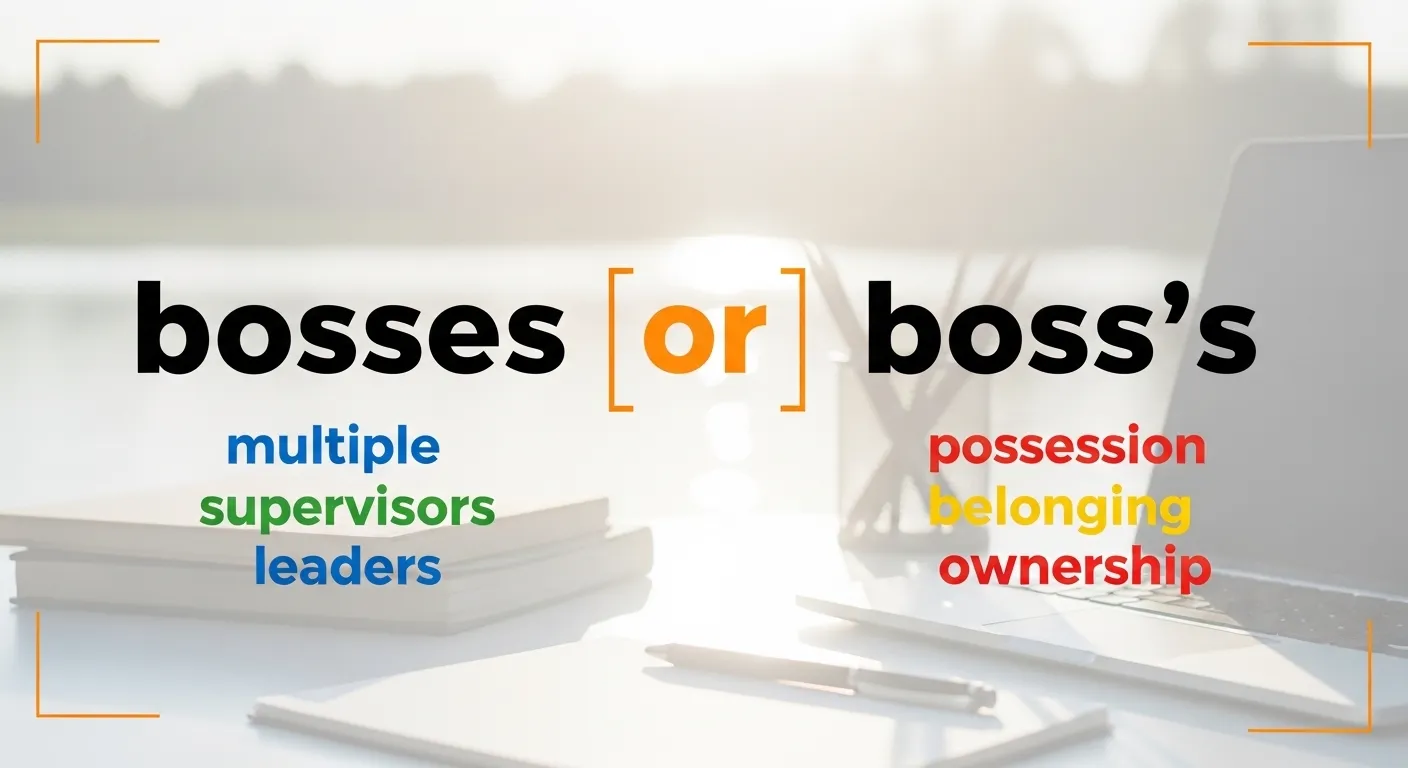
Bosses is plural.
Boss’s is singular possessive.
Simple Rule:
- Bosses = more than one boss
- Boss’s = something that belongs to one boss
Examples:
- I met all the bosses at the meeting. ✅ (plural)
- This is my boss’s office. ✅ (one boss owns the office)
If you are talking about ownership, use an apostrophe.
If you are talking about more than one person, do not use an apostrophe.
The Origin of Boss’s or Bosses
The word boss comes from the Dutch word baas, meaning master or overseer. It entered English in the 17th century in America.
English forms plurals by adding -s or -es:
- cat → cats
- bus → buses
- boss → bosses
Since boss ends in -s, we add -es to make it plural: bosses.
For possession, English uses an apostrophe:
- cat’s toy
- teacher’s book
- boss’s car
Because boss already ends in -s, we still add ’s in most modern style guides:
- boss’s decision
This is why confusion happens. You see bosses and boss’s, and both look similar.
But remember:
Plural = add -es
Possessive = add ’s
British English vs American English Spelling
Good news: There is no spelling difference between British and American English for this word.
Both use:
- Bosses (plural)
- Boss’s (singular possessive)
However, some style guides in British English allow a slight variation for possessives of words ending in -s.
American English Rule
In American English, especially under style guides like the Chicago Manual of Style and Associated Press:
- Always add ’s to singular nouns
- boss → boss’s
Example:
- My boss’s report is ready.
British English Rule
In British English, some style guides allow:
- boss’s (more common today)
- boss’ (less common, older style)
Example:
- My boss’ office (allowed in some UK publications)
Comparison Table
| Form | American English | British English | Meaning |
| Bosses | ✅ | ✅ | More than one boss |
| Boss’s | ✅ Standard | ✅ Standard | Belonging to one boss |
| Boss’ | ❌ Rare | ⚠ Sometimes allowed | Belonging to one boss |
Modern global English prefers boss’s.
Which Spelling Should You Use?
Your choice depends on what you mean.
If You Are in the US
Use:
- Bosses (plural)
- Boss’s (singular possessive)
Always follow the ’s rule.
If You Are in the UK or Commonwealth
Use:
- Bosses (plural)
- Boss’s (recommended)
You may see boss’, but it is less common today.
If You Write for a Global Audience
Use:
- Bosses
- Boss’s
This avoids confusion and follows modern standards.
Common Mistakes with Bosses or Boss’s
Here are the most frequent errors.
❌ Mistake 1: Using apostrophe for plural
Wrong:
- I met three boss’s yesterday.
Correct:
- I met three bosses yesterday.
Apostrophes do not make words plural.
❌ Mistake 2: Forgetting apostrophe for possession
Wrong:
- My bosses car is new. (if one boss)
Correct:
- My boss’s car is new.
❌ Mistake 3: Confusing plural possessive
If you have more than one boss and something belongs to all of them:
Plural possessive = bosses’
Example:
- The bosses’ meeting lasted two hours.
Rule:
- Plural (bosses) + apostrophe at the end → bosses’
Bosses or Boss’s in Everyday Examples
Let’s see how this works in real life.
Email Example
- My boss’s feedback was helpful.
- All the bosses agreed on the plan.
- The bosses’ decision was final.
News Example
- Company bosses announced new policies.
- The boss’s statement surprised employees.
Social Media Example
- My boss’s mood today 😅
- The bosses are watching!
Formal Writing Example
- The bosses’ approval is required before release.
- The boss’s authority was clearly defined.
Bosses or Boss’s – Google Trends & Usage Data
Search data shows that many people type:
- boss’s
- bosses
- bosses or boss’s
Most confusion comes from:
- Apostrophe placement
- Words ending in -s
- School grammar rules
In the United States, boss’s is more common in formal writing.
In the UK, both forms appear, but boss’s dominates modern publications.
Search interest is high in:
- US
- UK
- Canada
- Australia
This shows it is a global grammar question.
Comparison Table: Bosses vs Boss’s
| Word | Type | Meaning | Example |
| Bosses | Plural noun | More than one boss | The bosses met today. |
| Boss’s | Singular possessive | One boss owns something | The boss’s office is upstairs. |
| Bosses’ | Plural possessive | Multiple bosses own something | The bosses’ meeting was long. |
FAQs:
1. Is boss’s grammatically correct?
Yes. Boss’s is correct when showing possession.
2. Is bosses the plural of boss?
Yes. Add -es because the word ends in -s.
3. What is the plural possessive of boss?
It is bosses’.
Example:
- The bosses’ rules were strict.
4. Can I write boss’ instead of boss’s?
In American English, no.
In British English, sometimes but boss’s is preferred.
5. Why do people confuse bosses and boss’s?
Because both look similar and both end in -s.
6. How do I remember the difference?
Think:
- More than one? → bosses
- Belongs to one? → boss’s
7. Is bosses ever possessive?
Yes, when written as bosses’.
Conclusion:
The difference between bosses or boss’s is simple once you understand the rule.
Bosses is plural. Boss’s shows possession.
The confusion happens because the word already ends in -s, and adding more letters or punctuation makes it look complex.
In American English, always use boss’s for singular possession.
In British English, boss’s is also standard, though boss’ may appear in older styles. For global writing, boss’s is the safest choice.
Remember:
- No apostrophe for plural.
- Apostrophe + s for singular possession.
- Apostrophe after s for plural possession.
With this rule, you can write emails, reports, posts, and academic work with confidence. Small grammar details build trust and professionalism. Now you know exactly when to use bosses and when to use boss’s.
Find More About:
Trialled or Trialed: Which Spelling Is Correct? (2026)
Maximise or Maximize: Which Is Correct?