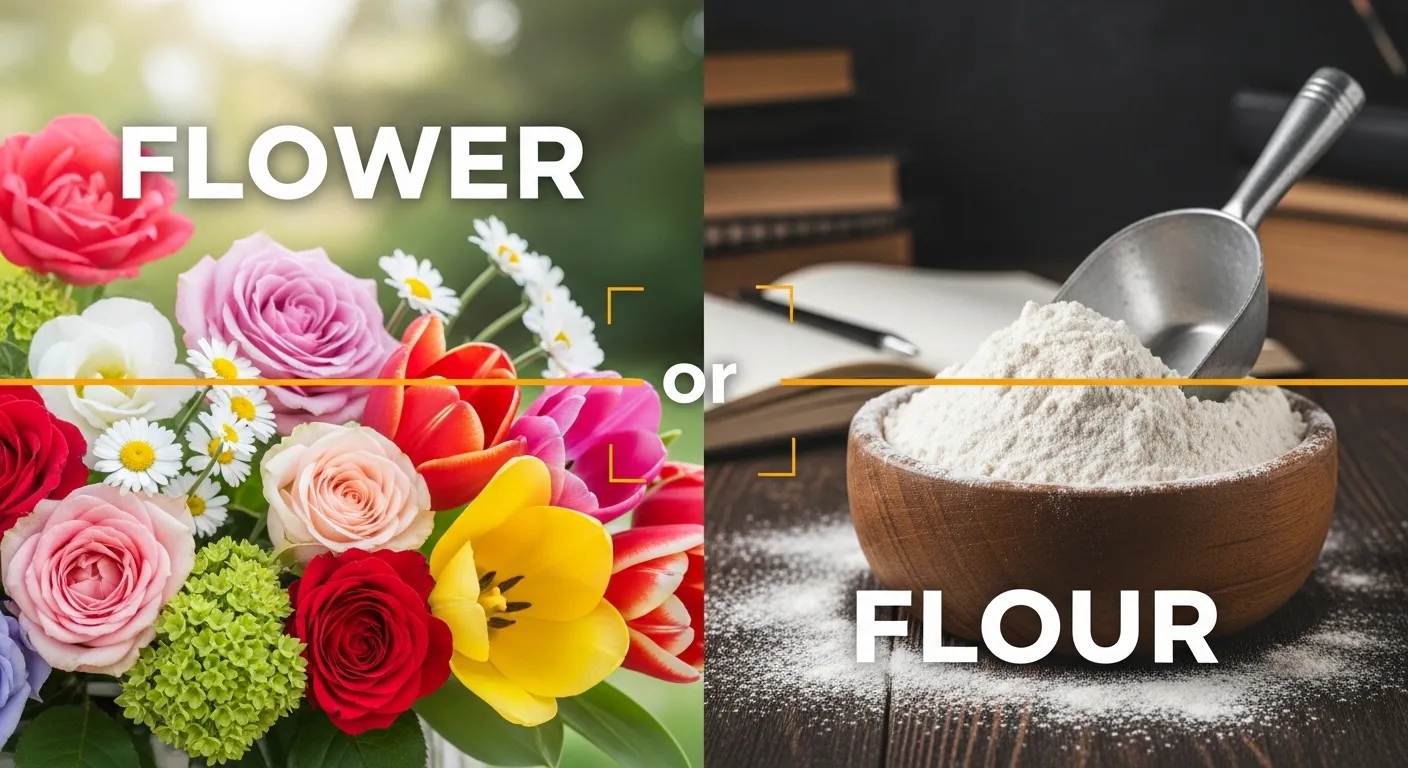
English has many words that sound alike but mean very different things. Flower or flour is a classic example.
Flower is a plant’s bloom, while flour is the powder used in baking.
Confusing them is common, especially in emails, schoolwork, or social media.
In this guide, you’ll quickly learn the difference, correct usage, common mistakes, and easy examples so you always use the right word, whether talking about gardening or baking.
Flower or Flour – Quick Answer
| Word | Meaning | Example |
| Flower | The colorful part of a plant | The garden is full of beautiful flowers. |
| Flour | Fine powder from grains, used in cooking | I need flour to bake a cake. |
Flower
- Refers to plants’ blooms.
- Can be singular (flower) or plural (flowers).
- Figurative meaning: beauty, growth, or flourishing.
Examples:
- She picked a flower from the garden.
- Tulips are my favorite flowers.
- The city began to flower with new ideas.
Flour
- Refers to ground grains used for cooking or baking.
- Common types: wheat flour, rice flour, almond flour.
Examples:
- Add two cups of flour to the recipe.
- Bread is made using flour and yeast.
- He spilled some flour while baking.
The Origin of Flower or Flour
Origin of Flower
The word flower comes from the Old French “flor” and Latin “flos”, meaning bloom. Over centuries, the spelling changed to flower, and its meaning has remained tied to plants and growth.
Origin of Flour
Flour comes from the Old French “fleur”, which literally means “the finest part of ground grain” or “blossom/choice.” In medieval times, the best part of milled grain was called “flour,” linking the idea of refinement and quality.
Interestingly, both words share a common root in Latin “flos” (flower), which explains why they sound identical in modern English.
British English vs American English Spelling
Unlike many words, flower and flour spellings do not change between British and American English. Both are universal, but confusion arises because of pronunciation.
Comparison Table
| Word | British English | American English | Meaning |
| Flower | Flower | Flower | Plant bloom |
| Flour | Flour | Flour | Ground grain for cooking |
Example Sentences – British English:
- The garden has beautiful flowers.
- I need flour to make scones.
Example Sentences – American English:
- The flowers in the backyard are blooming.
- She bought flour from the grocery store.
Which Spelling Should You Use?
The word choice depends entirely on meaning:
Use Flower When Talking About Plants
- Example: She placed a flower in the vase.
- Figurative: Creativity can flower in a supportive environment.
Use Flour When Talking About Cooking or Baking
- Example: Add flour to the dough.
- Other examples: Cake, bread, cookies, pancakes.
Audience-Based Advice
| Audience | Recommended Usage |
| US | Flower (plants) / Flour (baking) |
| UK | Flower (plants) / Flour (baking) |
| Australia / Canada | Same rules as US/UK |
| Global | Follow meaning: Flower = bloom, Flour = cooking |
Rule of thumb: Think about context plants or baking and the correct word becomes obvious.
Common Mistakes with Flour or Flower
1
- Incorrect: She added flower to the cake.
- Correct: She added flour to the cake.
Tip: Cake doesn’t bloom; it needs flour!
2
- Incorrect: The kitchen smelled like flowers.
- Correct: The kitchen smelled like flour.
Tip: Flowers smell sweet; flour smells like raw grain.
3
- Incorrect: He planted some flour in the garden.
- Correct: He planted some flowers in the garden.
Tip: You plant blooms, not powder.
Memory Trick:
- Flower = bloom, plant
- Flour = powder, cooking
Flower or Flour in Everyday Examples
In Emails
- Garden club: “Our flower beds need watering this week.”
- Cooking blog: “Use 2 cups of flour for the recipe.”
In News Articles
- Flowers: “Spring flowers brighten the city parks.”
- Flour: “Flour prices are rising due to supply shortages.”
On Social Media
- Flower: “Look at these amazing flowers in my garden 🌸.”
- Flour: “Baking cookies with extra flour today! 🍪”
In Formal Writing
- Flowers: “The study focused on flower diversity in urban areas.”
- Flour: “The recipe requires finely sifted flour for best results.”
Flour vs Flower – Google Trends & Usage Data
Search trends show that many people confuse flower or flour, especially students, bloggers, and ESL learners.
Contextual Popularity
| Context | Most Common Word |
| Gardening | Flower |
| Cooking / Baking | Flour |
| Figurative Writing | Flower (as in “ideas flower”) |
Popular Search Countries
- United States
- United Kingdom
- Canada
- Australia
- India
Homophone confusion is global people often search “flower or flour meaning” or “difference between flower and flour.”
Flower vs Flour :Comparison Table
| Feature | Flower | Flour |
| Type | Noun | Noun |
| Meaning | Plant bloom | Ground grain for cooking |
| Figurative Meaning | Growth, beauty, flourishing | None |
| Example | Pick a flower from the garden | Add flour to the batter |
| Category | Nature / Plants | Cooking / Baking |
FAQs
1. Are flower and flour homophones?
Yes. They sound the same but have different meanings and spellings.
2. Can flower be used as a verb?
Yes. “Ideas flower when people collaborate.” It means to grow or develop.
3. Can flour be used as a verb?
Yes. “Flour the baking tray lightly.” It means to sprinkle flour on something.
4. Why do people confuse flower and flour?
Because they sound identical when spoken, but have very different meanings.
5. Is “flower in the cake” ever correct?
No. Cakes need flour, not blooms.
6. How can I remember the difference?
Flower = bloom / plant, Flour = cooking powder. Think about context.
7. Does spelling change between UK and US English?
No. Both words are spelled the same worldwide.
Conclusion
The confusion between flower or flour is common because they sound the same but mean different things.
Flower = plant blooms or growth, flour = baking powder.
Use flower for plants or figurative growth, and flour for cooking or recipes. Spelling is the same in British and American English just pick the word that fits the context.
Following this simple rule keeps your writing clear and professional.
Discover More About:
Maximise or Maximize: Which Is Correct?
Handle or Handel: Which One Is Right And Wrong (2026)