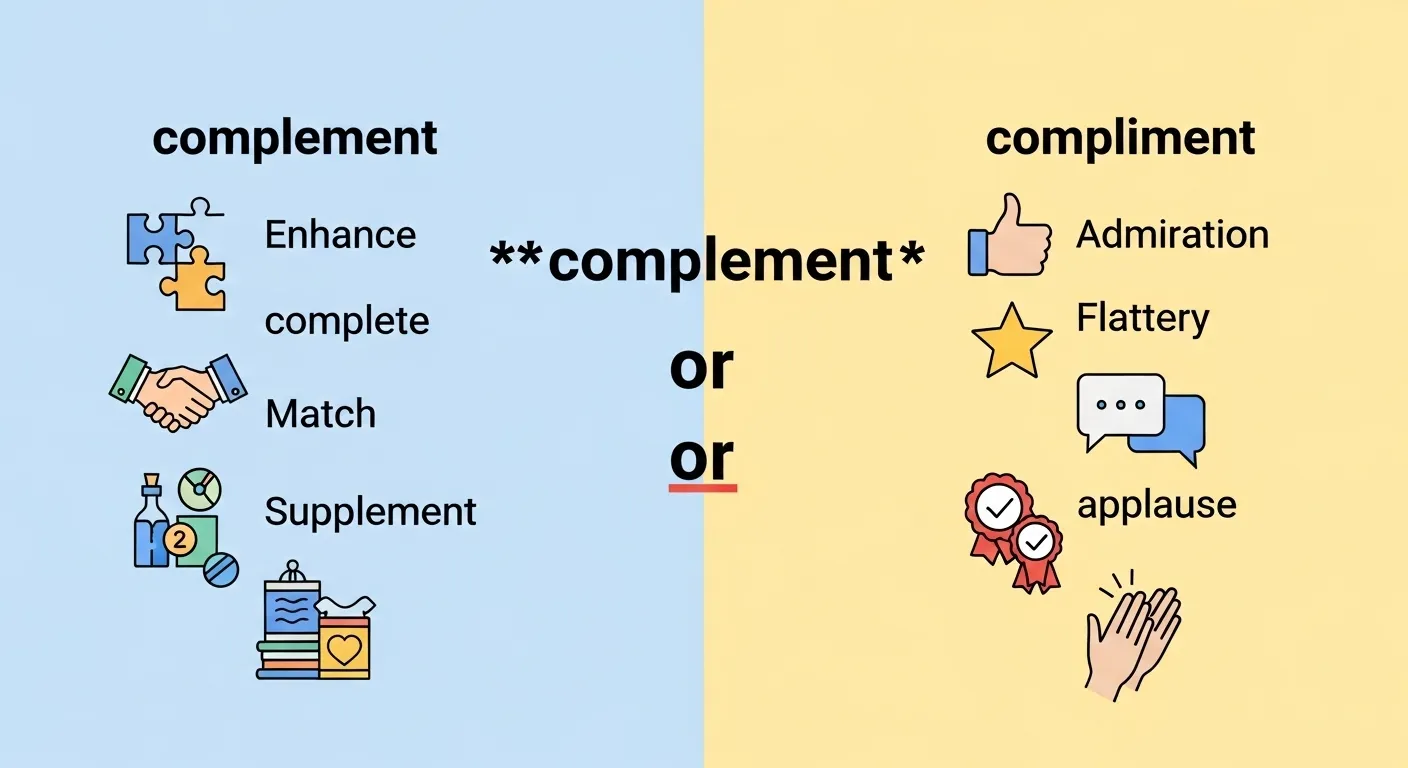
Have you ever confused “complement” or “compliment” because they sound the same but have different spellings and meanings? You’re not alone. Complement refers to something that completes, improves, or goes well with something else, while compliment means a positive remark or expression of praise. These two words are homophones, so choosing the correct spelling depends on what you mean.
For example, “The blue shoes complement her dress” means the shoes look good with the dress. But “He gave her a compliment” means he said something nice about her. Both words can also be used as verbs: complement means to enhance or complete, while compliment means to praise.
Understanding complement or compliment can help you avoid common spelling and word-choice mistakes in emails, essays, messages, and everyday writing. This guide explains their meanings, pronunciation, examples, common mistakes, and an easy trick to remember which word to use.
Complement or Compliment
Here is the simple rule:
- Complement (with “e”) = something that completes or improves something.
- Compliment (with “i”) = praise or a nice comment.
Easy Memory Trick
- Compliment has “I” → “I say something nice.”
- Complement has “E” → “Enhance” or “Extra” that completes.
Examples
✅ This sauce complements the pasta.
(It improves or matches the pasta.)
✅ She gave me a compliment about my presentation.
(She praised me.)
❌ She complimented my outfit because it complemented her style.
(This sentence is correct because both meanings are used properly.)
The Origin of Complement or Compliment
Both words come from Latin, but they developed differently over time.
Complement
The word complement comes from the Latin word complementum, which means “something that fills up” or “completes.”
It entered English through Old French. It kept the meaning of completing something.
For example:
- A wine complements a meal.
- Skills complement each other.
Compliment
The word compliment comes from Latin complere, meaning “to complete,” but later it developed a social meaning in French and English — expressing respect or praise.
Over time, English kept both spellings to show different meanings.
That is why:
- Complement = complete
- Compliment = praise
The spelling difference exists to separate meaning clearly.
British English vs American English Spelling
Unlike words such as British English and American English differences like “color/colour,” there is no spelling difference between complement and compliment in UK or US English.
Both countries use:
- complement (complete)
- compliment (praise)
Comparison Table
| Word | Meaning | British Spelling | American Spelling |
| Complement | To complete or enhance | Complement | Complement |
| Compliment | Praise or admiration | Compliment | Compliment |
There is no regional variation. The difference is only about meaning.
Which Spelling Should You Use?
Your choice depends on meaning, not location.
Use “Complement” if:
- Something completes something else.
- Something improves or matches well.
- You are talking about balance.
Example:
- Your skills complement mine.
- This tie complements your suit.
Use “Compliment” if:
- You are praising someone.
- You are giving a nice remark.
- You are showing admiration.
Example:
- She complimented his work.
- That was a lovely compliment.
Professional Advice
- In business emails, use compliment carefully.
- In marketing, “complementary services” means they work well together.
- In fashion or design, colors complement each other.
Always double-check meaning before publishing.
Common Mistakes with Compliment or Complement
Here are frequent errors:
❌ Mistake 1: Mixing Meaning
Wrong:
She complemented me on my speech.
Correct:
She complimented me on my speech.
Why? Because it is praise.
❌ Mistake 2: Using Compliment for Matching
Wrong:
This wine compliments the steak.
Correct:
This wine complements the steak.
Why? Because it improves the meal.
❌ Mistake 3: Confusing “Complementary” and “Complimentary”
- Complementary = completing or matching.
- Complimentary = free or praising.
Example:
- Complimentary breakfast = free breakfast.
- Complementary colors = colors that match.
Complement or Compliment in Everyday Examples
Let’s see real-life usage.
In Emails
- Thank you for the compliment.
- Your experience complements our team.
In News Articles
- The new policy complements existing laws.
- The actor received compliments for her role.
In Social Media
- Thanks for the sweet compliment!
- That jacket complements your style.
In Formal Writing
- These strategies complement each other.
- The speaker was honored by the compliments.
Compliment vs Complement – Google Trends & Usage Data
Search data shows that many users type “complement or compliment” into Google because they are unsure which word fits.
In countries like:
- United States
- United Kingdom
- Canada
- Australia
the search volume stays steady throughout the year. It increases during academic seasons when students write essays.
Usage trends show:
- “Compliment” appears more in social and personal contexts.
- “Complement” appears more in business, design, and academic writing.
People often search the phrase together because they are comparing the two words.
Comparison Table – Complement vs Compliment
| Feature | Complement | Compliment |
| Main Meaning | Complete or enhance | Praise |
| Part of Speech | Noun & Verb | Noun & Verb |
| Memory Trick | E = Enhance | I = I praise |
| Example | The sauce complements the dish. | She gave me a compliment. |
| Related Word | Complementary | Complimentary |
FAQs
1. What is the main difference between complement and compliment?
Complement means to complete or improve. Compliment means praise.
2. Is complement or compliment correct for matching colors?
Use complement.
Example: Blue complements orange.
3. Is a free hotel breakfast complementary or complimentary?
Complimentary means free.
So it is a complimentary breakfast.
4. Can both words be verbs?
Yes.
- She complimented him.
- The design complements the theme.
5. Is there a British vs American difference?
No. Both British English and American English use the same spellings.
6. Why do people confuse these words?
Because they sound similar and differ by one letter.
7. What is an easy way to remember the difference?
“I” in compliment = “I give praise.”
“E” in complement = “Enhance.”
Conclusion:
The confusion between complement or compliment is common, but the rule is simple.
- Complement (E) means to complete or enhance.
- Compliment (I) means praise.
There is no British or American spelling difference. The meaning decides the word.
If something matches or improves, use complement. If you are giving praise, use compliment.
Just remember: E = Enhance, I = I praise. One small letter changes everything so choose wisely and write with confidence.
Learn More About:
Synched or Synced: Which Spelling Is Correct?
Week or Weak: Difference and Correct Usage (2026)

I’m a U.S. based content writer and language researcher with a strong focus on English grammar, spelling differences, and frequently confused terms. My writing is aimed at helping readers write more clearly and correctly in daily use, workplace communication, and digital content.