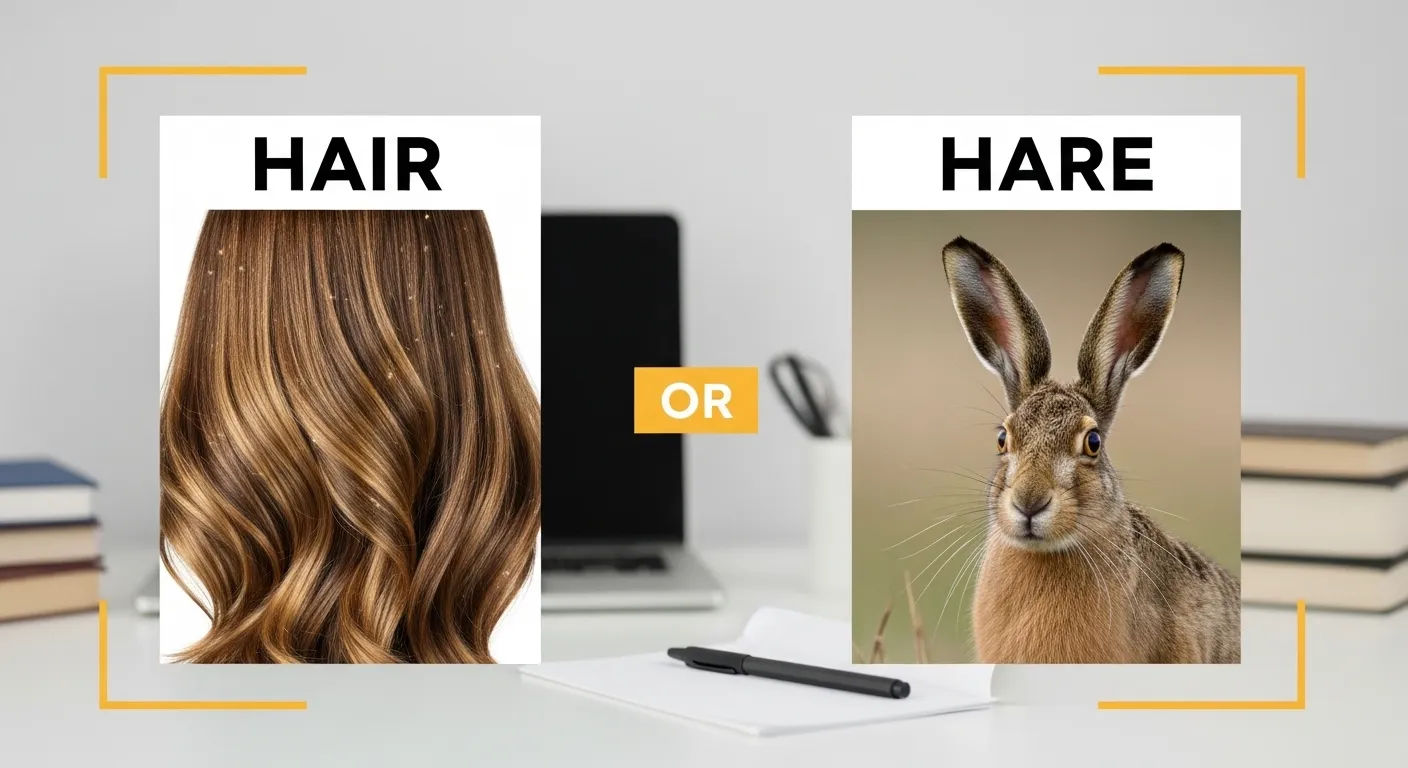
English has many words that sound the same but mean different things. Hair vs hare is a common example.
Hair refers to the strands on the human head or body, while a hare is a fast running wild animal similar to a rabbit. Because they sound identical, many people confuse them in writing.
In this guide, you will quickly learn the difference between hair and hare, with simple examples to help you use each word correctly.
Hair Or Hare – Quick Answer
The difference between hair and hare is simple:
| Word | Meaning | Example |
| Hair | The strands that grow on human or animal skin | She brushed her hair before leaving. |
| Hare | A fast-running wild animal similar to a rabbit | The hare ran quickly across the field. |
Hair refers to the thin strands growing on the head or body.
Example:
Her hair is long and shiny.
Hare refers to a wild animal that looks like a rabbit but has longer ears and stronger legs.
Example:
The hare escaped from the fox.
Even though these words sound identical, their meanings are completely different.
The Origin of Hair Or Hare
Understanding the origin of words helps explain why they look and sound similar.
Origin of Hair
The word hair comes from the Old English word “hǣr.” It has been used for centuries to describe the strands that grow on humans and animals. The word remained almost unchanged through Middle English and modern English.
Historically, hair has been associated with identity, beauty, culture, and health. Many expressions in English include the word hair, such as:
- Bad hair day
- Split hairs
- Let your hair down
These phrases show how common the word has been in everyday language.
Origin of Hare
The word hare comes from the Old English word “hara.” It refers to a wild animal known for its speed and strong legs.
Hares are different from rabbits. They are generally larger, have longer ears, and can run much faster.
The word became famous in stories and fables. One of the most famous examples is “The Tortoise and the Hare,” a classic tale that teaches the lesson that slow and steady effort wins the race.
Because both hair and hare evolved from Old English words with similar sounds, they eventually became homophones in modern English.
British English vs American English Spelling
Unlike many English words, hair and hare do not change spelling between British and American English. Both versions of English use the same spelling.
However, confusion still happens because the words sound identical.
| Word | British English | American English | Meaning |
| Hair | Hair | Hair | Strands growing on the body |
| Hare | Hare | Hare | A fast-running wild animal |
This means there is no spelling difference based on region. The only thing that matters is choosing the correct word based on meaning.
Examples:
British English:
She tied her hair in a ponytail.
American English:
The hare jumped over the grass.
The spelling remains exactly the same.
Which Spelling Should You Use?
Choosing the correct word depends entirely on the meaning of your sentence.
Use “Hair” When Talking About:
- Human or animal strands
- Hairstyles
- Grooming
- Beauty and health
Examples:
- She cut her hair yesterday.
- My hair gets curly in humid weather.
- He washed his hair before work.
Use “Hare” When Talking About:
- A wild animal similar to a rabbit
- Wildlife or nature
- Stories or fables
Examples:
- The hare ran across the meadow.
- A fox chased the hare through the forest.
- The story of the tortoise and the hare is famous.
Quick Advice
- If the sentence is about people or grooming, use hair.
- If the sentence is about animals, use hare.
This rule works for readers in the United States, United Kingdom, Canada, Australia, and other English-speaking countries.
Common Mistakes with Hair Or Hare
Because these words sound the same, writers sometimes use the wrong spelling.
Here are some common mistakes.
Mistake 1
Incorrect:
Her hare looks beautiful today.
Correct:
Her hair looks beautiful today.
Explanation: Hair refers to strands on the head.
Mistake 2
Incorrect:
The fox chased the hair.
Correct:
The fox chased the hare.
Explanation: The sentence is about an animal.
Mistake 3
Incorrect:
I need to brush my hare.
Correct:
I need to brush my hair.
Mistake 4
Incorrect:
The hair ran across the road.
Correct:
The hare ran across the road.
Easy Memory Trick
A helpful way to remember the difference:
- Hair = Human
- Hare = Hopping animal
Both words start with the same sound, but their meanings are completely different.
Hair Or Hare in Everyday Examples
Understanding real-life examples helps make the difference clear.
In Emails
Correct:
- I will be late because I am getting my hair cut.
- We saw a hare while hiking.
Incorrect:
- I am getting my hare cut.
In News Writing
Example with hair:
A new study shows that diet and stress can affect hair growth.
Example with hare:
Wildlife experts reported an increase in the local hare population.
On Social Media
Hair example:
Just got a new haircut and I love my hair.
Hare example:
Look at this cute hare I saw in the park today.
In Formal Writing
Hair example:
Hair texture varies widely among individuals.
Hare example:
The mountain hare survives in cold climates.
These examples show how context determines which word is correct.
Hare vs Hair – Google Trends & Usage Data
Search data shows that hair is far more common than hare.
This is because hair is part of everyday life. People search for topics like:
- hair care
- hair loss
- hair growth
- hairstyles
These topics generate millions of searches each month.
The word hare, however, appears mostly in wildlife discussions, literature, and education.
Popular Searches by Region
United States
- hair care
- hair styles
- hair loss
United Kingdom
- hair products
- hairdressers
- mountain hare
Australia and Canada
- hair treatments
- wildlife hare species
Because of its everyday use, hair dominates search popularity globally.
Hair vs Hare Comparison Table
| Feature | Hair | Hare |
| Part of speech | Noun | Noun |
| Meaning | Strands growing on skin | Fast wild animal |
| Context | Beauty, grooming, biology | Wildlife, animals |
| Example sentence | She washed her hair. | The hare ran quickly. |
| Frequency | Extremely common | Less common |
FAQs
1. Are hair and hare pronounced the same?
Yes. Hair and hare are pronounced the same in English. This makes them homophones.
2. What does hair mean?
Hair refers to the thin strands that grow from the skin of humans and animals.
Example:
Her hair is very long.
3. What is a hare?
A hare is a wild animal that looks like a rabbit but has longer ears and runs very fast.
4. Is hare the same as rabbit?
No. Hares and rabbits are related but different animals. Hares are larger and faster than rabbits.
5. Do hair and hare have different spellings in British English?
No. Both British and American English use the same spelling for hair and hare.
6. Why do people confuse hair and hare?
People confuse them because they sound identical when spoken.
7. How can I remember the difference?
Remember this simple trick:
Hair = On your head
Hare = Animal in the wild
Conclusion
Hair vs hare are homophones, meaning they sound the same but have different meanings. Hair refers to the strands growing on the human head or body, while a hare is a fast running wild animal similar to a rabbit.
The confusion happens because the words sound identical. To use them correctly,
Remember: hair relates to appearance or grooming, and hare refers to an animal. Knowing this simple difference helps you avoid spelling mistakes and write more clearly.
Discover More About:
Analyses or Analysis: Using These Words Correctly
Dieing or Dying: A Simple Guide To The Correct Spelling In 2026