Have you ever stopped while writing and wondered whether to use “hole” or “whole”? You’re not alone.
These two words sound exactly the same, but they mean completely different things. Because of this, many people search “hole or whole” to quickly understand which spelling is correct.
This confusion is common in emails, essays, blog posts, and social media.
A small mistake like writing “the whole in the wall” instead of “the hole in the wall” can change the meaning of a sentence and make writing look careless.
In this quick guide, you will learn the simple difference between hole and whole, when to use each word, and how to avoid this common mistake.
Hole or Whole – Quick Answer
The words hole and whole sound the same, but they mean very different things.
| Word | Meaning | Example |
|---|---|---|
| Hole | An opening or empty space | There is a hole in my shirt. |
| Whole | Complete or entire | I ate the whole pizza. |
Simple Explanation
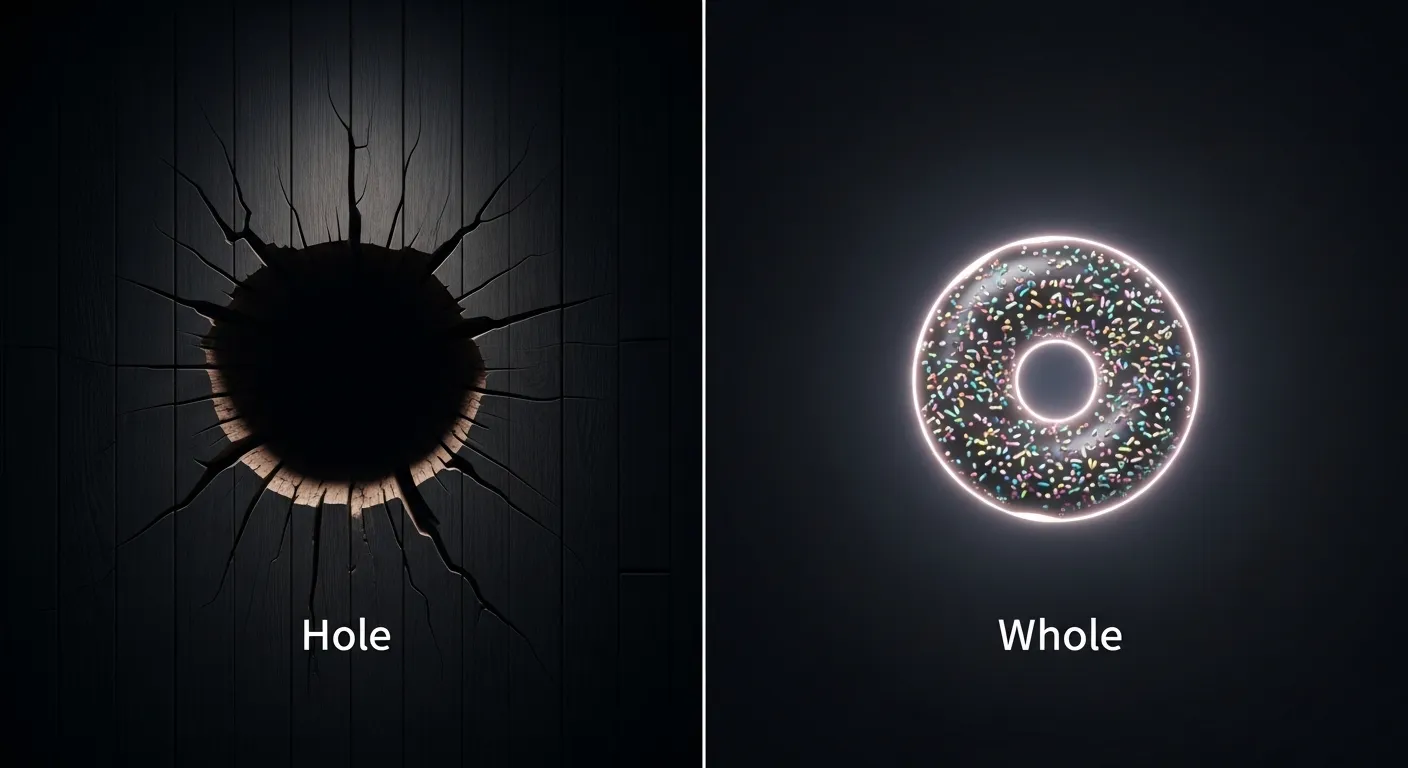
Hole refers to an opening, gap, or hollow space.
Example:
- The dog dug a hole in the yard.
- There is a hole in the wall.
Whole means complete, entire, or full.
Example:
- She read the whole book in one day.
- We watched the whole movie.
Quick Memory Trick
- Hole = Empty space
- Whole = Entire thing
If your sentence talks about a gap or opening, use hole.
If it talks about something complete, use whole.
The Origin of Hole or Whole
Understanding where these words come from helps explain why they look similar but mean different things.
Origin of “Hole”
The word hole comes from the Old English word “hol”, which meant a hollow place or cavity. The word has been used in English for more than 1,000 years.
Examples from history include:
- A hole in the ground
- A hole in clothing
- A hole in a wall
Over time, the meaning stayed almost exactly the same.
Origin of “Whole”
The word whole comes from the Old English word “hāl”, which meant healthy, complete, or unbroken.
This word is related to several modern English words such as:
- Heal
- Health
- Wholesome
Originally, whole described something unbroken or complete. Later it began to mean entire or total.
Why They Sound the Same
English pronunciation changed over centuries. Even though hole and whole came from different roots, modern English pronounces them the same.
This is why they became homophones.
British English vs American English Spelling
Unlike many English words, hole and whole have the same spelling in British and American English.
There is no spelling difference between the two versions of English.
| Meaning | British English | American English |
|---|---|---|
| Opening or gap | Hole | Hole |
| Complete or entire | Whole | Whole |
Examples in British English
- The road has a large hole.
- She ate the whole cake.
Examples in American English
- There is a hole in the fence.
- He watched the whole game.
Both spellings are exactly the same in UK, US, Canada, Australia, and other English-speaking countries.
The difference depends only on meaning, not location.
Which Spelling Should You Use?
Choosing between hole and whole is simple once you understand the meaning.
Use “Hole” When Talking About:
- An opening
- A gap
- A hollow space
Examples:
- The socks have a hole.
- The rabbit ran into its hole.
- The drill made a hole in the wall.
Use “Whole” When Talking About:
- Something complete
- Something entire
- A full amount
Examples:
- I spent the whole day working.
- She told me the whole story.
- They ate the whole cake.
Quick Audience Advice
| Audience | Recommendation |
|---|---|
| American writers | Use hole or whole based on meaning |
| British writers | Same spelling rules |
| Global writers | Follow meaning only |
There is no regional difference. Just focus on context.
Common Mistakes with Hole or Whole
Because these words sound the same, writers often confuse them.
Here are some common mistakes.
Mistake 1
❌ There is a whole in my shoe.
✔ There is a hole in my shoe.
Explanation: A shoe has an opening, not something complete.
Mistake 2
❌ I ate the hole pizza.
✔ I ate the whole pizza.
Explanation: The sentence talks about the entire pizza.
Mistake 3
❌ The dog dug a whole in the garden.
✔ The dog dug a hole in the garden.
Explanation: The dog created an opening in the ground.
Mistake 4
❌ She read the hole book yesterday.
✔ She read the whole book yesterday.
Explanation: The sentence means the entire book.
Hole or Whole in Everyday Examples
These words appear in daily communication everywhere.
Emails
- There is a hole in the document where the chart should be.
- Please review the whole report before sending it.
News Writing
- The explosion created a large hole in the road.
- The whole city celebrated the victory.
Social Media
- My favorite jeans have a hole now 😭
- I watched the whole series in one weekend!
Formal Writing
- The drill created a precise hole in the metal.
- The whole population was affected by the policy.
Hole or Whole – Google Trends & Usage Data
Search data shows that people frequently look up “hole or whole” because they want clarification.
Popular Search Countries
High search interest appears in:
- United States
- United Kingdom
- Canada
- Australia
- India
- Pakistan
Students, writers, and English learners often search this phrase when they are unsure which word to use.
Contexts Where Confusion Happens
Most searches happen when people write:
- School essays
- Emails
- Social media captions
- Blog posts
- Professional documents
Because both words sound identical, spellcheck cannot always catch the mistake if the word is technically correct.
That is why understanding the meaning is important.
Hole vs Whole Comparison Table
| Feature | Hole | Whole |
|---|---|---|
| Meaning | Opening or gap | Complete or entire |
| Word type | Noun | Adjective / noun |
| Example | Hole in the wall | Whole story |
| Pronunciation | Same as whole | Same as hole |
| British spelling | Hole | Whole |
| American spelling | Hole | Whole |
FAQs
1. What is the difference between hole and whole?
A hole is an opening or empty space.
A whole means complete or entire.
Example:
- The dog dug a hole.
- I ate the whole cake.
2. Are hole and whole pronounced the same?
Yes. They are pronounced exactly the same.
This makes them homophones.
3. Is “hole” ever used to mean complete?
No. Hole always refers to an opening or gap. It never means complete.
4. Is there a British vs American difference?
No. Both countries use the same spelling:
- Hole
- Whole
The difference depends only on meaning.
5. How can I remember the difference?
A simple trick:
- Hole = Empty
- Whole = Entire
Think of whole as the whole thing.
6. Can “whole” be used as a noun?
Yes, sometimes.
Example:
- The story must be viewed as a whole.
Here it means the entire thing together.
7. Why do people confuse hole and whole?
People confuse them because:
- They sound identical
- English spelling is irregular
- Fast typing causes mistakes
This makes them a common grammar search topic.
Conclusion:
The difference between hole and whole is simple once you know the meaning.
Hole refers to an opening or empty space, while whole means complete or entire. Even though they sound the same, they are used in very different contexts.
Remember the quick rule: hole = opening, whole = entire.
Keeping this in mind will help you avoid common mistakes and write clearly in emails, essays, and everyday communication.
Using the correct word shows strong English skills and makes your writing more professional and easy to understand.
Discover More Post:
Principal or Principle: Learn the Difference in Simple Words
Weather or Whether: How to Use the Right Word Every Time
Complement or Compliment – Which Is Correct (2026)

I’m a U.S. based content writer and language researcher with a strong focus on English grammar, spelling differences, and frequently confused terms. My writing is aimed at helping readers write more clearly and correctly in daily use, workplace communication, and digital content.