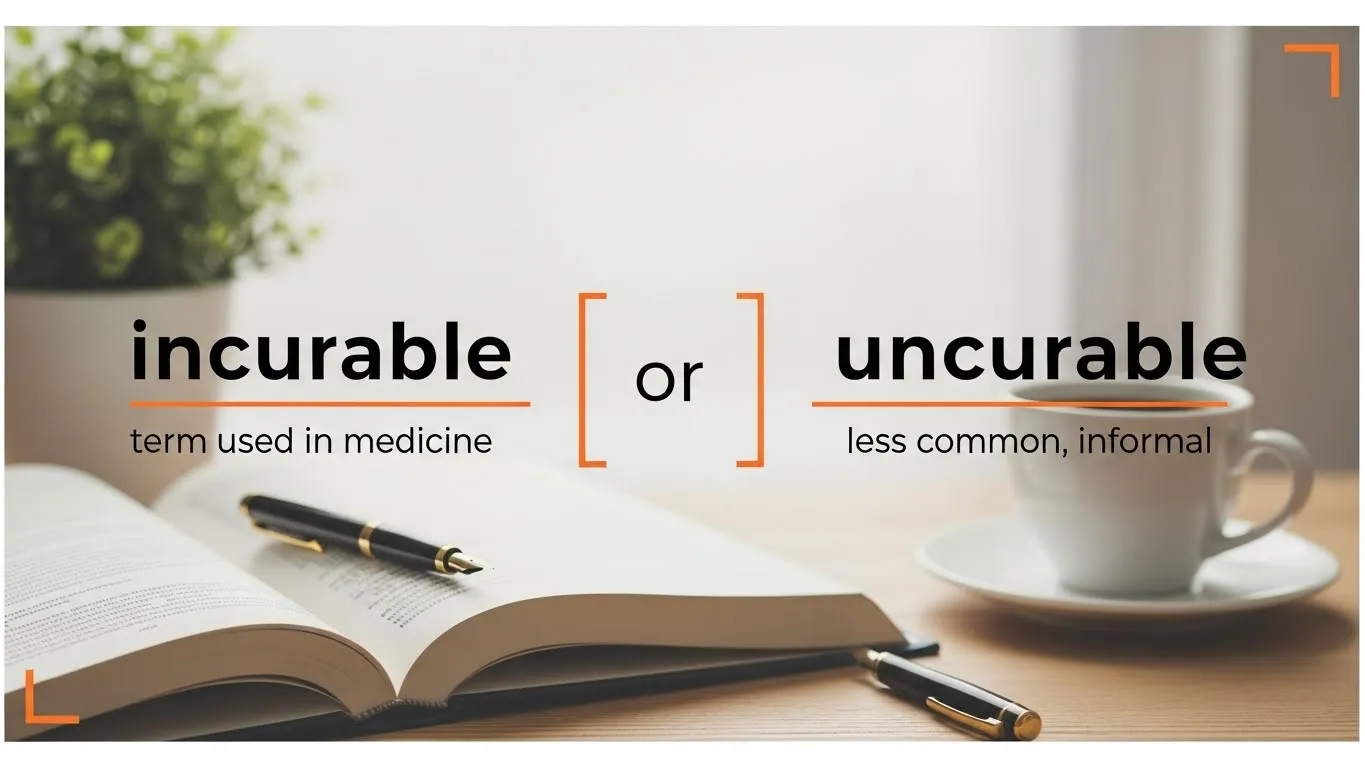
The confusion between incurable and uncurable is common, especially in medical or formal writing.
Incurable is correct. Uncurable is incorrect and not used in standard English.
At first, uncurable may look right because of the “un” prefix, but English doesn’t always follow simple rules. That’s why many people double-check before using it.
In this guide, you’ll quickly understand the correct spelling, see examples, and avoid this mistake with confidence.
Incurable or Uncurable – Quick Answer
Incurable is the only correct and accepted spelling in modern English.
Uncurable is considered nonstandard and incorrect in professional, academic, and published writing.
Correct Examples
- The disease is incurable, but it can be managed.
- He has an incurable habit of being late.
- Scientists are researching treatments for incurable conditions.
Incorrect Examples
- ❌ The disease is uncurable.
- ❌ She suffers from an uncurable illness.
Bottom line: If you want correctness, clarity, and credibility, always use incurable.
The Origin of Incurable and Uncurable
To understand why incurable is correct, we need to look at word history.
Latin Roots
The word incurable comes from Latin:
- in- = not
- curare = to heal or care for
Incurabilis in Latin meant “not able to be cured.”
English borrowed this word directly, preserving its original structure. Instead of forming a new word using un- + curable, English kept the Latin-based prefix in-.
Why Uncurable Never Took Hold
While English often uses un- (unhappy, unclear, unfair), it does not apply to every adjective. In some cases, older Latin prefixes remained fixed.
Over time:
- Incurable became standardized
- Uncurable appeared occasionally but was never accepted by dictionaries
- Editors and style guides rejected uncurable as incorrect
That is why modern English recognizes incurable as the only valid form.
British English vs American English Spelling
This confusion is not about regional spelling differences.
Key Point
Both British English and American English use “incurable.”
There is no regional variant called uncurable.
Comparison Table
| Aspect | British English | American English |
| Correct spelling | Incurable | Incurable |
| Alternative form | None | None |
| Dictionary accepted | Yes | Yes |
| Used in medicine | Yes | Yes |
| Used in media | Yes | Yes |
Unlike colour vs color or finalise vs finalize, incurable has no spelling variation across English-speaking regions.
Which Spelling Should You Use?
Your audience does not change the answer but it affects how serious the mistake looks.
For US Audiences
Always use incurable. Medical, legal, and academic writing demands precision.
For UK & Commonwealth Audiences
Use incurable exclusively. British English strongly follows dictionary standards.
For Global or SEO Writing
Use incurable. It ranks correctly, avoids spelling penalties, and matches search intent.
Professional advice:
If you write uncurable, your work may appear unedited, unreliable, or AI-unchecked.
Common Mistakes with Uncurable or Incurable
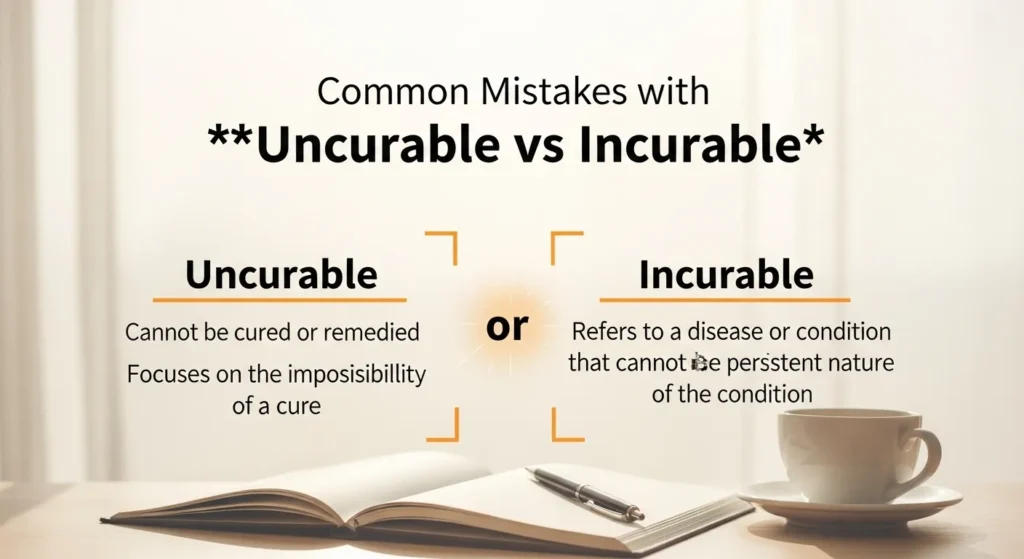
Here are the most frequent errors writers make:
1. Assuming “un-” Is Always Correct
- ❌ uncurable disease
- ✅ incurable disease
2. Overcorrecting Based on Logic
English is historical, not always logical. Word origin matters more than structure.
3. Using “Uncurable” in Informal Writing
Even in blogs, emails, or social posts, uncurable looks wrong to readers.
4. Ignoring Spellcheck Warnings
Most spellcheckers flag uncurable do not ignore them.
Incurable vs Uncurable – Comparison Table
| Feature | Incurable | Uncurable |
| Dictionary accepted | ✅ Yes | ❌ No |
| Correct spelling | ✅ Yes | ❌ No |
| Used in medicine | ✅ Yes | ❌ No |
| Academic writing | ✅ Yes | ❌ No |
| SEO safe | ✅ Yes | ❌ No |
| Considered an error | ❌ No | ✅ Yes |
Incurable in Everyday Examples
Seeing correct usage in context makes it easier to remember.
Emails
- “The condition is incurable, but treatment can reduce symptoms.”
News Articles
- “Doctors are working to manage incurable diseases more effectively.”
Social Media
- “Some habits feel incurable, but awareness helps.”
Academic Writing
- “The illness was long considered incurable before modern research.”
Professional Reports
- “The patient suffers from an incurable genetic disorder.”
Uncurable vs Incurable – Google Trends & Usage Data
Search data shows a clear pattern.
Popularity by Country
- Incurable dominates searches in:
- United States
- United Kingdom
- Canada
- Australia
- India
- United States
Why “Uncurable” Appears in Searches
- Users are unsure
- Learners rely on logic
- ESL writers test both spellings
Content Insight
Google recognizes incurable as correct. Pages using uncurable often rank poorly or require correction.
SEO takeaway:
Target incurable as the primary keyword. Use uncurable only to explain why it is wrong.
FAQs:
1. Is uncurable ever correct?
No. Uncurable is not accepted in modern standard English.
2. Why does uncurable sound right?
Because English often uses un- as a prefix, but this word follows Latin rules instead.
3. Do dictionaries accept uncurable?
Major dictionaries do not list it as a standard word.
4. Is incurable formal or medical only?
No. It is used in everyday, emotional, academic, and professional contexts.
5. Can uncurable be used creatively?
In creative fiction, anything is possible but it still reads as an error to most readers.
6. Does British English allow uncurable?
No. British English strictly uses incurable.
7. Is there a verb form related to incurable?
Yes. The verb is cure. The adjective form is incurable.
8. Is It Incurable or Uncurable?
Incurable is the correct and standard English word. It means something cannot be cured or healed.
Uncurable is generally considered nonstandard and is rarely used in modern English.
Conclusion:
The choice between incurable or uncurable is not about style or region. It is about correctness.
Incurable is the only spelling accepted by dictionaries, editors, and medical experts worldwide. Uncurable, though it looks logical, is treated as a spelling mistake in modern English.
This confusion exists because English borrowed incurable from Latin and kept its original form, even as other prefix rules evolved. That history is why only one spelling is standard today.
If you are writing a blog, academic paper, news article, or everyday message, using incurable protects your credibility and keeps your writing clear and professional.
Remember this one rule:
If something cannot be cured, it is incurable always.
Learn More About:
Attendance or Attendence: Which Is Correct?
Marshmallow or Marshmellow: Which Is Correct? (2026)

I’m a U.S. based content writer and language researcher with a strong focus on English grammar, spelling differences, and frequently confused terms. My writing is aimed at helping readers write more clearly and correctly in daily use, workplace communication, and digital content.