Have you ever wondered whether the correct spelling is leery or leary? You are not alone. Both forms appear online, which often confuses writers and English learners.
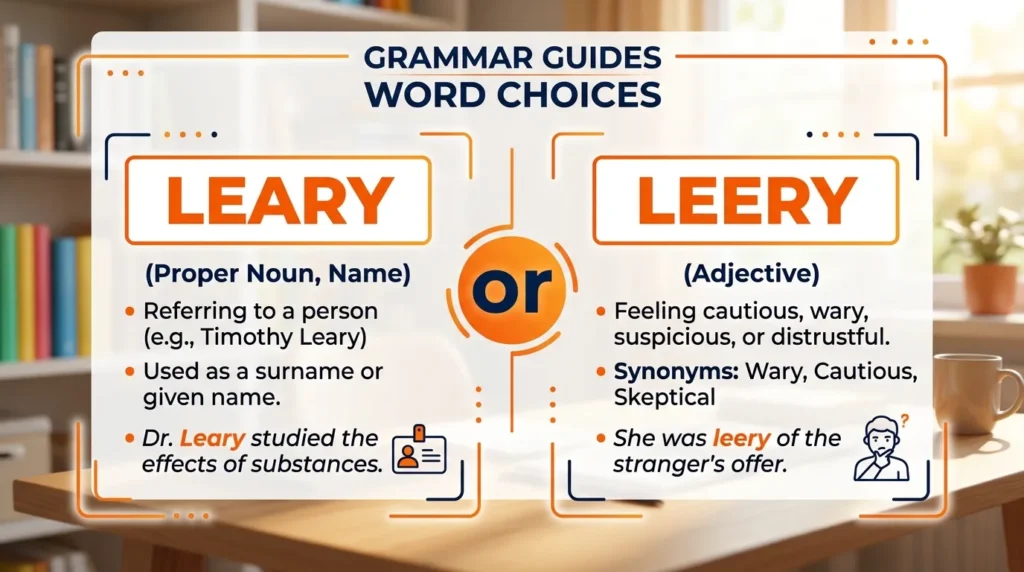
Leery is the correct and standard spelling. Leary is usually considered a misspelling or a surname.
Because the words look and sound similar, many people use the wrong form in emails, articles, and everyday writing.
This guide will explain the difference between leery vs leary, why the confusion exists, and how to use the correct spelling confidently every time.
Leery or Leary – Quick Answer
Leery is the correct and preferred spelling in modern English.
Leary is considered nonstandard, outdated, or informal.
Examples
- ✅ She was leery of strangers.
- ❌ She was leary of strangers.
If you want safe, professional, and widely accepted writing, always use leery.
The Origin of Leary and Leery
The word leery comes from the Middle English word lerie, meaning cautious or suspicious. It entered English in the early 1700s.
Early English spelling was not fixed. Writers often spelled words based on sound. This led to variations like leary, which appeared occasionally in informal writing.
Over time, dictionaries and publishers standardized spelling. Leery became the accepted form, while leary faded out.
Why the confusion still exists
- Both spellings look logical
- They sound identical
- Old texts sometimes used leary
- Spellcheck may not flag it clearly
Modern English, however, recognizes only leery as correct.
Leery Definition
Leery means cautious, suspicious, or unwilling to trust something completely. It is used when someone feels unsure, careful, or doubtful about a person, situation, or offer.
Examples of Leery
- She was leery of sharing her personal information online.
- Many customers are leery about fake websites.
- He felt leery after hearing the bad reviews.
Simple Meaning
If you are leery, you are being careful because something does not feel fully safe, honest, or trustworthy.
Leery vs Leary Spelling Difference
The main spelling difference is that leery is the standard and widely accepted English word, while leary is usually considered a misspelling or alternative spelling of leery.
Leary Meaning vs Leery Meaning
Leery means cautious, suspicious, or wary of something.
Leary is generally treated as a misspelling of leery and does not have a separate standard meaning in modern English.
Example:
- She was leery of sharing her personal information online.
Correct Spelling of Leery
The correct spelling is leery. It is used to describe someone who is cautious, skeptical, or hesitant because they do not fully trust a person, situation, or idea.
Example:
- Many customers are leery of deals that seem too good to be true.
Leery or Leary Which Is Correct?
Leery is the correct and preferred spelling in modern English. If you want to express caution, suspicion, or wariness, use leery.
Avoid leary in formal, academic, and professional writing.
Synonyms of Leery
- Wary
- Cautious
- Suspicious
- Skeptical
- Distrustful
- Hesitant
- Doubtful
- Guarded
- Apprehensive
- Watchful
British English vs American English Spelling
Unlike many spelling debates, this one is not regional.
Both British English and American English use “leery.”
Comparison Table
| Feature | Leery | Leary |
| Meaning | Cautious, suspicious | Same meaning |
| Dictionary status | Correct | Nonstandard |
| American English | ✅ Yes | ❌ No |
| British English | ✅ Yes | ❌ No |
| Professional writing | ✅ Accepted | ❌ Avoid |
| Modern usage | Very common | Rare |
There is no situation where “leary” is preferred.
Which Spelling Should You Use?
Use leery if you are writing for:
- American audiences
- British or Commonwealth readers
- International or global readers
- Academic papers
- Business emails
- Blogs and websites
- News or media content
Avoid leary because:
- It looks outdated
- It may be flagged by editors
- It reduces credibility
- It is not dictionary-standard
Bottom line:
If your goal is clear, modern English choose leery every time.
Common Mistakes with Leary or Leery
Here are mistakes people often make:
Mistake–1: Treating both as correct
- “Both are fine” → ❌ Incorrect
Mistake-2: Assuming leary is British
- British English uses leery, not leary
Mistake-3: Using leary in formal writing
- Looks informal and unpolished
✅ Correct Usage
- Always replace leary with leery
Leary and Leery in Everyday Examples
Emails
- ✅ I am leery of approving this without details.
- ❌ I am leary of approving this without details.
News Writing
- ✅ Investors remain leery of the market.
- ❌ Investors remain leary of the market.
Social Media
- ✅ I’m leery of online ads.
- ❌ I’m leary of online ads.
Academic Writing
- ✅ Researchers are leery of biased data.
- ❌ Researchers are leary of biased data.
Leary vs Leery – Google Trends & Usage Data
Search data shows that “leery” is far more common than “leary.”
Key insights
- “Leery” dominates searches in the US, UK, Canada, and Australia
- “Leary” appears mainly due to spelling confusion
- Professional publications overwhelmingly use leery
People search “leery or leary” because:
- Spellings look similar
- They want confirmation
- They want to avoid mistakes
Usage data confirms: leery is the standard choice worldwide.
Comparison Table: Leery vs Leary
| Aspect | Leery | Leary |
| Correct spelling | ✅ Yes | ❌ No |
| Dictionary accepted | ✅ Yes | ❌ Rare |
| Modern usage | High | Very low |
| Formal writing | Safe | Risky |
| SEO & publishing | Recommended | Avoid |
FAQs:
1. Is “leary” ever correct?
No. Modern English considers leary incorrect or nonstandard.
2. Is leery American or British?
Both. Leery is used in all major English varieties.
3. Why do people still use leary?
Because it sounds right and looks logical, but it is not standard.
4. Will spellcheck catch leary?
Not always. That’s why the mistake persists.
5. Can leary be used informally?
Even informally, leery is still the better choice.
6. Does leery mean afraid?
Not exactly. It means cautious or suspicious, not fearful.
7. Is leery related to “wary”?
Yes. Both express caution and alertness.
Conclusion:
The confusion between leery or leary is common, but the rule is simple.
Leery is the correct spelling. It is accepted in American English, British English, and global usage.
Leary, while sometimes seen online, is outdated and non standard.
If you are writing emails, academic papers, articles, or website content, choosing leery ensures clarity and professionalism. Using the correct form helps your writing look polished, trustworthy, and modern.
Whenever you feel unsure, remember this rule:
If it expresses caution or suspicion, the spelling is always leery.
Learn More About:
Attendance or Attendence: Which Is Correct?
Whose or Who’s: The Simple Rule That Clears the Confusion