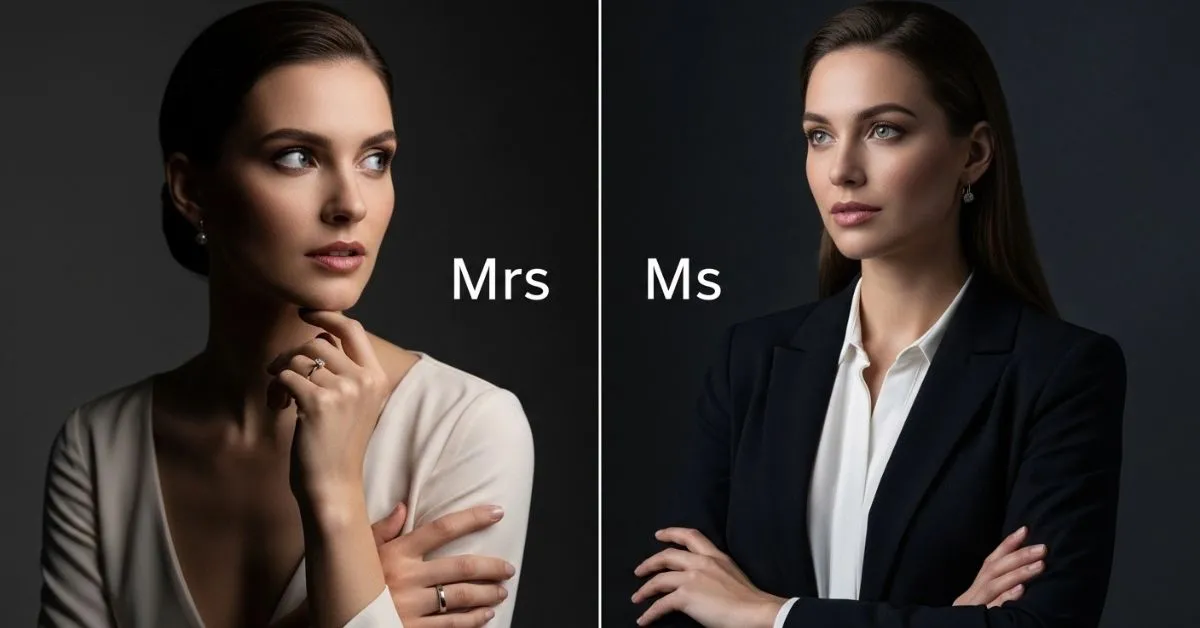
Many people often get confused about whether to use Mrs or Ms when addressing a woman.
This confusion is especially common in professional emails, invitations, or formal situations.
Users frequently search questions like: When should I use Mrs or Ms? or Is Ms only for unmarried women?
If you’ve ever wondered which title is appropriate, this guide is perfect for you.
In this article, we will explain in simple, practical terms when and where to use Mrs and Ms, so you can address anyone confidently and respectfully.
Mrs or Ms – Quick Answer
Mrs is used for a married woman who uses her husband’s surname or prefers the title.
Ms is used for any woman, regardless of marital status.
Examples:
- Mrs Johnson hosted the event. (married woman)
- Ms Taylor will lead the meeting. (marital status unknown or irrelevant)
Key rule:
If you don’t know or don’t want to mention marital status, Ms is always the safest choice.
The Origin of Mrs or Ms
Both Mrs and Ms come from the same root word: Mistress. In earlier English, Mistress was the female equivalent of Master and did not relate to marriage.
How they evolved:
- Mrs developed in the 16th–17th century and became linked to married women.
- Miss emerged for unmarried women.
- Ms appeared much later, gaining popularity in the 20th century, especially during the women’s rights movement.
Ms was created to solve a problem:
Why should a woman’s title reveal her marital status when a man’s title (Mr) does not?
There is no spelling difference between British and American English for these titles. The difference lies in usage, tone, and tradition, not spelling.
British English vs American English Usage
While spelling is identical, usage patterns differ slightly between British and American English.
Key differences:
- American English strongly favors Ms in professional and formal contexts.
- British English still uses Mrs more often in social and traditional settings, but Ms is widely accepted.
Comparison Table
| Aspect | British English | American English |
| Use of Mrs | Common socially | Less common professionally |
| Use of Ms | Increasingly common | Default professional choice |
| Formal documents | Mrs or Ms | Mostly Ms |
| Workplace emails | Ms preferred | Ms standard |
Bottom line:
Both dialects accept Mrs or Ms, but Ms is more neutral and modern.
Which Title Should You Use?
Choosing between Mrs or Ms depends on context and audience.
Use Mrs if:
- The woman has clearly stated she prefers Mrs
- You know she is married and uses the title
- You are writing in a traditional or social setting
Use Ms if:
- You don’t know marital status
- You are writing professionally
- You want to be respectful and neutral
- You’re addressing a global or mixed audience
Audience-based advice:
- US audience: Use Ms
- UK/Commonwealth: Ms for professional, Mrs for personal if known
- Global audience: Always Ms
When in doubt, Ms is never wrong.
Common Mistakes with Mrs or Ms
These mistakes appear often in emails, forms, and online content.
Mistake 1: Assuming marriage
❌ Mrs Smith (without confirmation)
✅ Ms Smith
Mistake 2: Mixing Miss and Ms
❌ Ms Johnson (unmarried) — Ms doesn’t mean unmarried
✅ Ms Johnson — correct and neutral
Mistake 3: Using Mrs professionally by default
❌ Dear Mrs Taylor (business email, unknown status)
✅ Dear Ms Taylor
Mistake 4: Thinking Ms is informal
❌ Ms is casual
✅ Ms is professional and formal
Mrs or Ms in Everyday Examples
Emails
- Dear Ms Khan,
Thank you for your message.
News Articles
- Ms Williams said the policy would change next year.
Social Media
- Congrats to Ms Ahmed on her promotion!
Formal Writing
- The report was presented by Ms Thompson.
Invitations
- Mr and Mrs Carter (formal, traditional)
- Ms Carter (neutral, modern)
Mrs or Ms – Google Trends & Usage Data
Search interest in mrs or ms has grown steadily over the past decade. The rise reflects:
- Increased workplace communication
- Online forms requiring titles
- Awareness of inclusive language
Usage trends by region:
- United States: Ms dominates professional use
- United Kingdom: Balanced but shifting toward Ms
- Canada & Australia: Ms preferred in formal contexts
- South Asia & Middle East: Ms common in international settings
Context matters:
- Legal and official forms still allow Mrs
- Corporate, academic, and media writing favor Ms
Comparison Table: Mrs vs Ms
| Feature | Mrs | Ms |
| Indicates marriage | Yes | No |
| Professional use | Limited | Preferred |
| Neutral | No | Yes |
| Global acceptance | Moderate | High |
| Safe default | No | Yes |
FAQs
1. What is the main difference between Mrs and Ms?
Mrs shows marriage. Ms does not show marital status.
2. Is Ms rude or informal?
No. Ms is polite, professional, and widely accepted.
3. Can a married woman use Ms?
Yes. Many married women prefer Ms.
4. Should I use Mrs or Ms in business emails?
Use Ms unless told otherwise.
5. Is Mrs outdated?
Not outdated, but more traditional and less common professionally.
6. What should I use if I’m unsure?
Always choose Ms.
7. Do British and American English spell them differently?
No. Spelling is the same; usage differs slightly.
Conclusion:
In conclusion, understanding the difference between Mrs. and Ms. helps maintain respect and accuracy in writing.
Mrs. refers to a married woman, traditionally using her husband’s surname, while Ms. is a neutral title that doesn’t indicate marital status.
Using these abbreviations correctly shows professionalism and awareness of modern etiquette.
For writers, students, and professionals, remembering this small detail can improve clarity and prevent misunderstandings, making your communication polite, precise, and inclusive in all contexts.
Learn More About:
Parfum or Perfume? Which One Is Correct in 2026
Where or When: Difference And Uses:

I’m a U.S. based content writer and language researcher with a strong focus on English grammar, spelling differences, and frequently confused terms. My writing is aimed at helping readers write more clearly and correctly in daily use, workplace communication, and digital content.