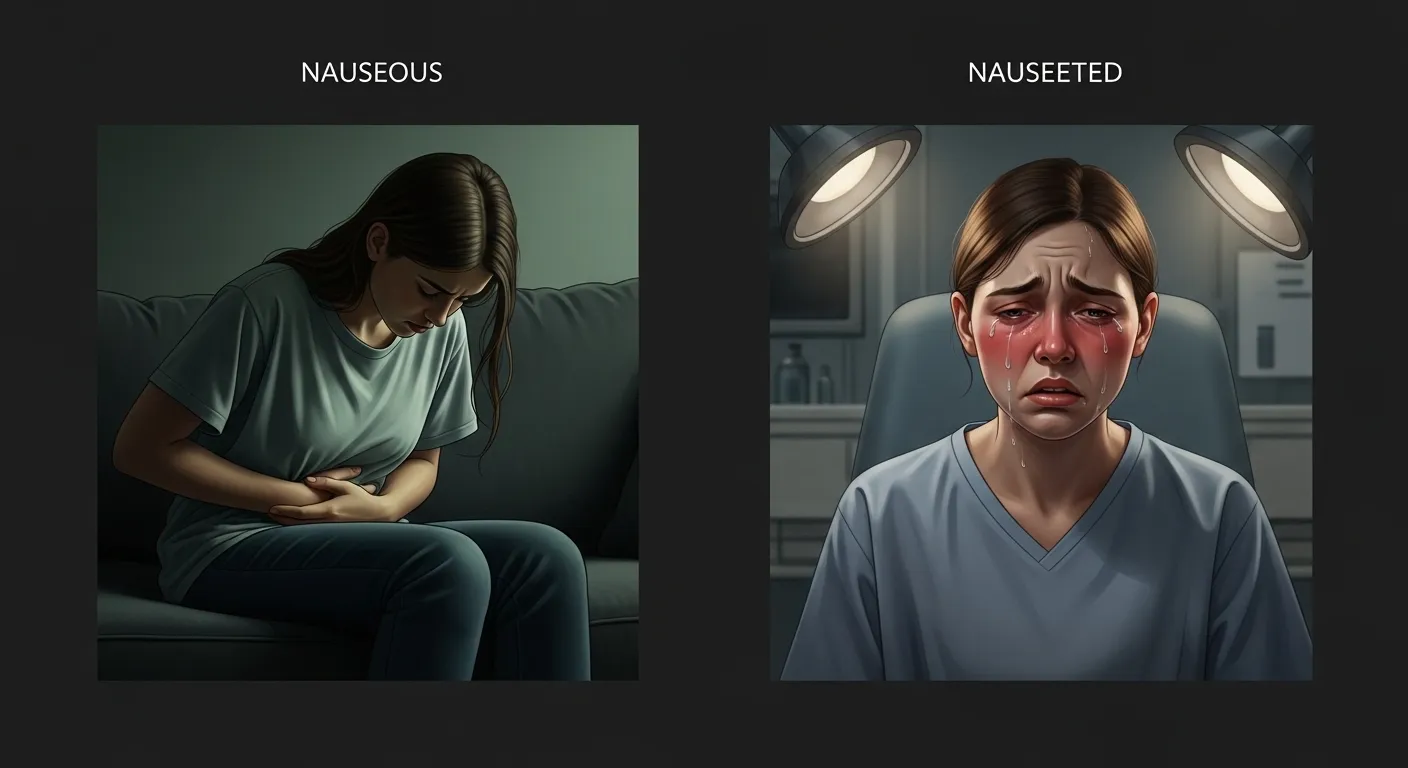
Ever felt sick to your stomach and paused before writing a message?
Should you say nauseous or nauseated? Both sound right, but only one fits perfectly depending on context.
This common confusion pops up in movies, news, and everyday conversation.
Writers, students, and professionals search for a clear answer to avoid mistakes and sound confident.
In this guide, you’ll get a quick answer, learn the history, see British vs American usage, spot common mistakes, and explore real-life examples.
By the end, you’ll know exactly which word to use and when.
Nauseous or Nauseated – Quick Answer
Quick answer:
- Nauseated means you feel sick.
- Nauseous originally meant something causes nausea, but today it is often used to mean feeling sick too.
Simple Examples:
- I feel nauseated after eating bad food. ✅
- The smell was nauseous. (It caused nausea.) ✅
- I feel nauseous. (Common in modern English.) ✅
In strict grammar:
- A nauseous smell causes sickness.
- A nauseated person feels sick.
But in modern American English, many people use nauseous to mean nauseated. Both are widely accepted today.
The Origin of Nauseous or Nauseated
The word comes from the Latin word “nausea,” meaning seasickness or stomach sickness.
Nauseous – The Older Meaning
First used in English in the 1600s, nauseous meant:
- Causing nausea
- Offensive or disgusting
Example from older usage:
- The medicine had a nauseous taste.
Nauseated – The Clear Feeling
Nauseated came later. It clearly described:
- A person who feels sick
Example:
- She felt nauseated during the flight.
Why Did the Meaning Change?
Over time, people started using nauseous to describe how they felt. Language evolves. As more people used it this way, the meaning expanded.
Today:
- Traditional grammar: keeps meanings separate.
- Modern usage: accepts both for feeling sick.
This is why confusion exists.
British English vs American English Spelling
Unlike words such as color/colour, there is no spelling difference between British and American English here. The difference is about usage preference, not spelling.
American English
In the United States:
- Nauseous is very common for feeling sick.
- Nauseated is also correct and often preferred in formal writing.
British English
In the UK:
- Nauseated is more common when describing feeling sick.
- Nauseous is more often used for something that causes sickness.
Comparison Table
| Context | American English | British English |
| Feeling sick | Nauseous (common) / Nauseated | Nauseated (preferred) |
| Causing sickness | Nauseous | Nauseous |
| Formal writing | Nauseated preferred | Nauseated preferred |
| Casual speech | Nauseous very common | Both used carefully |
So, there is no spelling change. The difference is about tradition and style.
Which Spelling Should You Use?
Here is simple advice based on your audience.
If You Write for a US Audience
You can safely use:
- Nauseous (very common)
- Nauseated (more precise)
In formal or academic writing, nauseated is slightly safer.
If You Write for a UK or Commonwealth Audience
It is better to use:
- Nauseated when describing feeling sick.
- Nauseous when describing something unpleasant.
British readers may notice the difference more.
If You Write for a Global Audience
Choose nauseated when describing how someone feels.
It is clear. It avoids debate. It sounds professional.
Best safe rule:
- Feeling sick → Nauseated
- Causing sickness → Nauseous
Common Mistakes with Nauseous or Nauseated
Here are frequent errors people make.
Mistake 1: Mixing the Original Meaning
❌ The food was nauseated.
✅ The food was nauseous.
Food cannot feel sick. It causes sickness.
Mistake 2: Using “Very Nausea”
❌ I feel very nausea.
✅ I feel nausea.
✅ I feel nauseated.
“Nausea” is a noun.
“Nauseated” is an adjective.
Mistake 3: Thinking Nauseous Is Wrong
Many teachers say nauseous is wrong for feeling sick.
That is not true in modern English. It is widely accepted.
Mistake 4: Overthinking in Casual Speech
In conversation, saying:
- “I feel nauseous” is completely normal.
Do not panic in everyday use.
Nauseous Vs Nauseated in Everyday Examples
Let’s see how these words appear in daily life.
In Emails
- I am feeling nauseated today and will work from home.
- The smell in the office kitchen is nauseous.
Professional emails prefer nauseated.
In News Reports
- Several passengers felt nauseated during turbulence.
- The chemical released a nauseous odor.
Journalists often keep the traditional distinction.
On Social Media
- That video made me nauseous.
- I feel so nauseous after that ride.
Casual platforms use nauseous freely.
In Medical Writing
Doctors usually write:
- The patient reported feeling nauseated.
- The medication caused nauseous effects.
Medical contexts prefer precision.
Nauseated or Nauseous – Google Trends & Usage Data
Search interest for “nauseous or nauseated” is high in:
- United States
- United Kingdom
- Canada
- Australia
In the US, nauseous is searched more often.
In the UK, nauseated appears slightly more in formal content.
Why do people search this?
- School assignments
- Professional writing
- Grammar correction tools
- Conflicting teacher advice
Modern dictionaries accept both meanings for nauseous. However, style guides still recommend clarity in formal writing.
Language data shows:
- Casual speech → prefers nauseous
- Academic writing → prefers nauseated
Side-by-Side Comparison Table
| Feature | Nauseous | Nauseated |
| Part of speech | Adjective | Adjective |
| Original meaning | Causing nausea | Feeling nausea |
| Modern US meaning | Feeling sick (common) | Feeling sick |
| Formal safety | Moderate | High |
| Medical clarity | Less precise | More precise |
| British preference for feeling sick | Less common | Preferred |
FAQs:
1. Is it correct to say “I feel nauseous”?
Yes. In modern American English, it is correct and common.
2. What is more grammatically correct?
Traditionally, nauseated is more precise when describing feeling sick.
3. Do doctors say nauseous or nauseated?
Most medical professionals use nauseated for clarity.
4. Is nauseous wrong in British English?
Not wrong, but nauseated is often preferred for feeling sick.
5. Which word should students use in exams?
Use nauseated to be safe in formal writing.
6. Can something be nauseated?
No. Only a person or living being can feel nauseated.
7. Why do people argue about this?
Because the original meaning changed over time, and some teachers prefer the older rule.
Conclusion:
The debate over nauseous or nauseated comes from history, not confusion. Originally, nauseous described something that caused sickness.
Nauseated described someone who felt sick. Over time, everyday speech changed the meaning. Now, many people use nauseous to mean feeling sick, especially in the United States.
So what should you do?
If you want perfect clarity and professionalism, choose nauseated when describing how you feel. It avoids debate.
It sounds precise. It works well in academic, medical, and global writing.
If you are speaking casually, especially in American English, saying “I feel nauseous” is completely normal and accepted.
The safest rule is simple:
- Feeling sick → Use nauseated
- Causing sickness → Use nauseous
Now you can write with confidence, clarity, and zero confusion.
Learn More About:
Trialled or Trialed: Which Spelling Is Correct? (2026)
Maxxed or Maxed: Which Spelling Is Correct?