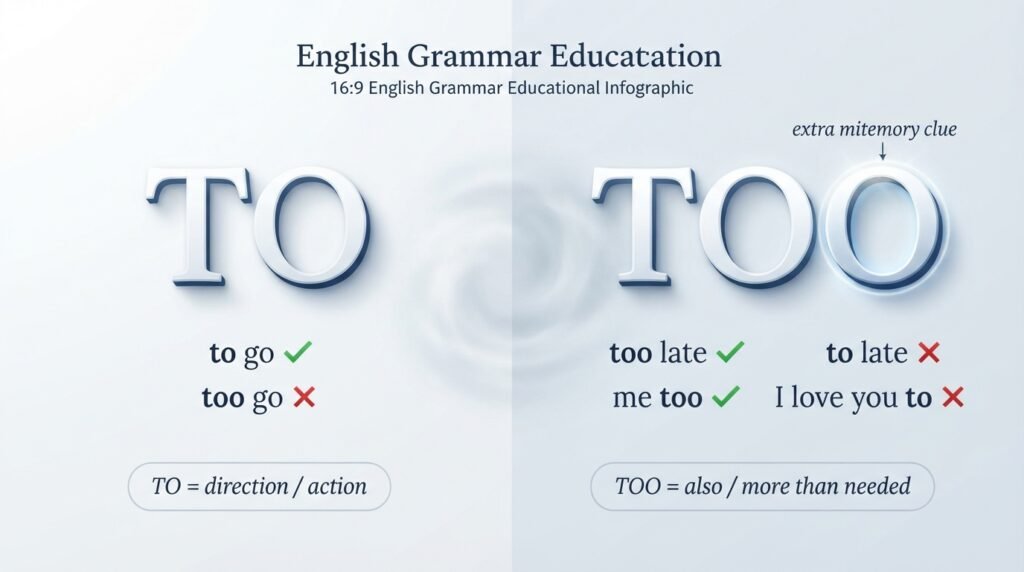
To and too sound the same, but they have different meanings and grammatical uses. To is commonly used for direction, purpose, or before a base verb, while too means also or more than necessary.
For example:
- I want to go home.
- I want to go too.
- It is too late.
If you have ever searched “to or too,” “to vs too,” or “what’s the difference between to and too?”, the good news is that the rule is easier than it first appears.
The key is to look at the meaning and function of the word, not just how it sounds. This guide explains the difference between to and too, when to use each one, common mistakes, everyday examples, and simple memory tricks.
To or Too
Here is the simplest to and too difference:
| Word | Main use | Example |
|---|---|---|
| To | Direction, purpose, relationship, or infinitive | I want to learn. |
| Too | Also | I want to learn too. |
| Too | More than necessary or desirable | It is too difficult. |
Use to when:
- showing direction: We went to school.
- showing a relationship or destination: Give it to me.
- showing purpose: I came to help.
- introducing an infinitive: I want to sleep.
Use too when:
- you mean also: I want one too.
- something is excessive: The bag is too heavy.
Easy memory trick
Think of the extra o in too as meaning extra.
Too = also or extra.
To = direction, purpose, or infinitive.
To Meaning and Usage
To is a very common English word with several grammatical functions.
1. To shows direction
Use to when someone or something moves toward a place or person.
Examples:
- She went to the office.
- We drove to the airport.
- He walked to the store.
- Send the package to my house.
Here, to connects the action with its destination.
2. To introduces an infinitive verb
One of the most common uses is:
to + base verb
Examples:
- to go
- to eat
- to study
- to work
- to learn
In sentences:
- I want to learn English.
- She needs to leave early.
- They decided to stay home.
- I would love to help.
This explains why “to go” is correct but “too go” is not.
3. To can show purpose
Examples:
- I called to ask a question.
- She went outside to get some fresh air.
- He studied hard to pass the exam.
In these examples, to introduces the purpose of an action.
Too Meaning and Usage
Too is an adverb with two major meanings.
1. Too means “also”
When too means “also,” it adds another person, thing, or situation.
Examples:
- I like coffee too.
- She is coming too.
- I watched that movie too.
- “I’m tired.” “Me too.”
You can often replace this use of too with also:
I want to come too.
= I also want to come.
This is why “me too” is correct.
2. Too means more than necessary
Too can also describe something that exceeds what is wanted, needed, suitable, or possible.
Examples:
- The coffee is too hot.
- This box is too heavy.
- It is too late.
- The room is too noisy to study.
- The shoes are too small.
There is an important difference between very and too.
Very increases degree:
The coffee is very hot.
Too normally indicates an excessive degree:
The coffee is too hot to drink.
So saying that too simply means “very” is incomplete. Its meaning is usually closer to more than is acceptable, appropriate, or needed.
To vs Too – What Is the Difference?
The difference between to and too is mainly grammatical.
| Feature | To | Too |
|---|---|---|
| Common role | Preposition / infinitive marker | Adverb |
| Direction | Yes | No |
| Purpose | Yes | No |
| Before an infinitive | Yes | No |
| Means “also” | No | Yes |
| Shows excess | No | Yes |
| Example | Go to school | Come too |
| Example | Want to learn | Too difficult |
Compare:
I want to go.
Here, to introduces the verb go.
I want to go too.
Here, too means also.
I want to go too early.
Here, too indicates an excessive degree.
That is the core to vs too grammar rule.
When to Use To or Too
If you are wondering when to use to or too, ask what the sentence means.
Do you mean direction?
Use to.
We went to school.
Do you mean purpose?
Use to.
I called to ask something.
Do you have “to + verb”?
Use to.
I want to learn.
Do you mean “also”?
Use too.
I want to learn too.
Do you mean excessive or more than necessary?
Use too.
This lesson is too difficult.
This meaning-based method is much more reliable than trying to remember every possible sentence.
To or Too Examples You Use Every Day
Here are some practical to or too examples:
- I need to finish my work.
- Can you send this to me?
- We are going to the mall.
- I would love to visit.
- I want one too.
- She wants to come too.
- It is too expensive.
- Is it too late?
- He arrived too early.
- The box is too heavy.
- I like this song too.
- They need to leave now.
Notice how the correct word depends on the intended meaning.
“To Go” or “Too Go”?
If you are asking “to go or too go?”, the correct phrase is:
to go
Examples:
- I want to go home.
- We need to go now.
- She decided to go alone.
- Would you like to go with us?
Why?
Because to introduces the infinitive verb go.
❌ I want too go home.
✅ I want to go home.
“Too Late” or “To Late”?
The correct expression is:
too late
Examples:
- It is too late to call.
- We arrived too late.
- Is it too late to apply?
- It was too late to change the plan.
Here, too means the time has gone beyond what is suitable or possible.
So:
❌ to late
✅ too late
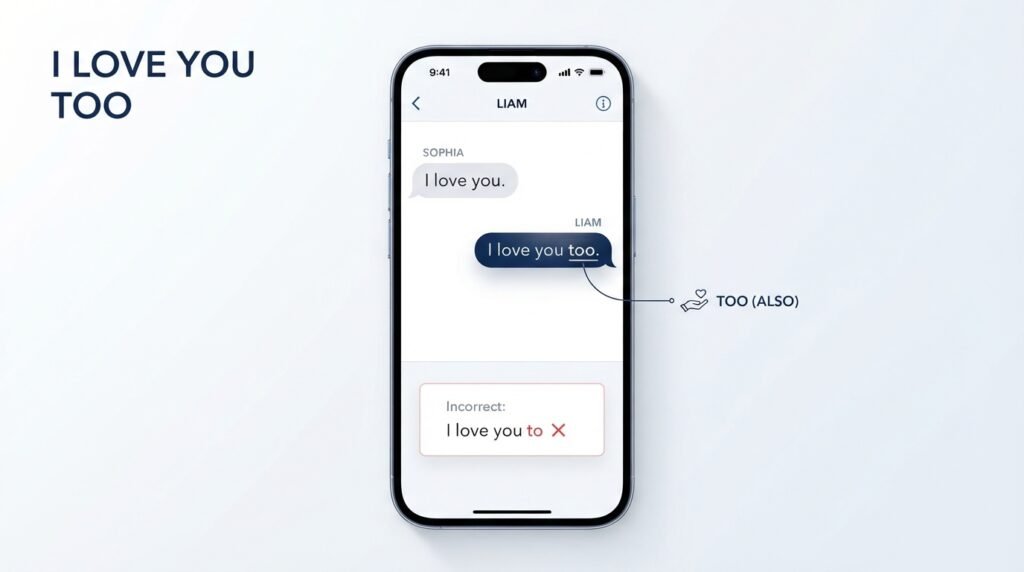
“I Love You Too” or “I Love You To”?
The correct expression is:
I love you too.
Here, too means also.
For example:
“I love you.”
“I love you too.”
The same rule applies to:
- I miss you too.
- I like you too.
- You too.
- Me too.
- Have a good day too.
If you mean also, choose too.
“I Would Love To” or “I Would Love Too”?
The correct phrase is:
I would love to.
Examples:
- I would love to help.
- I would love to visit.
- I would love to join you.
Here, to is connected with an implied or following verb.
But both words can appear in one sentence:
I would love to come too.
The first to introduces come. The second too means also.
“Look Forward To” or “Look Forward Too”?
The correct expression is:
look forward to
Examples:
- I look forward to meeting you.
- We look forward to hearing from you.
- I look forward to your reply.
There is an important grammar point here.
In look forward to, the word to is a preposition. Therefore, when a verb follows it, the verb normally takes the -ing form:
✅ I look forward to meeting you.
❌ I look forward to meet you.
So not every to before a word is an infinitive marker.
“Referring To” or “Referring Too”?
The correct phrase is:
referring to
Examples:
- What are you referring to?
- I am referring to your previous message.
- The report refers to a different case.
Here, to belongs to the expression refer to.
Referring too would only be correct if too separately meant “also” or indicated excess.
“To and From” or “Too and From”?
The correct phrase is:
to and from
Examples:
- Travel to and from work.
- The bus runs to and from the airport.
- We receive messages to and from different departments.
When you are talking about movement between places, use to, not too.
Common Mistakes With To and Too
Mistake 1: “I want too eat.”
❌ I want too eat.
✅ I want to eat.
To introduces the infinitive verb eat.
Mistake 2: “Me to.”
❌ Me to.
✅ Me too.
Here, too means also.
Mistake 3: “It is to expensive.”
❌ It is to expensive.
✅ It is too expensive.
The price is more than acceptable.
Mistake 4: “I would love too help.”
❌ I would love too help.
✅ I would love to help.
Mistake 5: “I love you to.”
❌ I love you to.
✅ I love you too.
Mistake 6: “Too go”
❌ I need too go.
✅ I need to go.
Mistake 7: “To late”
❌ It is to late.
✅ It is too late.
A Simple Trick to Remember To or Too
Use these three questions whenever you are unsure.
1. Can I replace it with “also”?
If yes, use too.
I want to come too.
I also want to come.
2. Does it mean more than necessary?
If yes, use too.
The water is too hot.
3. Is it showing direction, purpose, or followed by a base verb?
If yes, use to.
I went to school.
I came to help.
I want to learn.
Remember:
TO = direction, purpose, or infinitive
TOO = also or excessive
To or Too in British and American English
There is no British-versus-American spelling difference between to and too.
Both British and American English use:
- to for direction, purpose, and infinitives
- too for “also” and excessive degree
For example:
American English:
I want to go too.
British English:
I want to go too.
The spelling remains the same.
This is different from words such as color/colour and favorite/favourite, where regional spelling can differ.
The Origin of To and Too
The modern words to and too have a related history. Both developed from the Old English word tō, although they developed different meanings and grammatical functions over time.
To retained uses connected with direction and developed its modern grammatical functions, including its use with infinitive verbs.
Too developed from an older sense associated with “also” or “in addition,” and later became associated with excessive degree as well.
Their shared history helps explain why to and too have similar pronunciation despite having different meanings and spellings today.
To and Too: Quick Reference Guide
Remember these common expressions:
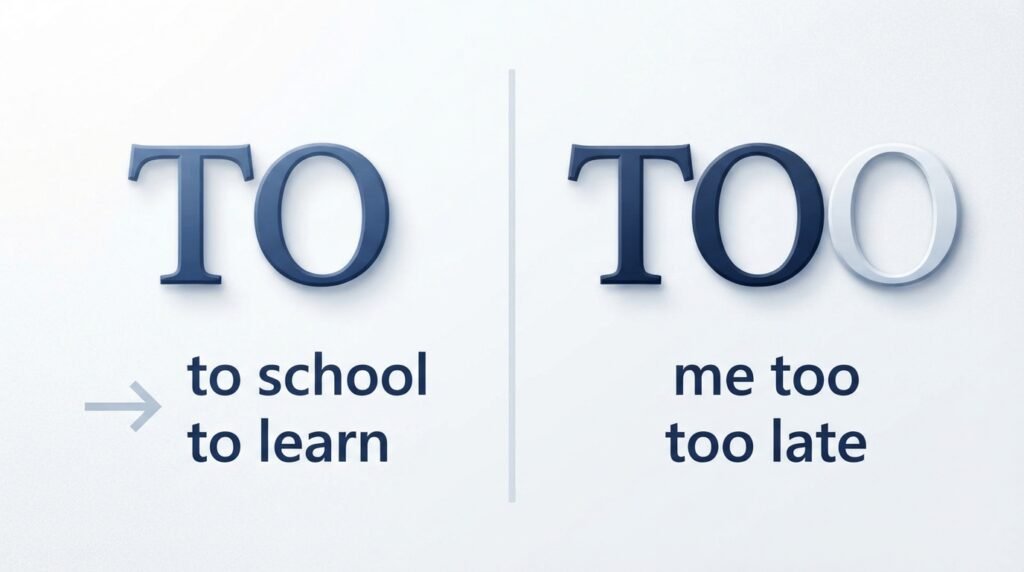
- to school → direction
- to learn → infinitive
- to help → purpose
- me too → also
- too late → excessive/beyond the suitable time
- too much → excessive amount
- too quickly → excessive degree of speed
- too often → excessive frequency
- look forward to → fixed expression
- referring to → fixed expression
- to and from → movement between places
- I love you too → also
Once you recognize the meaning, the spelling becomes much easier.
FAQs About To and Too
What is the difference between to and too?
To commonly shows direction, purpose, a relationship, or introduces an infinitive verb. Too means also or indicates an excessive degree.
When should I use to or too?
Use to for direction, purpose, or an infinitive such as to go. Use too when you mean also or more than necessary, such as too late.
What is the difference between too and to?
The order of the words does not change the rule. To and too have different functions: to commonly connects an action with a destination or verb, while too means “also” or “excessively.”
Is it “to go” or “too go”?
It is to go. The word to introduces the infinitive verb go.
Is it “too late” or “to late”?
It is too late. Too indicates that the appropriate time has been exceeded.
Is it “I love you too” or “I love you to”?
It is I love you too when you mean “I love you also.”
Is “me too” correct?
Yes. Me too means that you feel or experience the same thing as someone else.
Can “too” mean “very”?
Not exactly. Too can indicate a high degree, but it normally carries the idea of something being more than necessary, suitable, or wanted.
Is there a British or American difference?
No. The spelling and basic grammar of to and too are the same in British and American English.
What is the easiest way to remember them?
Remember: too has an extra “o,” so think “extra.” If you mean also or more than necessary, use too. Otherwise, check whether to is being used for direction, purpose, or an infinitive.
Conclusion
The difference between to and too is easier to understand when you focus on what the word is doing in the sentence.
Use to for direction, purpose, relationships, and infinitive verbs:
I want to go to school.
Use too when you mean also or more than necessary:
I want to go too.
It is too late.
This simple distinction helps with common questions such as to or too, too or to, to vs too, to go or too go, too late or to late, I love you too or to, and look forward to or too.
When you are unsure, do not rely on pronunciation because the two words sound alike. Instead, ask whether you mean also, excessive, direction, purpose, or to + verb.
The easiest memory trick remains: TOO has an extra “o” for an extra meaning.
With that rule in mind, you can use to and too correctly in texts, emails, school assignments, social media posts, and professional writing.
Discover More About:
Analyses or Analysis: Using These Words Correctly
Maxxed or Maxed: Which Spelling Is Correct? (2026)