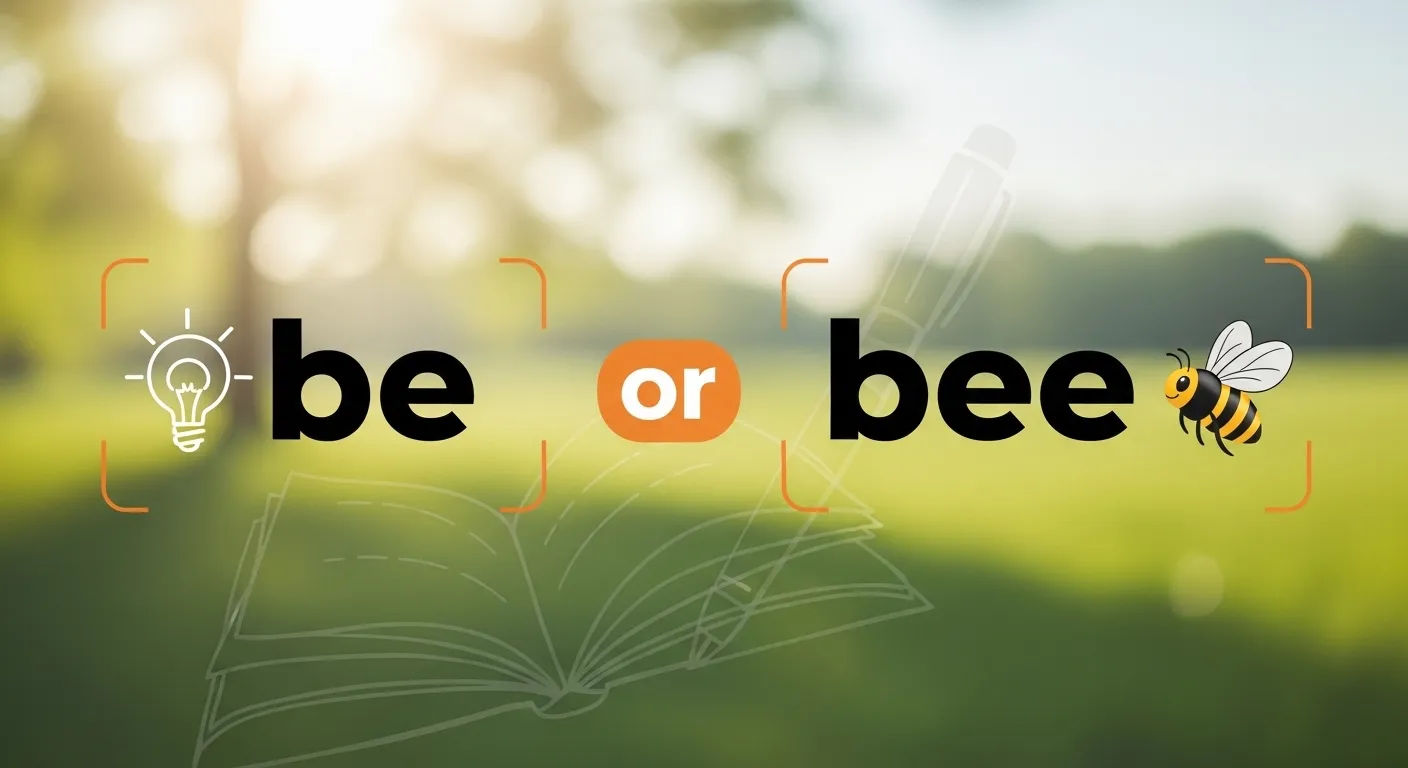
Many people search for “be vs bee” because the two words sound the same but have very different meanings. They are homophones, which means they share the same pronunciation but different spellings and definitions.
For example, writing “I want to bee successful” looks wrong, even though it sounds correct when spoken. The correct word is be, which is a verb meaning to exist or become. The word bee, however, is a noun that refers to the small flying insect that makes honey.
Quick answer:
- Be = a verb used for existence or identity (I want to be happy.)
- Bee = the honey making insect (A bee landed on the flower.)
In this guide, you will quickly learn the difference between be and bee, when to use each one, and how to avoid this common spelling mistake.
Be or Bee – Quick Answer
The difference between be and bee is simple:
| Word | Part of Speech | Meaning | Example |
| Be | Verb | To exist, live, or happen | I want to be a writer. |
| Bee | Noun | A flying insect that makes honey | A bee landed on the flower. |
Simple Explanation
Be is one of the most important verbs in English. It describes existence or identity.
Examples:
- I want to be happy.
- She will be here soon.
- They want to be successful.
Bee is a completely different word. It refers to an insect known for pollination and honey production.
Examples:
- A bee is flying around the garden.
- The bee collected nectar from the flower.
- Honey comes from a bee.
Quick Tip:
If you are talking about existence or becoming something, use be.
If you are talking about an insect, use bee.
The Origin of Be or Bee
Understanding the history of these words makes their difference clearer.
Origin of “Be”
The word be comes from Old English “bēon”, which meant to exist or to become. It is one of the oldest verbs in the English language.
Over time, it developed many forms, including:
- am
- is
- are
- was
- were
- been
- being
Examples:
- I am ready.
- She is happy.
- They were late.
All of these forms belong to the verb be.
Because of its importance, be is considered a core verb in English grammar.
Origin of “Bee”
The word bee comes from Old English “bēo.” It referred to the small insect known for producing honey and pollinating plants.
Bees have played an important role in agriculture and nature for thousands of years.
The word has remained almost unchanged for centuries.
Examples:
- Honey bee
- Bumble bee
- Worker bee
The spelling bee has always referred to the insect, which helps prevent confusion with the verb be.
British English vs American English Spelling
Unlike many English words, be vs bee has no spelling difference between British and American English.
Both varieties of English use the same spellings.
| Word | British English | American English | Meaning |
| Be | Be | Be | Verb meaning to exist |
| Bee | Bee | Bee | Honey-making insect |
Examples in British English
- I want to be a doctor.
- A bee landed on the window.
Examples in American English
- She wants to be an artist.
- A bee is buzzing near the flowers.
Even though spelling rules often differ between British and American English (like color vs colour), be and bee stay exactly the same worldwide.
Which Spelling Should You Use?
Choosing the correct word depends entirely on meaning, not location.
Use “Be” When:
You are talking about existence, identity, or becoming something.
Examples:
- I want to be successful.
- He will be at the meeting tomorrow.
- Try to be honest.
This usage applies everywhere:
- United States
- United Kingdom
- Canada
- Australia
- Global English
Use “Bee” When:
You are referring to the insect.
Examples:
- A bee is sitting on the flower.
- The bee collected nectar.
- Honey comes from a bee.
Simple Rule
Be = verb
Bee = insect
Remember this rule and you will never confuse them again.
Common Mistakes with Bee or Be
Because the words sound identical, writers often make spelling errors.
Here are the most common mistakes.
Mistake 1
❌ I want to bee a teacher.
✔ I want to be a teacher.
Explanation:
“Bee” is an insect, not a verb.
Mistake 2
❌ She will bee happy.
✔ She will be happy.
Explanation:
The correct verb form is be.
Mistake 3
❌ A be is flying around the garden.
✔ A bee is flying around the garden.
Explanation:
When referring to the insect, use bee.
Mistake 4
❌ Honey comes from a be.
✔ Honey comes from a bee.
Easy Memory Trick
Think of two “e” letters in bee as two wings of the insect.
Bee → insect with wings
Be vs Bee in Everyday Examples
Seeing these words in real-life situations helps understand their correct usage.
Emails
Correct:
- I hope to be part of your team.
- Please be available at 3 PM.
Incorrect:
- I hope to bee part of your team.
Social Media
Correct:
- Just be yourself.
- A bee landed on my coffee!
News Headlines
Examples:
- Scientists say the honey bee population is declining.
- The president will be visiting tomorrow.
Formal Writing
Examples:
- The goal is to be transparent and honest.
- The honey bee plays a crucial role in pollination.
Casual Conversation
Examples:
- Just be patient.
- A bee is buzzing near the flowers.
Bee vs Be – Google Trends & Usage Data
Search data shows that “be vs bee” is commonly searched by:
- English learners
- Students
- Writers
- Bloggers
- ESL learners
Countries Searching This Topic
High search interest often comes from:
- United States
- United Kingdom
- India
- Pakistan
- Philippines
These regions have large populations learning English or using it professionally.
Context of Searches
Most people search this phrase when they want to know:
- correct spelling in writing
- grammar differences
- homophone explanations
- school homework answers
- writing corrections
Because be is one of the most used verbs in English, it appears far more often in writing than bee.
However, bee appears frequently in:
- biology topics
- environmental news
- agriculture articles
Be vs Bee Comparison Table
| Feature | Be | Bee |
| Part of Speech | Verb | Noun |
| Meaning | To exist or become | A flying insect |
| Example | I want to be successful | A bee makes honey |
| Usage | Grammar and verbs | Biology and nature |
| Frequency | Extremely common | Less common |
| Spelling Variation | None | None |
FAQs
1. What is the difference between be and bee?
Be is a verb meaning to exist or become something.
Bee is a noun referring to the insect that produces honey.
2. Why do people confuse be and bee?
They sound exactly the same when spoken. Because of this identical pronunciation, many writers mix up the spelling.
3. Is bee ever used as a verb?
No. Bee is always a noun referring to the insect. It is never used as a verb.
4. Is there a British vs American difference for be and bee?
No. Both British English and American English use the same spelling for be and bee.
5. Which word is more common?
Be is far more common because it is part of everyday grammar.
Examples include:
- be happy
- be ready
- be successful
6. How can I remember the difference?
Remember this trick:
Bee has two “e” letters like two wings of an insect.
7. Can bee appear in phrases?
Yes. Examples include:
- honey bee
- spelling bee
- worker bee
Conclusion
Conclusion
The difference between be vs bee is easy to remember. Be is a verb used for existence or becoming something, while bee is the insect that makes honey.
The spelling is the same in both British and American English.
Simply remember: use “be” for actions or identity, and “bee” for the insect.
Discover More About:
To or Too – Clear The Confusion
Die or Dye – Clear The Difference and Use?