Confused about licence or license? You’re not alone. Both spellings are correct, but their use depends on the type of English and the part of speech.
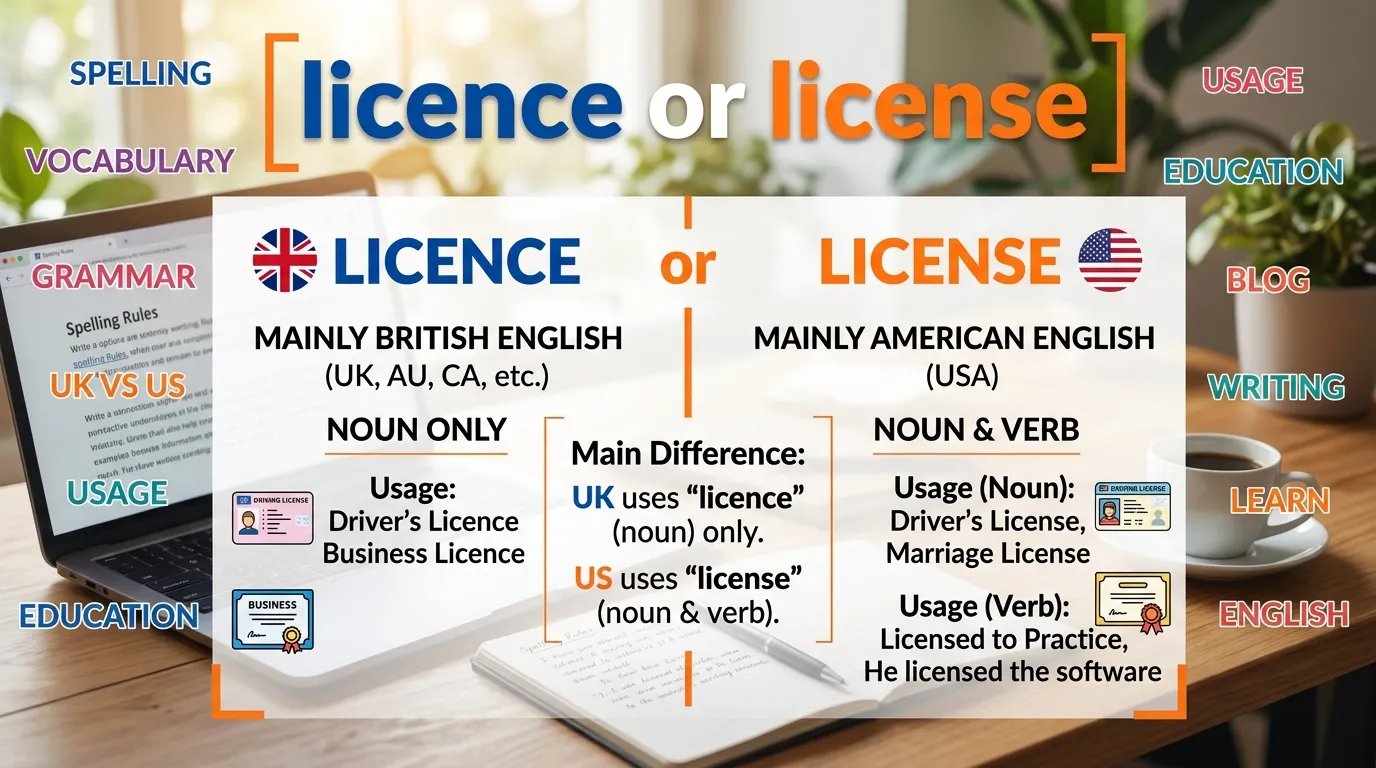
In American English, license is used as both a noun and a verb. In British English, licence is the noun, while license is the verb.
This difference often causes confusion in writing, especially in legal, academic, and professional contexts. Choosing the right form helps your writing look accurate and polished.
Use license in American English; in British English, use licence for a noun and license for a verb.
Licence or License – Quick Answer
The correct spelling depends on the type of English you are using.
- In American English, license is both the noun and the verb.
- In British English, licence is the noun, and license is the verb.
Examples
- American English: I have a driver’s license.
- American English: The state will license the business.
- British English: I have a driving licence.
- British English: The council will license the restaurant.
Quick Rule
- Licence = noun (British English only)
- License = verb (British English) and noun + verb (American English)
The Origin of Licence and License
Both words come from the Latin word licentia, meaning freedom, permission, or liberty. This Latin term passed into Old French as licence before entering Middle English.
Over time, English developed two spelling patterns. British English kept the noun spelling licence and adopted license for the verb. American English later simplified the system by using license for both forms.
This is similar to other British noun-verb spelling pairs, such as:
- practice / practise
- advice / advise
- device / devise
The split helps British English distinguish between the noun and the action.
Licence Meaning
Licence is the British English spelling of a noun that refers to an official permission, permit, or authorization to do something.
Example:
You need a driving licence to operate a car in the UK.
Licence Definition
A licence is an official document or authorization that allows a person or organization to perform a specific activity legally.
Licence Noun or Verb?
In British English, licence is primarily used as a noun.
Example:
She renewed her business licence last month.
Licence Synonym
Common synonyms for licence include:
- Permit
- Authorization
- Certification
- Approval
- Permission
- Accreditation
Licence Plural Form
The plural form of licence is licences.
Example:
The company holds several operating licences.
License Meaning
License is the American English spelling used for both the noun and the verb. It refers to official permission or the act of granting permission.
Example:
You need a driver’s license in the United States.
License Definition
A license is a legal permit, certification, or authorization that grants permission to carry out a particular activity.
License Noun or Verb?
In American English, license can be both a noun and a verb.
Examples:
- Noun: He applied for a fishing license.
- Verb: The agency will license the new software.
License Synonym
Common synonyms for license include:
- Permit
- Authorization
- Approval
- Permission
- Certification
- Credential
License Plural Form
The plural form of license is licenses.
Example:
The business obtained all required licenses before opening.
British English vs American English Spelling
This is where most confusion happens.
British English
- Licence = noun
- License = verb
Examples:
- She renewed her driving licence.
- The city will license new taxi operators.
American English
- License = noun
- License = verb
Examples:
- He applied for a business license.
- The state will license the clinic.
Comparison Table
| Usage | British English | American English |
| Noun | Licence | License |
| Verb | License | License |
Which Spelling Should You Use?
Your choice depends on your audience.
Use License If:
- You are writing for an American audience.
- Your readers are in the United States.
- You want one spelling for both noun and verb.
Use Licence If:
- You are writing British English.
- Your audience is in the UK, Australia, New Zealand, or other Commonwealth countries.
- You are using the word as a noun.
Global Writing Tip
If your audience is international, choose the spelling style that matches your brand, publication, or region, and use it consistently.
Common Mistakes with License or Licence
Many writers mix these spellings, especially in British English.
Common Errors
❌ I renewed my driving license. (British noun)
✔ I renewed my driving licence.
❌ The company received a new operating licence. (American noun)
✔ The company received a new operating license.
❌ The council will licence the venue. (British verb)
✔ The council will license the venue.
Easy Memory Trick
- In British English, c stands for certificate (noun) → licence
- s stands for service or action (verb) → license
License and Licence in Everyday Examples
Emails
- Please send a copy of your business license.
- Your driving licence has been approved.
News
- The agency revoked the restaurant’s operating license.
- The driver lost his licence after the incident.
Social Media
- Finally got my driver’s license today!
- Just renewed my driving licence.
Formal Writing
- The company holds a valid export license.
- Applicants must possess a professional licence.
License vs Licence – Google Trends & Usage Data
Search interest for licence or license remains high because people often need quick spelling guidance.
Search Patterns by Region
- United States: “license” dominates.
- United Kingdom: “licence” as noun is more common.
- Canada: Both forms appear, depending on context.
- Australia and New Zealand: British rules usually apply.
- India and Pakistan: Mixed usage, often influenced by educational systems.
Common Search Queries
- licence vs license
- license or licence UK
- driving licence or license
- business license spelling
- licence meaning
This shows that the confusion is global and highly relevant.
Licence vs License: Comparison Table
| Feature | Licence | License |
| Part of Speech | Noun | Verb (UK), Noun + Verb (US) |
| British English | Yes | Yes |
| American English | No | Yes |
| Example | Driving licence | Business license |
| Common Usage | UK/Commonwealth noun | US standard form |
FAQs
What is the difference between licence and license?
In British English, licence is a noun and license is a verb. In American English, license is both.
Is licence correct in American English?
No. American English uses license for both noun and verb.
Is license correct in British English?
Yes, but only as a verb. The noun form is licence.
Which spelling should I use for a driver’s licence?
Use driver’s licence in British English and driver’s license in American English.
Why do British and American English spell it differently?
British English separates the noun and verb forms. American English uses one spelling for simplicity.
Is licence still used today?
Yes. It is the standard noun spelling in British English and other Commonwealth countries.
How can I remember the difference?
In British English, licence ends in c for certificate, while license ends in s for action.
Conclusion:
The choice between licence and license depends entirely on the version of English you are using.
In American English, license is always correct as both a noun and a verb. In British English, the rule is slightly different: licence is the noun, while license is the verb.
This distinction matters in professional, academic, legal, and everyday writing.
If you are writing for a British audience, remember licence for the thing and license for the action.
If you are writing for an American audience, just use license every time.
When in doubt, consider your audience and stay consistent throughout your writing.
Find More About:
Handle or Handel: Correct Spelling, Meaning And Usage
Affect or Effect: Meaning, Difference And Usage

I’m a U.S. based content writer and language researcher with a strong focus on English grammar, spelling differences, and frequently confused terms. My writing is aimed at helping readers write more clearly and correctly in daily use, workplace communication, and digital content.