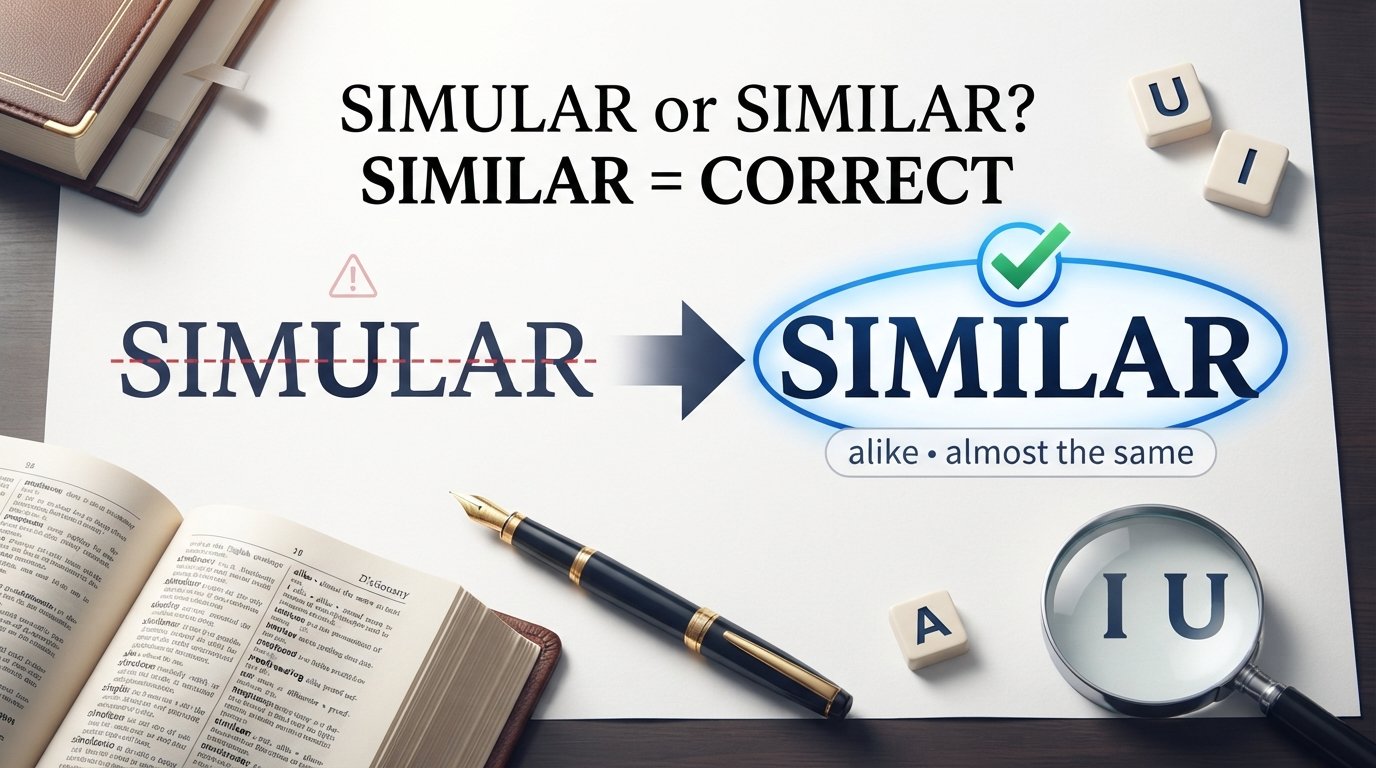
One small spelling mistake can make a familiar word look completely unfamiliar. If you’re wondering about simular or similar, the correct spelling is similar. Simular is a common misspelling and is not the standard English spelling.
The word similar means almost the same as something else, although it does not mean completely identical. For example, you might say, “The two houses have a similar design,” or “Their opinions are similar, but not exactly the same.”
The confusion may happen because the word’s pronunciation does not clearly reveal whether the middle vowel should be i or u when you write it. If you’re searching for simular or similar, you may want a quick spelling check, but you may also want to understand what similar means and how to use it correctly.
In this guide, you’ll learn why similar is correct, what it means, see clear examples, and discover an easy way to remember the correct spelling.
Simular or Similar
Similar is the correct spelling.
Simular is an incorrect spelling in standard English.
Correct
The two houses look similar.
Incorrect
The two houses look simular.
The correct spelling is:
S-I-M-I-L-A-R
The word similar is an adjective. It describes things that are alike or have features in common.
More examples
- These two phones are similar.
- We have similar interests.
- Your idea is similar to mine.
- The two paintings have a similar style.
- The results were similar in both tests.
Easy spelling trick
Break the word into parts:
sim + ilar = similar
Remember that the middle of the word contains “imi”:
S-I-M-I-L-A-R
Not:
S-I-M-U-L-A-R ❌
So, whenever you ask “simular or similar?”, choose similar.
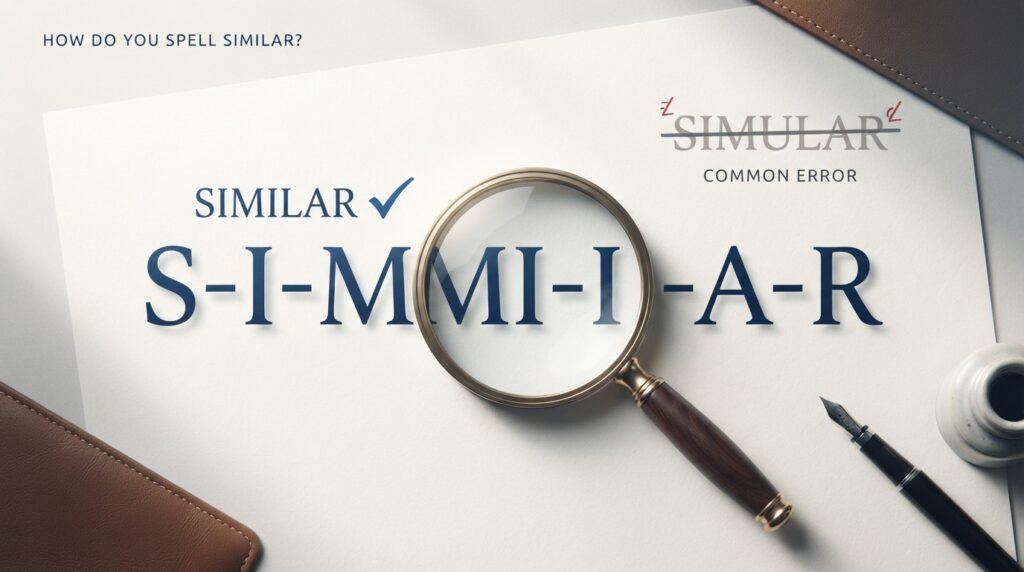
How Do You Spell Similar?
The correct spelling is:
SIMILAR
It has seven letters:
S – I – M – I – L – A – R
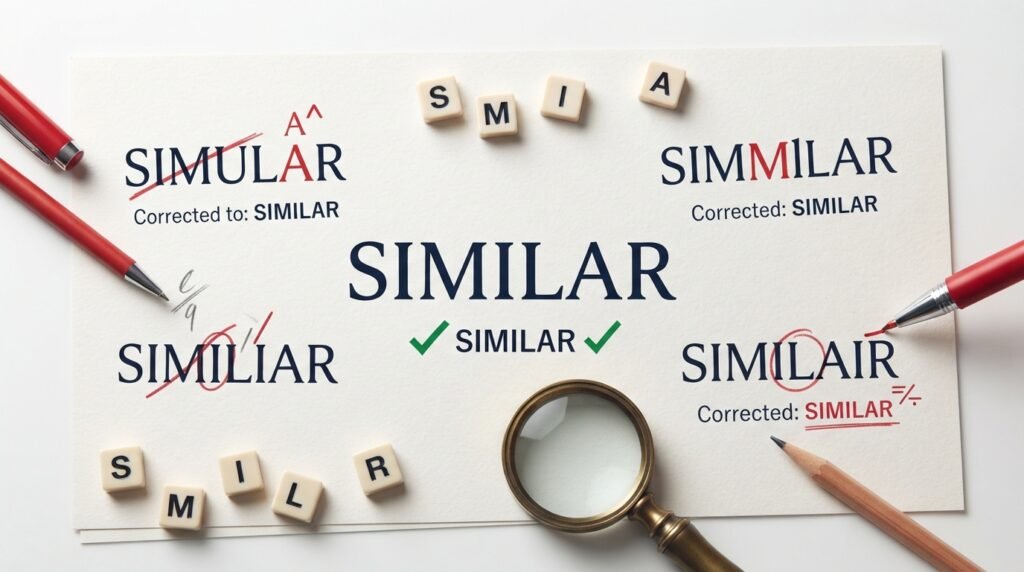
A common mistake is replacing the second i with u:
simular ❌
Another common mistake is adding or moving letters:
- similiar ❌
- simmilar ❌
- similair ❌
- simular ❌
- similar ✅
Similar pronunciation
Similar is commonly pronounced approximately as:
SIM-uh-lar
In normal speech, some sounds may become less clear. That can make the word seem as if it contains a u, which may explain why people write simular.
However, pronunciation does not change the standard spelling.
Correct: similar
Incorrect: simular
The Origin of Similar
The word similar comes from the Latin word similis, which means “like” or “alike.”
The idea behind the word has remained fairly consistent. When we call two things similar, we mean they share certain qualities or characteristics.
The word entered English through forms connected with Latin and French. Over time, similar became the standard English spelling used today.
This history also helps explain why simular is not the correct form. English contains many words with Latin roots, and their modern spellings do not always match the way they sound in everyday speech.
The spelling similar has remained the standard form in modern English.
Why does “simular” look correct?
The main reason is pronunciation.
When similar is spoken quickly, the middle sounds can become weak. A listener may hear something close to “sim-uh-lar” and assume the word should be spelled simular.
But English spelling often cannot be predicted perfectly from pronunciation.
The best way to remember this word is to memorize its written form:
similar = S-I-M-I-L-A-R
British English vs American English Spelling
There is no spelling difference between British English and American English for this word.
Both use:
similar ✅
Neither standard variety uses simular as an alternative spelling.
| English Variety | Correct Spelling | Incorrect Form |
|---|---|---|
| British English | similar | simular |
| American English | similar | simular |
| Canadian English | similar | simular |
| Australian English | similar | simular |
| Academic English | similar | simular |
| Formal English | similar | simular |
| Online English | similar | simular |
Examples
British English:
The two reports contain similar information.
American English:
The two reports contain similar information.
The spelling stays the same.
This is different from words such as colour/color and centre/center, which have recognized British and American spelling differences. Similar does not have this type of variation.
Skiddish or Skittish: Which Word Should You Use?
Which Spelling Should You Use?
You should use similar in all standard English writing.
For a US audience
Use:
similar ✅
This is the standard American English spelling.
For a UK audience
Use:
similar ✅
British English uses the same spelling.
For a global audience
Use:
similar ✅
It is the standard form understood across major English-speaking regions.
In school assignments
Use similar.
The two characters have similar personalities.
Writing simular may be treated as a spelling error.
In professional writing
Use similar in:
- emails
- reports
- presentations
- business documents
- proposals
- applications
For example:
We found a similar issue in the previous report.
On social media
People may type simular by mistake, especially when writing quickly. However, if you want your post or message to look correct, use similar.
Common Mistakes with Simular or Similar
Several spelling mistakes can occur because similar is easy to mishear or type incorrectly.
Mistake 1: Simular
Incorrect:
The two products are simular.
Correct:
The two products are similar.
The u is not part of the standard spelling.
Mistake 2: Similiar
Some people accidentally add an extra i.
Incorrect: similiar ❌
Correct: similar ✅
Remember that the correct sequence is:
SIM-I-LAR
Mistake 3: Simmilar
Some writers double the m.
Incorrect: simmilar ❌
Correct: similar ✅
There is only one m.
Mistake 4: Similair
Some people switch the final letters.
Incorrect: similair ❌
Correct: similar ✅
The ending is:
-lar
not:
-lair
Mistake 5: Thinking “simular” is British English
It is not.
Both British and American English use:
similar
Mistake 6: Confusing similar with same
These words are related, but they do not always mean the same thing.
The two bags are similar.
This means they share features.
The two bags are the same.
This usually suggests they are identical or exactly alike in the relevant way.
Similar in Everyday Examples
The word similar is common in many types of writing.
In Emails
Your proposal is similar to the plan we discussed yesterday.
We received a similar request from another customer.
These examples work well in professional communication.
In News Writing
A similar incident was reported in the area.
The company recorded similar results this year.
News writing often uses similar when comparing events, results, or situations.
In Social Media
These outfits look so similar!
We have very similar music tastes.
The word works naturally in casual online communication.
In Formal Writing
The two reports show similar patterns.
Similar concerns were raised during the meeting.
In Academic Writing
The researchers found similar results in both experiments.
These findings are similar to those of the earlier study.
In Everyday Conversation
Your phone looks similar to mine.
We have similar interests.
These colors are very similar.
The two restaurants have similar menus.
Similar in a Sentence
Here are simple examples showing how similar works in different sentences:
- The two houses look similar.
- My answer is similar to yours.
- We have similar interests.
- These shoes are very similar.
- The twins have similar personalities.
- The two designs are similar in style.
- Their opinions are quite similar.
- The results were similar in both groups.
Using “similar to”
A very common structure is:
similar to + noun/pronoun
Examples:
This phone is similar to mine.
Her dress is similar to yours.
The new design is similar to the old one.
A common mistake is using the wrong preposition.
Correct: similar to
Incorrect: similar with
For example:
The new model is similar to the old model. ✅
Cancel or Cancell: The Correct Spelling Explained
Similar Meaning and Synonyms
Similar means alike, comparable, or having qualities in common.
Some useful synonyms include:
- alike
- comparable
- resembling
- related
- analogous
- close
- corresponding
However, these words are not always perfect replacements.
Similar
The two designs are similar.
Alike
The two designs look alike.
Comparable
The two products are comparable in price.
Resembling
The new building is resembling the old one.
A more natural version of the last sentence is:
The new building resembles the old one.
The best synonym depends on the context.
Similar vs. Same
Similar and same are often confused.
Similar means two things have important features in common.
Same usually means there is no difference in the relevant feature or that two things are identical.
Compare these sentences:
We bought similar phones.
The phones may look alike or have similar features, but they may not be identical.
We bought the same phones.
This usually means the phones are the same model or identical in the relevant sense.
So, similar does not always mean exactly the same.
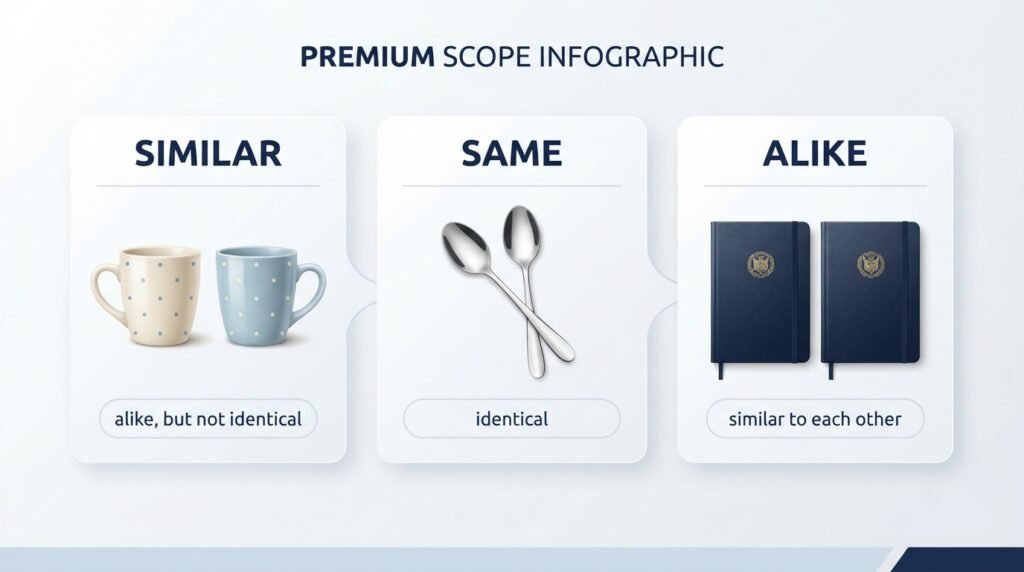
Similar vs. Alike
Similar and alike have close meanings, but their grammar can differ.
We often use similar to:
Your dress is similar to mine.
We commonly use alike after a linking verb:
The two dresses look alike.
Both express the idea of resemblance.
Quick comparison
| Word | Basic Meaning | Example |
|---|---|---|
| similar | Almost the same | The two cars are similar. |
| alike | Similar to each other | The two cars look alike. |
| same | Identical or not different | We have the same car. |
| identical | Exactly the same | The two copies are identical. |
Simular or Similar – Comparison Table
| Spelling | Correct? | Meaning | Example |
|---|---|---|---|
| similar | ✅ Correct | Alike or almost the same | The two designs are similar. |
| simular | ❌ Incorrect | Misspelling of similar | Avoid this spelling in standard English. |
| same | ✅ Correct | Identical or not different | We have the same phone. |
| alike | ✅ Correct | Similar to each other | The sisters look alike. |
| identical | ✅ Correct | Exactly the same | The two copies are identical. |
The key distinction is simple:
Similar = correct spelling
Simular = incorrect spelling
Simular or Similar – Search Trends & Common Usage
People who search for “simular or similar” are usually trying to confirm the correct spelling. This type of search often comes from a spelling check, writing task, school assignment, email, or quick online search.
The incorrect form can appear because similar may sound like “sim-uh-lar” when spoken naturally. That makes simular an understandable spelling mistake, even though it is not the standard form.
Searches may also include related phrases such as:
- simular or similar
- similar meaning
- how to spell similar
- similar pronunciation
- similar in a sentence
- similar synonym
- is simular a word
- similar vs same
- similar spelling
The important usage pattern is straightforward: similar is the established standard English form, while simular is generally a misspelling.
If you are writing for a professional, academic, or general English-speaking audience, similar is the spelling you should choose.
Frequently Asked Questions
1. Which is correct, simular or similar?
Similar is correct. Simular is a misspelling and is not the standard English spelling.
2. What does similar mean?
Similar means alike or almost the same. It describes people, objects, ideas, or situations that share certain qualities.
3. Is simular a word?
Simular is not the standard English spelling of similar. In normal English writing, use similar instead.
4. How do you spell similar?
The correct spelling is:
S-I-M-I-L-A-R
It contains one m, two i letters, and ends with -lar.
5. Why do people spell similar as simular?
The mistake often comes from pronunciation. When similar is spoken quickly, its middle sounds may be unclear, making simular seem like a natural spelling.
6. Is similar spelled differently in British English?
No. British and American English both use similar. There is no standard British spelling simular.
7. What is another word for similar?
Common synonyms include alike, comparable, resembling, related, and analogous. The best choice depends on the sentence.
8. Is similar the same as identical?
No. Similar means alike in some way, while identical means exactly the same in the relevant features.
9. What is the difference between similar and same?
Similar means things share features but may still be different. Same usually means there is no difference in the relevant way.
10. What preposition is used with similar?
The most common structure is similar to.
My jacket is similar to yours.
Conclusion
When choosing between simular or similar, the correct answer is similar. The spelling simular is a common mistake caused mainly by the way the word can sound in fast, natural speech. It is not a standard British or American English spelling.
Similar means alike or almost the same. It is used to compare people, objects, ideas, opinions, designs, results, and situations. You can use it in everyday conversation, social media, emails, school assignments, academic writing, news articles, and professional documents.
There is no British-versus-American spelling difference here. Both forms of English use similar. The easiest way to remember the word is to focus on its letters: S-I-M-I-L-A-R. Do not replace the second i with u, and do not add an extra i or double the m.
So, if you are ever unsure whether to write “simular” or “similar,” choose similar. It is the standard, correct spelling and the right choice for clear and professional English.